
Section 301 is one of the federal government’s main tools for responding to foreign trade practices that the United States considers unfair.
It is not a single tariff. It is an investigative and enforcement framework established by the Trade Act of 1974.


The Office of the U.S. Trade Representative can initiate an investigation into a foreign government’s act, policy or practice. USTR then determines whether the conduct violates a trade agreement or is unjustifiable, unreasonable or discriminatory and burdens or restricts U.S. commerce.
- USTR investigates a foreign act, policy or practice.
- The agency determines whether it is unreasonable or discriminatory and burdens U.S. commerce.
- USTR proposes a response and takes public comment.
- The agency issues a final action and may later modify it.
If the statutory conditions are met, the trade representative can take responsive action. Tariffs are one option. Other responses can include restrictions on services, suspension of trade-agreement benefits or negotiation of an agreement intended to eliminate the disputed practice.
The process matters because it produces an administrative record. USTR identifies the practice, publishes notices, accepts comments, consults affected governments, conducts hearings where required, issues findings and publishes the final action.
That record does not make the decision politically neutral or legally unassailable. The executive branch still defines the challenged practice, evaluates the evidence, connects it to U.S. commerce and selects the remedy.
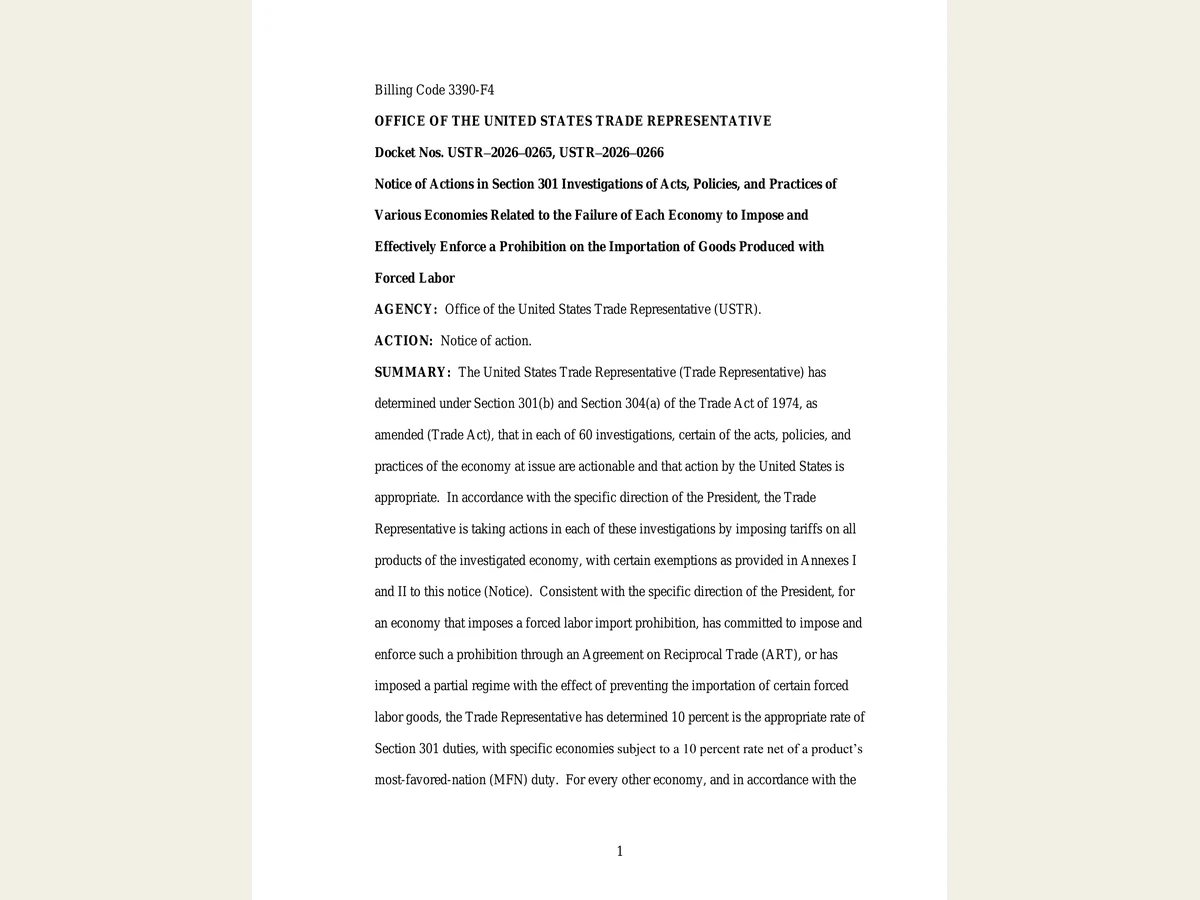
The new forced-labor action illustrates the law’s breadth. USTR investigated 60 economies for failing to impose and effectively enforce restrictions on imports produced with forced labor. It concluded that the failures were unreasonable and burdened or restricted U.S. commerce.
USTR then imposed duties generally set at 10% or 12.5%, with exemptions and special calculations for several trading partners.
The United States has long prohibited imports produced wholly or partly with forced labor. USTR’s theory is that weak foreign import controls allow forced-labor goods to circulate through global markets, distort competition and undermine firms that avoid such production.
The remedy is not limited to a shipment shown to contain forced-labor inputs. It applies broadly to covered imports from an economy based on the agency’s findings about that government’s laws and enforcement.
That design raises several questions.
How closely must the remedy fit the challenged practice? A broad tariff affects lawful goods as well as suspect supply chains.
How will USTR decide that a government has improved enough to qualify for lower rates or removal?
What evidence distinguishes effective enforcement from a prohibition that exists only on paper?
How do the new duties interact with ordinary tariffs, Section 232 measures, trade agreements and product exemptions?
Section 301 has supported major trade actions for decades, including extensive tariffs on Chinese goods. Its flexibility makes it powerful. The same flexibility makes the quality of the investigation and the precision of the final notice especially important.
Readers evaluating any Section 301 action should look for five things: the foreign practice USTR identifies; the evidence supporting the finding; the statutory category invoked; the remedy selected; and the process for modification or termination.
The tariff is charged to importers when covered goods enter the United States. It is not a bill sent to a foreign treasury. Who ultimately pays depends on contracts, market power, supply alternatives and pricing decisions throughout the distribution chain.
Section 301 gives the administration leverage. It does not eliminate the need to ask whether the leverage is lawful, proportionate and likely to produce the stated result.