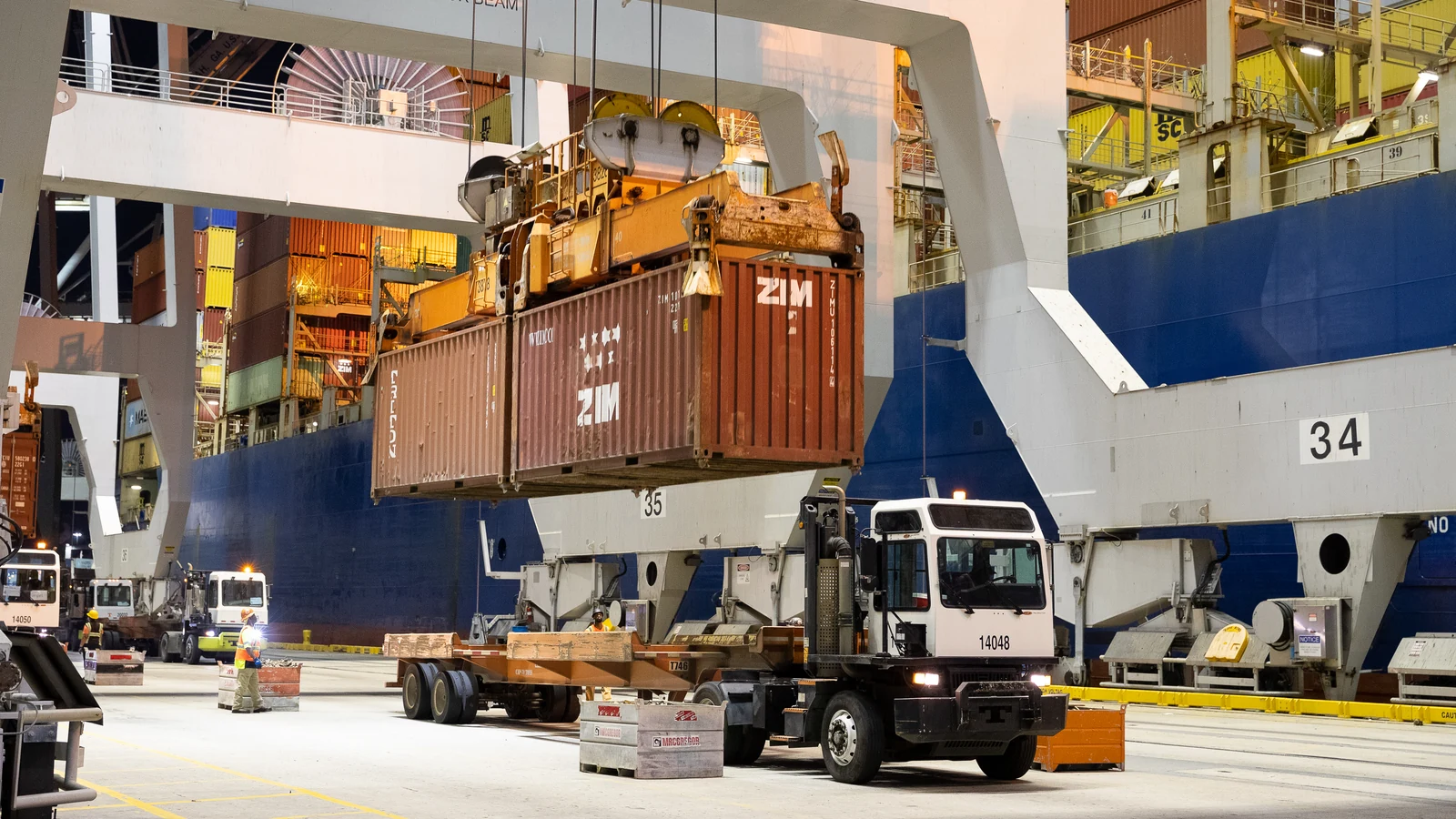
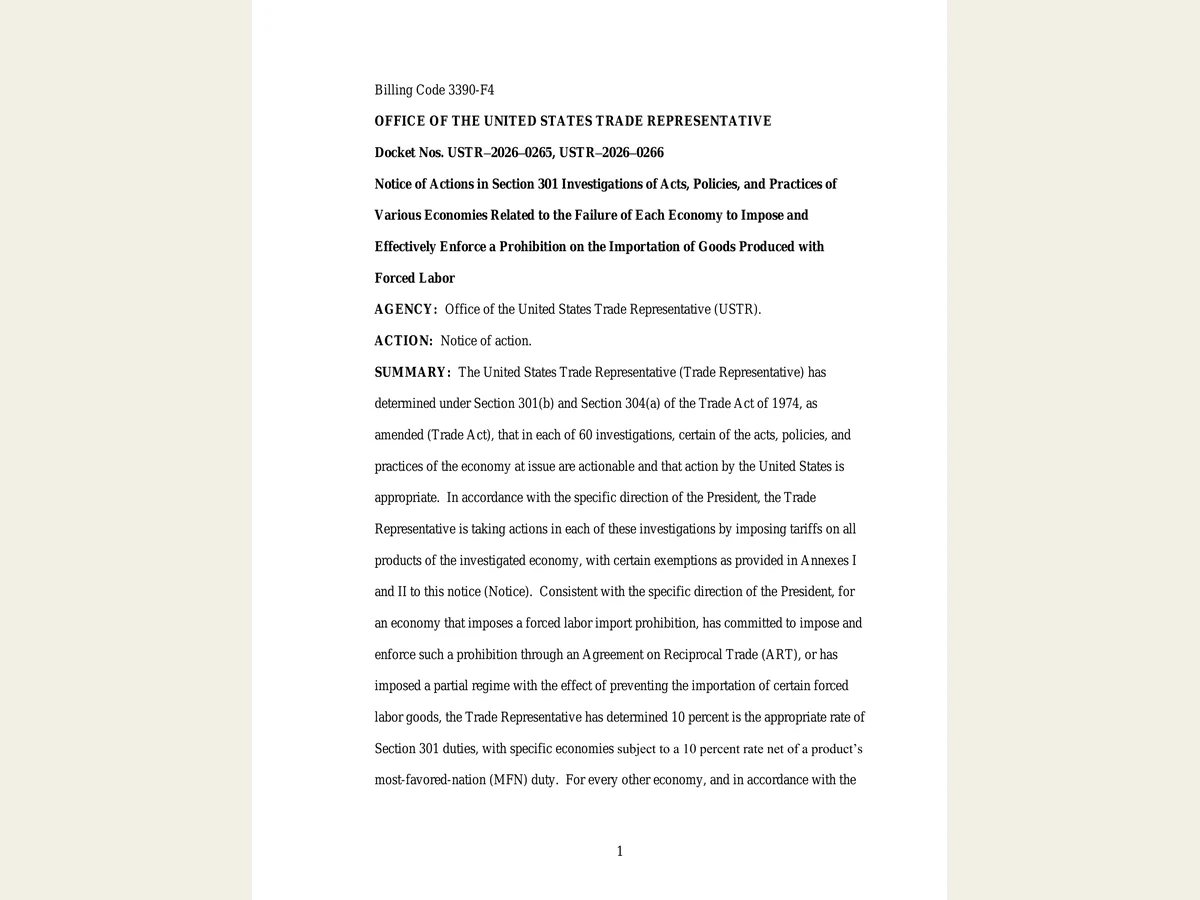
The Trump administration imposed new Section 301 tariffs on imports from 60 economies beginning July 24, using foreign governments’ treatment of forced-labor goods as the stated basis for duties generally set at 10% or 12.5%.
The Office of the U.S. Trade Representative announced final action July 23 after investigations that began in March. USTR says the process included two rounds of public hearings, more than 2,100 public comments and consultations with more than 45 governments.
The additional duties apply to covered products entered for consumption, or withdrawn from warehouse for consumption, at or after 12:01 a.m. Eastern time on July 24. The implementation notice includes a limited transit exception for goods already loaded and in final transit before that time if they enter by July 28.
| Group | Announced rate |
|---|---|
| Most covered economies | 10% |
| 17 listed economies | Net MFN tariff below 10%, otherwise no extra Section 301 tariff |
| Economies with an existing 10% Section 301 tariff | 12.5% total Section 301 rate |
Seventeen economies receive the 10% rate: Argentina, Bangladesh, Cambodia, Canada, Ecuador, El Salvador, Guatemala, Honduras, India, Indonesia, Jordan, Malaysia, Mexico, Pakistan, Sri Lanka, Trinidad and Tobago and the United Kingdom.
USTR says those economies either have a forced-labor import prohibition, committed to adopt and enforce one through a reciprocal trade agreement or operate a partial regime that blocks some forced-labor goods.
Products from the European Union and Taiwan receive a special calculation intended to bring the combined most-favored-nation and Section 301 rate to 10% when the ordinary tariff is below 10%. Products already carrying an MFN rate of at least 10% receive no additional Section 301 duty under that calculation.
Japan, South Korea and Switzerland receive a similar calculation using a 12.5% threshold. Other investigated economies generally face a 12.5% additional duty.

The action is broad, but it is not universal. USTR exempted informational materials, donations, accompanied baggage, articles already subject to Section 232 tariffs and specified products that the agency says present supply, disruption or effectiveness concerns. The legally controlling product lists appear in the notice’s annexes.
The administration describes the policy as pressure on trading partners that have not imposed and effectively enforced bans on imports made with forced labor.
That description does not mean every product imported from a covered economy has been found to involve forced labor. The duties apply by economy and tariff classification based on USTR’s findings about government policy and enforcement.
The action also creates a bargaining mechanism. A trading partner can receive more favorable treatment if it adopts or commits to enforce an import prohibition. USTR says Cambodia, Guatemala, Honduras, India, Sri Lanka and Trinidad and Tobago adopted prohibitions after the investigations began, while Jordan made a commitment through a reciprocal trade agreement.
The tariffs are collected from importers at the U.S. border. Foreign governments do not directly pay them. Importers may absorb the cost, pass it to customers, renegotiate contracts, shift suppliers or stop importing affected products.
The economic effect will depend heavily on the annexes. A headline rate says little about a particular product until its tariff classification, ordinary duty and exemption status are known.
The final notice also contemplates tariff-rate quotas for certain textile and apparel trade involving Bangladesh, Cambodia, Indonesia and Malaysia. Those provisions are intended to encourage the use of U.S. cotton and textile inputs.
Legal and diplomatic disputes are likely to focus on whether USTR’s findings adequately support broad economy-wide duties, whether the remedy fits the identified practices and how the agency changes rates when a government reforms its import system.
For businesses and consumers, the immediate practical question is narrower: which products entered after July 24 now carry an additional duty, and who ultimately bears that cost?