The Interlochen Investigation | Part 1
This is the first installment of a continuing Boho News investigation into historical abuse allegations, institutional accountability and Jeffrey Epstein’s relationship with Interlochen Center for the Arts.
Editor’s note: This article discusses allegations of sexual abuse and misconduct involving minors. Descriptions have been limited to the detail necessary to explain the evidence. The external investigation recorded accounts and institutional records but did not determine that every reported event occurred as described. Anonymous participants remain unidentified.
At a glance
- Approximately 180 interviews with about 150 distinct people
- Approximately 70 firsthand accounts of physical conduct of a sexual nature
- 47 respondents, broadly defined to include employees, trustees, donors, visitors and other affiliated adults
- Reported conduct beginning in the 1950s and continuing into the 2010s
- Additional reports of nonphysical sexual conduct, grooming and boundary violations excluded from the headline count
Source basis: Sanghavi Law Office report, pp. 2–8 (S1).
Interlochen Center for the Arts’ outside investigators interviewed about 150 people and recorded approximately 70 firsthand accounts of physical conduct of a sexual nature involving 47 adults connected to the institution, according to a 97-page report dated July 27, 2026.
The reported conduct began in the 1950s and continued into the 2010s. The respondents included faculty members, administrators, residence-life employees, camp personnel, trustees, donors, visitors and other adults who encountered children at Interlochen’s boarding high school or summer arts camp.
Those figures have led much of the early coverage. The report, however, does not say that 70 different alumni participated, that 70 discrete incidents occurred or that all 47 respondents were employees. Investigators documented historical accounts without deciding whether each event occurred as described. They also did not determine whether every institutional response was sufficient, timely or appropriate.
Across the individual accounts, the same conditions appear repeatedly: students living far from their families; prominent teachers with influence over young artists’ futures; private lessons in rooms with obscured windows; trips, cars, homes, cabins and hotels where adults could be alone with students; broad access for donors and trustees; records that were unavailable or no longer retained; and students who believed reporting could cost them their education, reputation or place at Interlochen.
The investigators separately identified limited family contact, student vulnerability, power imbalances, adult access, gaps in oversight and barriers to reporting as recurring themes. They did not make a causal finding that those conditions produced every reported event.
An investigation that grew far beyond one faculty member
Interlochen opened as a summer music camp in 1928. Its boarding Arts Academy opened in 1962. The institution now teaches students in grades 3 through 12 through the Camp and grades 9 through 12, plus postgraduates, through the Academy.

The investigation began with one alum’s report about one longtime faculty member and administrator.
According to the report, an Academy alum from the 1970s contacted Interlochen about a longtime faculty member and administrator. Interlochen and its board retained Sanghavi Law Office in September 2024 to investigate reports involving that individual, identified in the report only as Respondent 1.
In June 2025, the school expanded the assignment to include reports from any decade involving faculty, staff or other adults affiliated with the Academy. Investigators ultimately received information concerning the Camp as well. Interlochen later added targeted outreach to people it believed might have information concerning Jeffrey Epstein, a former camper and donor.
The law firm said it had no prior relationship with Interlochen. The institution helped locate participants and supplied available records, while the investigative team said it retained autonomy over the information it gathered and the observations it published. Interlochen asked the team to prioritize physical misconduct and complete a report during summer 2026.
Some work remained unfinished when the report was released. Investigators said they would continue speaking with additional people who came forward, and the report acknowledges that some interviews and follow-up outreach had not been completed. The published document is therefore a substantial historical record, but not a final census.
What investigators did, and what they deliberately did not do
Source note: S1, pp. 4–10; S2, methodology FAQ.
The investigative team conducted approximately 180 interviews with roughly 150 distinct people. Participants included alumni, relatives, current and former employees, people accused of misconduct and others with relevant knowledge. Some people provided written information instead of, or in addition to, an interview.
Investigators reviewed available student and personnel files, contacted respondents when possible and interviewed ten current or former employees about what the institution may have known and how it responded.
The historical record had obvious limits.
More than one-third of the 47 respondents were deceased. Only four respondents discussed in the main decade-by-decade section participated in interviews. None of the employees interviewed about institutional response had served as an administrator during the 1960s or 1970s. Some former employees did not respond, declined to participate or had died.
The documentary record was also incomplete. Investigators reviewed personnel files when they existed, but Interlochen said its current personnel-file retention period was seven years and that some older files had previously been purged. Some accused adults were donors, trustees, visitors or people for whom an employee file would not ordinarily exist. Other people could not be identified from the information participants remembered decades later.
For privacy, the report deliberately omits or generalizes some dates, disciplines, job titles, locations and biographical details. That decision protects alumni, but it also limits what an outside reader can independently reconstruct.
Most important, the firm did not attempt to adjudicate each account. Its report says the team did not determine whether the conduct occurred as reported. Interlochen’s accompanying public explanation states even more directly that investigators did not make individual credibility determinations and accepted information as true for purposes of compiling the report.
Those distinctions govern how the report should be described. A firsthand account is not a conviction. A personnel file documenting a contemporaneous complaint carries different weight from a later recollection. An admission is different from a denial. The absence of a surviving record does not prove that no report was made, and a reported disclosure does not by itself establish that senior leadership received or understood it.
The report contains all of those evidence types, sometimes within the same respondent entry.
What “approximately 70 accounts” actually counts
Source note: S1, pp. 7–8, 12–75; S2, respondent-identification FAQ. The arithmetic below is Boho News’ reconstruction from the report’s published section totals.
The figure repeated most often from the report is approximately 70 firsthand accounts of physical conduct of a sexual nature involving 47 respondents. The report does not say that those accounts came from 70 different people.
The report explains that when one person described conduct involving multiple adults, the conduct involving each adult was counted separately. It also separates physical conduct from a broader body of reports involving sexual comments, grooming, propositions, intrusive questions, boundary violations and other nonphysical behavior. Those additional concerns are not included in the headline total.
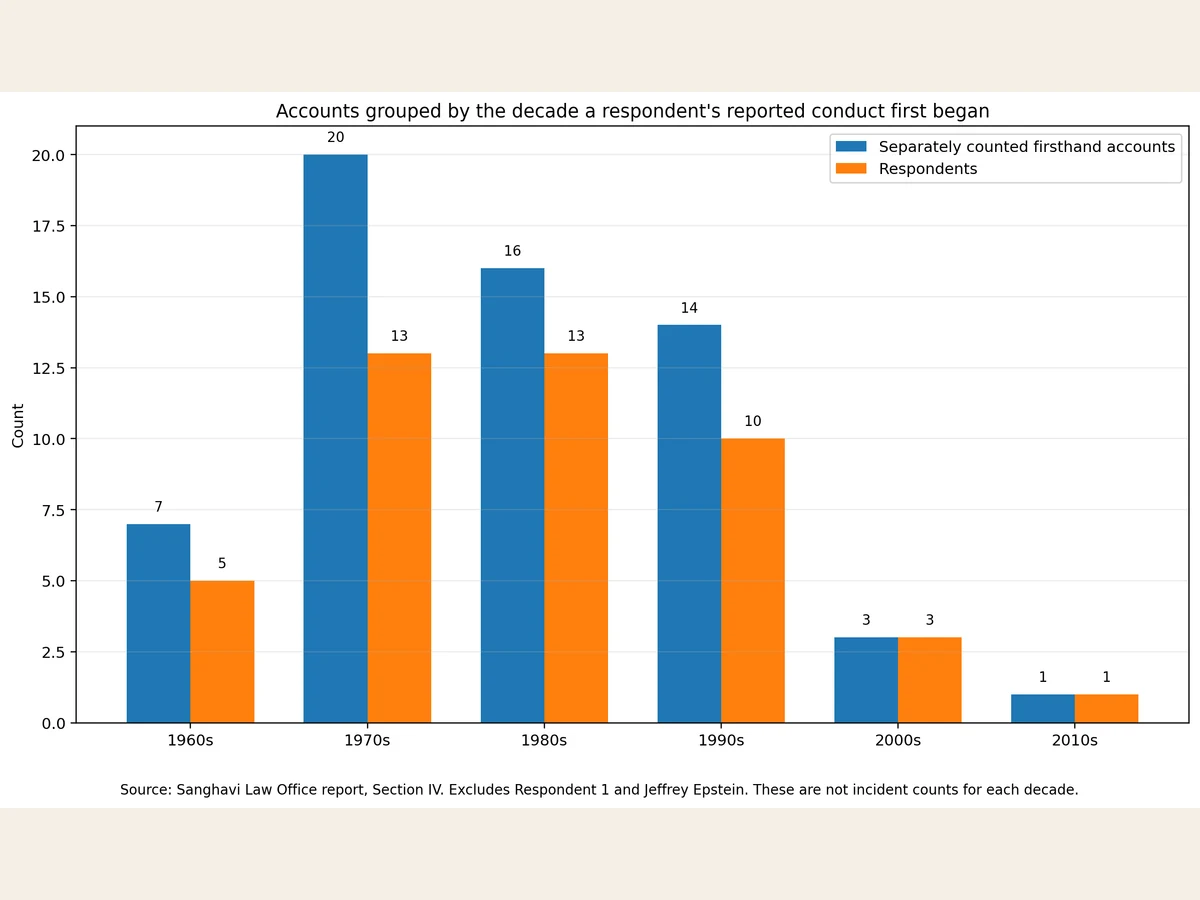
The published section totals allow the figure to be reconstructed. The main decade-organized section covers Respondents 2 through 46 and contains 61 separately counted firsthand accounts involving 45 respondents:
| Earliest decade assigned to respondent | Separately counted firsthand accounts | Respondents |
|---|---|---|
| 1960s | 7 | 5 |
| 1970s | 20 | 13 |
| 1980s | 16 | 13 |
| 1990s | 14 | 10 |
| 2000s | 3 | 3 |
| 2010s | 1 | 1 |
| Total | 61 | 45 |
A separate section records seven accounts involving Respondent 1, whom Interlochen later identified as Byron Hanson. Another separate section records two accounts involving Epstein.
Together, the three sections total:
61 + 7 + 2 = 70.
The report calls the total approximate and separately explains that post-Interlochen conduct may be included when it is relevant to conduct that began or occurred at Interlochen. Several respondent summaries include conduct after graduation. The report does not publish the number of unique alumni represented by the approximately 70 separately counted accounts.
The figure should not be converted into “70 victims,” “70 proven assaults” or necessarily “70 different alumni.” The report describes approximately 70 separately counted firsthand accounts involving 47 respondents.
How the report organizes seven decades of accounts
Source note: S1, pp. 11–75; S2.
The report says the conduct described to investigators began in the 1950s and continued into the 2010s, with most reports involving conduct before 2000.
The decade headings group each respondent by the earliest reported conduct involving that person. A respondent placed in the 1970s section stays there even when the report describes later conduct. The chart above therefore reflects the report’s organization, not the annual prevalence of misconduct. Several publicly identified respondents had long tenures at Interlochen.
Interlochen publicly identified Hanson, Respondent 1, as a faculty member and administrator from 1960 until 2015. It identified John “Jack” Hood, Respondent 8, as a faculty member and administrator from 1963 to 1979 who later returned in seasonal roles through 2004. It identified Charlie McWhorter, Respondent 19, as a trustee from 1970 to 1999.
Interlochen said it named those deceased respondents because investigators received multiple firsthand reports reflecting repeated and pervasive conduct and because public identification would not interfere with prosecution. The institution also publicly identified former faculty member Thomas Clower, saying he was convicted in 2005 after Interlochen reported the conduct and terminated him.
The remaining respondents are not publicly named in the report. Some are deceased; some are living. Interlochen says none currently works for the institution and that it supplied all respondent identities to the Grand Traverse County prosecutor and sheriff.
Those are institutional statements. The public materials reviewed by Boho News do not independently establish the present employment or volunteer activities of unnamed living respondents.
What the report describes
Source note: S1, pp. 4, 11–77.
The accounts cover a wide range of alleged conduct and boundary violations.
Some accounts describe sexual comments, intrusive questions, propositions, unwanted kissing or touching over clothing. Others describe adults escalating private lessons or mentoring relationships into sexual contact. Several participants described purported romantic relationships with faculty or staff, sometimes continuing for months or years. The report emphasizes that a student’s description of a relationship as consensual does not erase the adult’s professional responsibility or the power imbalance inherent in an educational setting.
The reported settings recur:
- faculty offices and practice rooms;
- private lessons;
- faculty homes;
- dormitories and residence-life rooms;
- cars and school-related travel;
- hotels and out-of-state trips;
- cabins and unoccupied campus buildings;
- wooded areas, camping trips and a nearby lake;
- donor or trustee interactions;
- trips that continued after a student left Interlochen.
Not every account describes the same severity. Not every respondent faced multiple reports. Some participants said they never told an adult at Interlochen. Some said friends or relatives knew. Some described contemporaneous reporting. Some institutional files contained warnings, complaints or disciplinary records. A few respondents participated and denied, partly acknowledged or described the conduct differently. Many could not be interviewed because they had died.
The accounts also vary in evidentiary support. Some rely on a participant’s later recollection; others are accompanied by contemporaneous disclosures, institutional files, respondent statements or criminal records.
What the report says Interlochen knew
Source note: S1, pp. 11–72. The six-part notice spectrum below is Boho News’ analytical framework for comparing differently supported entries.
There is no single answer across all 47 respondents.
In some cases, an alum said the conduct was never reported and investigators found no evidence that Interlochen knew. In others, participants believed adults must have seen warning signs but could not identify a direct report. Some people said they reported conduct, while no surviving record of that report could be found. Elsewhere, personnel files documented contemporaneous concerns, meetings, warnings, leaves, resignations, terminations, recommendations or referrals to authorities.
For comparison, the entries fall into six broad categories:
- No contemporaneous report identified.
- Possible informal awareness or visible warning signs.
- A report described by a participant, but no surviving institutional record.
- A contemporaneous complaint or concern documented in a file.
- Institutional action documented.
- Action accompanied by contradictory conduct, such as continued employment, rehiring or recommendations after notice.
Several entries pair alumni accounts with surviving institutional records.
Respondent 14: recommendations after meetings about sexual conduct
Source: S1, pp. 29–30. Investigator-recorded allegation plus personnel-file summary.
One alum described a faculty member repeatedly crossing sexual boundaries during private lessons in the 1970s. She told investigators that she eventually reported the conduct to Academy leadership, that other people came forward and that she was told the respondent would be asked to resign.
The personnel file reflected multiple meetings with Respondent 14 concerning sexual conduct toward an unidentified person. According to the report, an administrator wrote a recommendation letter within days of the third meeting. Interlochen then placed the respondent on leave. A second administrator wrote another recommendation approximately a month later, and the respondent was released from his contract at his own request roughly another month after that.
The public report does not disclose what the recommendation letters said, where they were sent or whether the recipients were told about the concerns. Those records remain central to determining what happened after Respondent 14 left Interlochen.
Respondent 31: contemporaneous reports, delayed termination and multiple recommendations
Source: S1, pp. 48–50. Investigator-recorded allegations, employee recollections and personnel-file summary.
Two alumni described sexual conduct by Respondent 31. One said she reported what had happened to a staff member and later met with senior administrators. She recalled feeling blamed and condescended to rather than supported.
The personnel file reflected contemporaneous reports involving that alum and another student. It also showed that Respondent 31 was terminated approximately four months after the report. After Interlochen knew of the conduct, according to the investigators, administrators and a teacher wrote multiple recommendation letters for him.
The existence of a recommendation does not establish that the writer concealed known misconduct. The letters, dates, recipients and surrounding correspondence are not included in the public report.
Respondent 32: warnings across years before resignation
Source: S1, pp. 50–52. Investigator-recorded allegations, respondent interview and personnel-file summary.
Two alumni described sexual conduct by Respondent 32. During his interview with investigators, the respondent denied intercourse with students but acknowledged sexual touching involving one alum and “probably” another student. He described a relationship that began while one alum was still a student and characterized its evolution in familial, friendly and romantic terms.
The personnel file reflected contemporaneous concerns in the 1980s and 1990s. In one instance, an administrator warned that unprofessional touching would result in termination. In the 2000s, one alum sent a letter describing conduct from the 1980s. Respondent 32 resigned approximately six weeks later, and an administrator told investigators the resignation was accepted in part because of the alum’s report.
This is one of the few entries that combines institutional records with a partial acknowledgment from the respondent.
Respondent 41: three documented nonphysical concerns, no discipline beyond recording them
Source: S1, pp. 62–63. Investigator-recorded allegation, counsel’s denial and personnel-file summary.
One alum described boundary-crossing physical conduct by a residence-life employee. Through counsel, Respondent 41 denied any improper conduct and declined an interview.
The personnel file did not show that Interlochen knew about the conduct described by that alum. It did show three separate contemporaneous reports of nonphysical sexual conduct involving students. Investigators wrote that no disciplinary action beyond documenting those concerns was taken.
The file did not corroborate the alum’s specific account. It did, however, document other concerns involving the same adult.
Respondent 46: a recommendation against rehiring, continued access and later reporting to authorities
Source: S1, pp. 71–72. Investigator-recorded allegation and personnel-file summary. The report states the respondent did not answer outreach.
An alum described sexual contact by a residence-life employee after the adult supplied him alcohol and the student became severely impaired. The alum said he did not report the encounter at the time.
The personnel file, however, contained earlier and later warning signs. A camp supervisor had recommended that Respondent 46 not be rehired because displays of affection toward campers made counselors uncomfortable. An administrator hired him anyway, attributing the problem to a difficult supervisory relationship.
During a later academic year, administrators questioned the respondent about whether anything inappropriate or physical had happened involving a student. Another administrator raised concerns that Respondent 46 took individual students off campus and had students alone in his room. A temporary hold on his next contract was lifted, and he continued working.
After another student and parent reported conduct, Interlochen notified child protective services within approximately two days, cooperated with a detective, began its own investigation, barred the respondent from campus and instructed him to stop contacting students.
The same personnel history records an earlier warning that did not prevent rehiring, later concerns that did not immediately end access, and an eventual report to child protection and law enforcement.
A pattern of uneven response
Source note: S1, pp. 11–72, especially pp. 29–30, 48–52, 62–63, 66–68 and 71–72. Interpretive conclusions are labeled as Boho News analysis.
The report does not show a uniform institutional response. In some cases no contemporaneous report was identified; in others administrators acted promptly. In the entry for Respondent 43, the report says Interlochen placed the employee on leave, contacted law enforcement, preserved and searched electronic records, terminated the employee after an arrest, and that the employee later pleaded guilty to attempted fourth-degree criminal sexual conduct. (S1, pp. 66–68.)
It also documents cases involving recommendations after notice, warnings without immediate separation, concerns recorded without discipline, unexplained departures and conflicting recollections about whether a person resigned or was terminated.
The surviving record is uneven. Some files describe recommendations after notice, warnings without immediate separation, rehiring despite prior concerns and decisions that left access in place. Other entries describe reporting to law enforcement, leave, termination and later criminal convictions.
Without the underlying recommendation letters, separation records and related correspondence, the report does not establish what outside institutions were told. Those records are a priority for further reporting.
The conditions that recur across decades
Source note: S1, pp. 81–88. The investigators identified themes but did not make causal findings.
After the respondent summaries, investigators identified six themes that participants said shaped the environment in which misconduct occurred: limited communication with family; student vulnerability; adult-student power imbalances; adults’ access to students; gaps in oversight and a permissive environment; and barriers to reporting.
The report does not claim those conditions caused every reported event, and alumni described many of the same features as strengths of an Interlochen education. Close relationships with teachers could provide exceptional mentorship while also blurring professional boundaries. Sponsor groups could give children far from home a substitute family while bringing students into private homes. One-on-one artistic instruction could be educationally valuable while placing students alone with powerful adults.

Isolation from home
Before mobile phones, email and routine internet access, boarding students had limited ways to tell family members what was happening day to day. Participants described one-way hall phones, limited mail access and a remote campus that parents could not easily reach.
Distance did not cause abuse, but it reduced the number of adults outside the institution who could notice a change or receive a disclosure quickly.
Children treated as unusually mature
Several alumni described arriving young, inexperienced and unprepared to recognize grooming or sexual boundary violations. Others said Interlochen treated students as unusually independent or adult.
Treating students as unusually mature could shift responsibility away from adults. Artistic ability, independence and life away from home did not change the professional duties of teachers, counselors, trustees or donors.
Prestige, scholarships and artistic futures
Faculty members could control lessons, casting, recommendations, scholarships and professional introductions. Participants described adults invoking their connections or making students feel chosen.
At an arts institution, that authority could extend beyond grades. A student could reasonably believe one teacher controlled auditions, recommendations, scholarships or access to a professional career.
The report also describes private instruction as a routine feature of arts education. Some rooms historically lacked windows, or their windows were covered. Physical touch can legitimately be part of teaching breathing, posture or technique. Those facts made it harder for students to distinguish appropriate instruction from boundary crossing and gave adults plausible access to students’ bodies in private settings.
Homes, sponsor groups and residence life
Interlochen used sponsor groups to create a sense of family for students living away from home. Alumni described dinners, movies, music and other gatherings at employees’ houses. Many remembered those experiences positively.
Others said group contact could become one-on-one contact, and that some adults used private homes to groom or engage in sexual conduct with students.
Residence-life staff occupied another position of unusual access. They lived near students and, according to some participants, sometimes acted more like peers or friends than supervisors. The report describes students being invited into staff rooms and boundary problems developing in the same spaces meant to provide care and oversight.
Cars, trips, hotels and other private spaces
Participants described conduct during school trips, personal trips, car rides, hotel stays, camping trips, boat rides and visits to adults’ homes.
Institutionally authorized contact could therefore move from campus into private spaces with little oversight.
Donors and trustees
The report also describes broad historical access for adults who were not employees. Alumni said donors and trustees could visit classes and rehearsals, walk through student areas, obtain information about children and transport students off campus.
Several participants viewed Epstein and Ghislaine Maxwell’s access as one example of that broader structure, rather than an isolated anomaly.
The donor-access issue extends beyond Epstein. Participants described ordinary practices that allowed wealthy supporters and trustees to obtain direct access to students.
A permissive environment and weak reporting routes
Some alumni described sexual relationships between adults and students as rumored, visible or tolerated. Others said they saw none of this. The report includes both experiences.
Participants described inconsistent sign-out rules, students staying overnight away from campus, adults drinking with students and employees failing to intervene when boundaries were visible. Some former students said they did not know where to report, believed they would not be believed or feared being punished, expelled or sent home.
Others worried about destroying a beloved teacher’s career or becoming known as the student responsible for an adult’s dismissal. Some had formed emotional attachments to the adults involved and did not understand the conduct as abuse until years later.
Other alumni said Interlochen responded promptly and made them feel believed. Those accounts provide a contrast to the cases involving delay, blame or no surviving record of a response.
Epstein’s place in the report
Source note: S1, pp. 73–75; S3; attached federal records E0014, E0020, E0023, E0024 and E0026.
Jeffrey Epstein takes up only a few pages of the report, but those pages connect the broader questions of donor access, scholarships, travel and contact with students.
Investigators contacted eight alumni whom Interlochen believed might have relevant information; six participated. Two described physical conduct of a sexual nature by Epstein.
One alum described meeting Epstein through Interlochen, tuition support, contact at the lodge once named for him, paid trips to New York while she was a student and repeated unwanted touching. A second alum described meeting Epstein through another Interlochen student, a paid New York trip after graduation and a sexual encounter involving a massage. The report says portions of the second account were corroborated. Her mother told investigators that she called Interlochen to warn that Epstein was preying on students, but investigators found no institutional record of that call.
The investigators expressly excluded public court filings and media reports from their Epstein section. The two-page summary is therefore not a complete public record of his relationship with Interlochen.
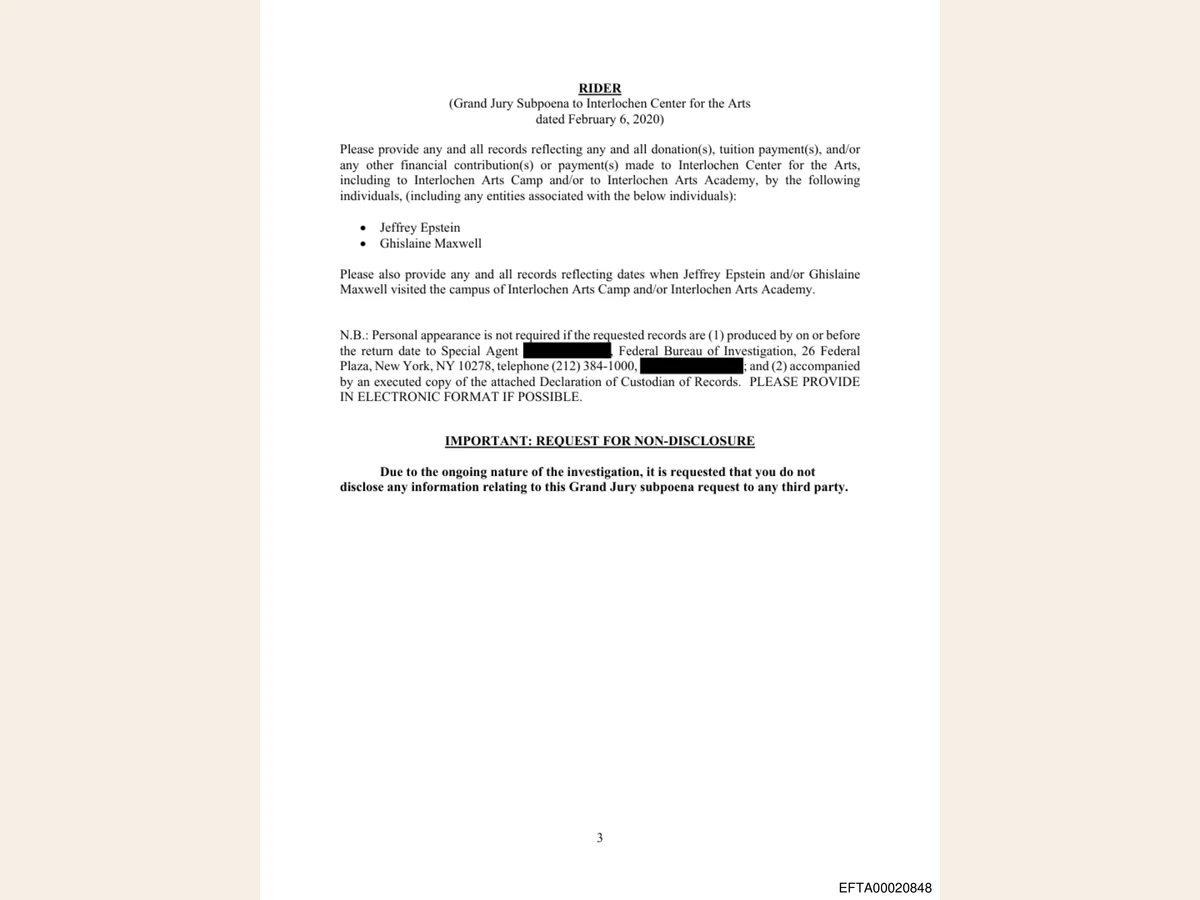
Boho News separately reviewed federal court records contained in the uploaded Epstein and Maxwell archive. A February 2020 grand-jury subpoena demanded Interlochen’s records of Epstein and Maxwell donations, tuition payments, other financial contributions and campus visits. A 1994 Interlochen letter thanked Epstein for a $200,000 lodge gift and described annual personal-use rights. Trial testimony from an Interlochen finance official authenticated donor correspondence and described the institution’s donor and student-record practices. Pilot testimony described repeated flights to Traverse City and visits to Interlochen. (E0014; E0020; E0024, document pp. 242–252; E0026, document pp. 123–124.)
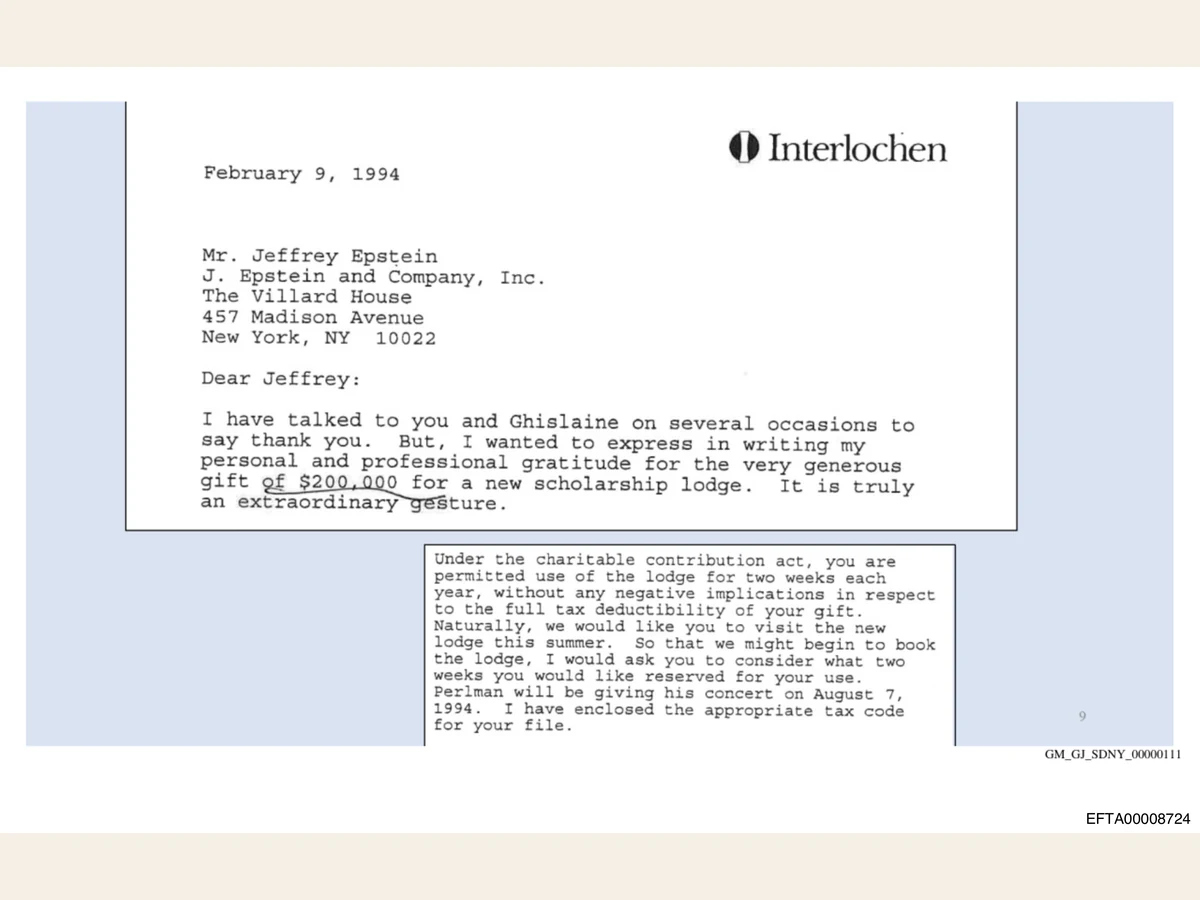
A later installment will examine those records in full. For this overview, they establish that Epstein’s documented relationship with Interlochen extended beyond the two accounts summarized in the Sanghavi report. The subpoena and correspondence do not establish that Interlochen knew he was engaging in misconduct.
What participants said the conduct cost them
Source note: S1, pp. 77–81.
The report devotes a separate section to the effects participants attributed to the conduct.
Some said it changed how they remembered Interlochen, turning a place they had loved into one associated with betrayal or danger. Some described disruptions to their education, including changing teachers, abandoning an artistic discipline or losing confidence in their work. Others described effects on professional choices, mental health, trust, intimacy and later relationships.
The reported effects differed from person to person.
A person could value friendships, training and artistic opportunities while also describing serious harm. Some alumni maintained deep affection for Interlochen. Others avoided reunions, stopped donating or distanced themselves from the institution. Some said the conduct shaped their lives for decades; others described narrower effects.
Several alumni described both valuable training and lasting harm. Affection for the school did not negate what they said happened there, and the reported harm did not erase every positive part of their education.
What Interlochen says has changed
Source note: S1, pp. 89–95; S2. These are institutional policy descriptions and announced actions, not independent findings of effectiveness.
Interlochen released the report with an apology and a list of current safeguards and planned actions.
The institution says none of the 47 respondents currently works there. It says all respondent names were provided to the Grand Traverse County prosecutor and sheriff. It established a counseling support fund, announced a review of naming recognitions and committed to an arts installation honoring survivors.
The report’s current-practices section is based on policies and information supplied by Interlochen. It describes background checks, annual training, professional-boundary rules, mandated reporting, multiple reporting channels, restrictions on closed-door one-on-one contact, supervision requirements, visitor identification, security cameras and rules for off-campus and donor interactions.
The investigation did not independently test whether those policies are consistently understood, enforced or effective. A later article in this series will examine their implementation through records and interviews with the current Interlochen community.
The same principle applies to law-enforcement referrals. Interlochen says it supplied respondent identities to local authorities. The public materials reviewed for this article do not disclose the exact transmittal dates, case numbers, contents of the referrals or status of any resulting review.
What the report does not answer
Source note: S1, pp. 4–10, 73–75 and 89–95; S2; S3; Boho News analysis.
The report is the most extensive public account Boho News has reviewed concerning historical misconduct at Interlochen. Major questions remain:
- How many unique alumni are represented by the approximately 70 separately counted accounts?
- Which reported events, if any, could be independently substantiated beyond the evidence summarized in the report?
- Were historical institutional responses adequate, and who made the relevant decisions?
- What was contained in personnel, student or administrative files that no longer exist?
- Do any living respondents currently work or volunteer around minors?
- Why were some adults recommended, rehired or allowed continued access after concerns were documented?
- What did outside institutions receive or learn when former Interlochen personnel applied elsewhere?
- What did Interlochen’s 2009 and 2019 Epstein reviews examine, and what work product survives?
- Was the reported warning call about Epstein made, and if so, who received it?
- How many alumni never came forward, declined contact or could not be located?
- Are the school’s current safeguards working as described?
The report also does not answer a question that will guide later reporting: whether Interlochen’s history and permissive access practices were publicly visible before Epstein began donating in 1990, and whether he or other outsiders deliberately exploited them. That remains an investigative hypothesis, not a finding of the report.
What the report establishes
Source note: S1; Boho News analysis.
For the first time, Interlochen has published a single document acknowledging that reports of sexual misconduct spanned generations, institutional roles and locations across the school and camp.
The report does not adjudicate the individual accounts, and publication is not the same as completed accountability. Its value lies in the record it assembles: firsthand accounts, contemporaneous disclosures, personnel-file summaries, respondent statements, institutional actions and gaps where the paper trail ends.
That record is now the starting point for further reporting. Boho News will use it to examine the school’s history before Epstein, the donor relationship documented in federal records, the fate of living respondents, the institution’s present safeguards and the public response to the report.
How Boho News reviewed the report
Boho News read the complete 97-page report and mapped each consequential claim to the report’s printed page numbers. This article distinguishes:
- adjudicated facts and guilty pleas;
- statements made by Interlochen;
- allegations recorded from firsthand participants;
- facts investigators said appeared in personnel or student files;
- respondent admissions, denials and nonresponses;
- federal court records;
- Boho News analysis and unresolved questions.
Boho News preserved the report’s anonymization. We did not attempt to identify unnamed alumni or respondents through biographical clues, and descriptions of alleged conduct are limited to the detail needed to explain the record.
Interlochen’s public response, announced actions and policy descriptions are attributed throughout. For anonymous respondents used as examples, the article preserves the response recorded in the report: participation and partial acknowledgment, denial through counsel, death or nonresponse. It adds no identifying information.