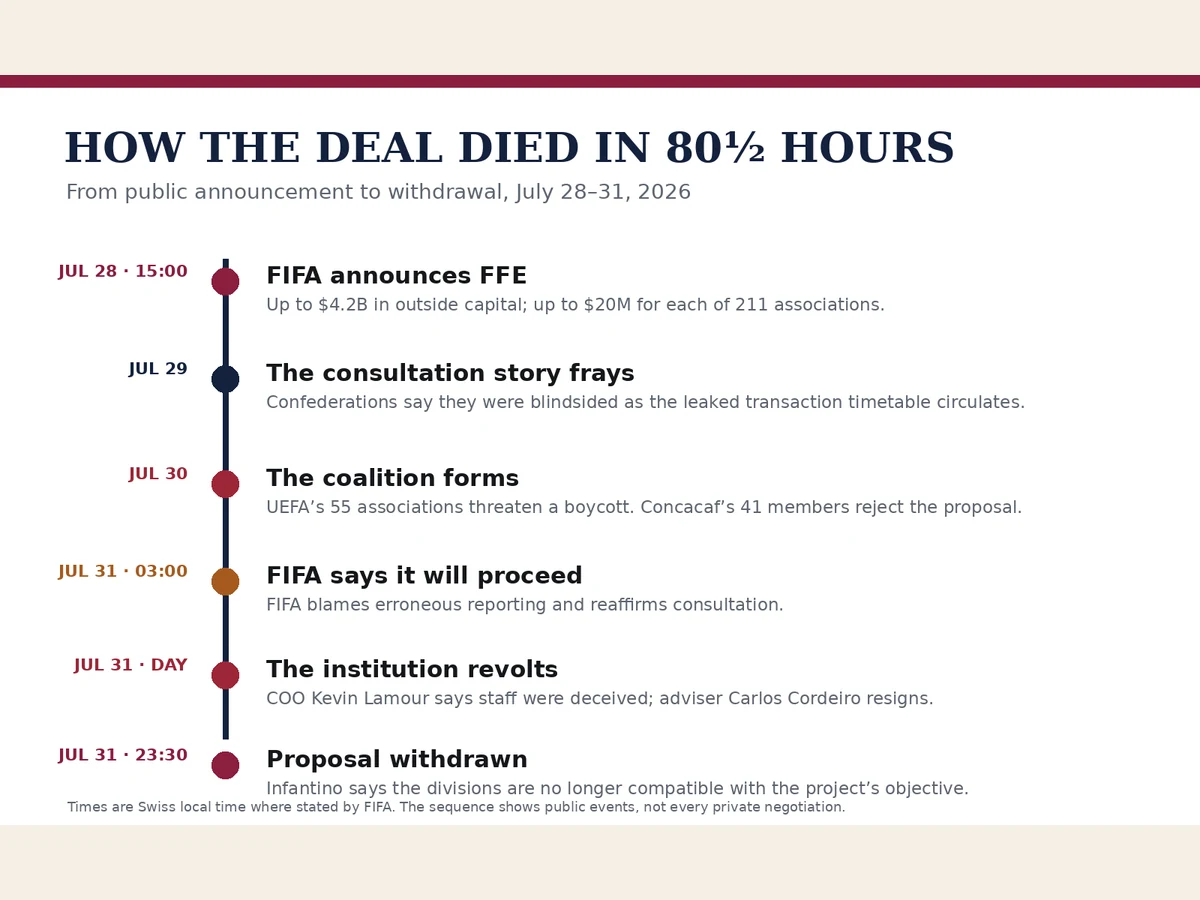
At 3 a.m. in Switzerland on Friday, FIFA said it would continue consulting its 211 member associations on a plan to place the commercial and event operations behind the World Cup and FIFA’s other tournaments into a new company partly owned by private investors.
Twenty and a half hours later, FIFA President Gianni Infantino killed it.
The official life of FIFA Forward Enterprise lasted 80 hours and 30 minutes, from FIFA’s announcement at 3 p.m. on July 28 to Infantino’s withdrawal statement at 11:30 p.m. on July 31. In that brief interval, an initiative promoted as the largest football-development program in history became the most serious challenge to Infantino’s authority since he took office in 2016.
The speed of the collapse can make the episode look like a simple public-relations disaster. It was more consequential than that. The transaction failed because opposition struck four foundations at once: the votes needed to authorize it, the tournaments needed to make it valuable, the management team needed to operate it and the institutional legitimacy needed to persuade investors that FIFA could deliver what it was offering.
The leak did not merely embarrass FIFA. It allowed national associations that otherwise might have considered the offer separately to coordinate before Infantino could assemble a majority. UEFA then threatened to remove the European teams that account for an enormous part of the World Cup’s sporting and commercial value. FIFA’s own chief operating officer said staff had been deceived. A senior Infantino adviser resigned and called the plan a bad deal.
By the time FIFA withdrew the proposal, it had become difficult to approve and irrational to finance.
What FIFA proposed to sell
FIFA did not propose selling FIFA itself. The organization would have remained a Swiss nonprofit association and would have retained formal control over football regulations, competition formats and the international match calendar.
Instead, FIFA proposed creating FIFA Forward Enterprise, or FFE, a FIFA-controlled subsidiary that would consolidate two categories of activity that are difficult to separate in practice:
- FIFA’s commercial rights, including broadcasting, sponsorship, ticketing and licensing.
- The operational delivery of FIFA tournaments, including the men’s and women’s World Cups and FIFA’s youth and club competitions.
Private investors would purchase minority, non-controlling interests in that subsidiary. FIFA said FFE would raise up to $4.2 billion at an initial equity valuation of $20 billion. Thrive Eternal, a permanent-capital company founded by Joshua Kushner, was expected to lead the investor group. JPMorgan was advising FIFA; OpenEconomics was approaching investors; and former Liberty Media chief executive Greg Maffei was identified as a key commercial adviser.
FIFA repeatedly emphasized that investors would not control football governance. That answer addressed the narrowest possible version of the concern. Minority shareholders do not need power over the Laws of the Game to influence a company’s behavior. Their economic return can depend on media packages, tournament inventory, ticket revenue, sponsorship yield, borrowing, costs and the timing of future sales.
The confidential 25-page member presentation reviewed by The Guardian reportedly described FIFA as commercially “undermonetized” and identified growth through a larger tournament portfolio, higher ticket revenue, streaming and subscription products, high-yield events, third-party capital and debt. It reportedly contemplated increasing annual global tournament activity from about 200 events to 450 and mentioned the women’s World Cup only once.
Those assumptions exposed the central contradiction in FIFA’s public case. FIFA said outside investors would have no operational role and “nothing changes.” But an investor does not pay billions of dollars for nothing to change. The investment case required more revenue, more events, more monetization or some combination of the three.
The $4.2 billion symmetry
The most revealing feature of the proposal was not hidden in a leaked email. FIFA published it.
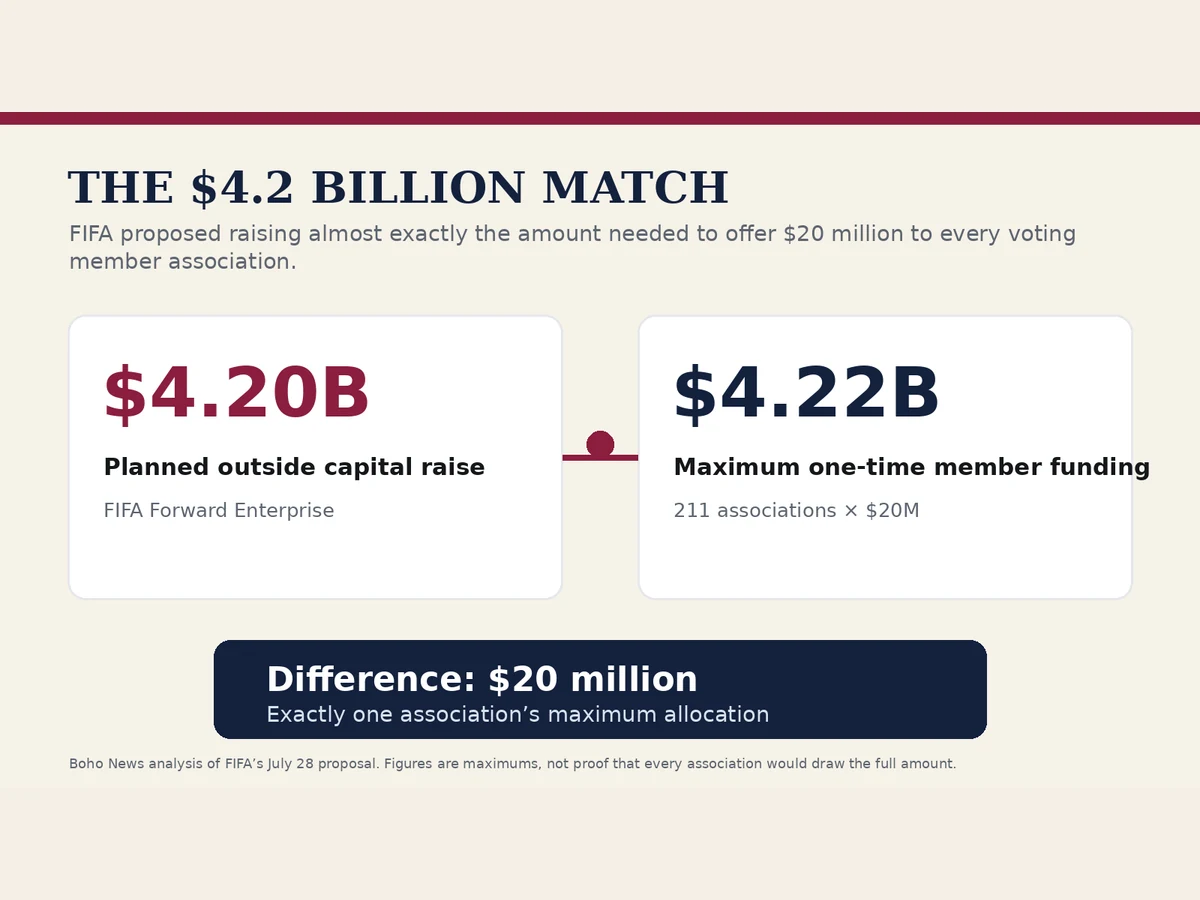
Every one of FIFA’s 211 member associations would have been eligible for up to $20 million in one-time project funding through a new FIFA Fast Forward Programme if FFE proceeded.
The maximum distribution was therefore:
211 associations × $20 million = $4.22 billion.
FIFA’s proposed outside capital raise was up to $4.2 billion.
The difference was $20 million, exactly one association’s maximum allocation. Put another way, the proposed raise could fund 210 of the 211 maximum payments dollar for dollar.
FIFA explicitly said the one-time program would be financed through FFE’s planned capital raise. The money was intended for football projects rather than delegates’ personal bank accounts, and participation would have been voluntary. Those distinctions matter. They prevent a responsible news organization from declaring that FIFA committed criminal bribery based on the public record now available.
They do not remove the political structure.
FIFA said FFE would not be established without support from a majority of member associations. Without FFE, there would be no outside capital raise. Without the raise, there would be no one-time $20 million program.
The collective proposition was straightforward:
Approve the transaction, and all 211 associations become eligible for the new money. Reject it, and the money does not exist.
FIFA later clarified that each association would receive a separate increase to $20 million in regular Forward funding for 2027 through 2030 regardless of that association’s individual position. But the organization also confirmed that the additional one-time payment depended on FFE proceeding.
This is not evidence that an individual voter was offered a personal payoff for an individual vote. It is evidence of what can fairly be called a collective financial inducement, institutional vote-buying architecture or patronage mechanism: the electorate deciding the transaction was also the class of institutions promised nearly the entire initial proceeds.
For smaller associations, the offer was not symbolic. Twenty million dollars could finance national training centers, pitches, competitions, staff and youth or women’s programs at a scale that local revenue might never support. Their interest in the plan cannot be dismissed as mere corruption. The proposal was powerful precisely because it combined a genuine development need with an enormous political incentive.
Why the leak changed the vote
Before the plan became public, each association could view the decision as an isolated bargain. The immediate benefit was visible and local. The long-term cost of granting investors a permanent interest in FIFA’s commercial subsidiary was uncertain, diffuse and shared across world football.
That creates a classic collective-action problem. A small federation could rationally support the proposal even if the transaction imposed larger aggregate costs on FIFA, because its guaranteed near-term gain could exceed its perceived share of those future costs.
The leak changed the decision from 211 separate calculations into a coordinated institutional conflict.
The confidential materials showed that the project had advanced considerably further than FIFA’s language of an open-ended consultation suggested. JPMorgan had reportedly been working on a valuation since early 2026. The Wall Street Journal reported that Infantino and Joshua Kushner had discussed the concept at least as early as 2025. The presentation reportedly laid out a rapid transaction process moving through investor materials, term sheets, commitments and long-form agreements.
Major governing bodies said they had not been meaningfully consulted. Concacaf said the proposal lacked due process, imposed an artificially short deadline and had not been reviewed or approved by the relevant FIFA governance bodies. UEFA said it had been conceived in secret and brought close to approval without meaningful consultation. FIFA Council members were reported to have learned significant details through the press.
The public story was “consultation before a possible transaction.” The leaked timetable looked more like “transaction preparation before institutional ratification.”
That distinction transformed the debate. Associations were no longer considering only whether development funding was desirable. They were being asked whether to validate a process in which advisers, a valuation, an expected anchor investor and an accelerated timetable had emerged before many of FIFA’s governing institutions understood the proposal.
The blocking coalition
A majority of FIFA’s 211 members is 106.
UEFA has 55 FIFA member associations. Concacaf has 35 FIFA members among its 41 regional members. The Asian Football Confederation has 46 FIFA members among its 47 members. Together, those three blocs contain as many as 136 FIFA votes.
That was not a recorded roll call of 136 individual votes. FIFA withdrew the proposal before a formal vote, and an association could theoretically have defied its confederation. But once UEFA unanimously rejected the plan, Concacaf’s 41 members collectively rejected it and Asian leaders aligned themselves with the demand for consultation and reform, FIFA’s plausible route to 106 votes was collapsing.
Even unanimous support from Africa’s 54 FIFA members, South America’s 10 and Oceania’s 11 would provide only 75 votes. Infantino would have needed substantial defections from the opposing regions.
The leak made those defections more costly. A federation considering the $20 million could no longer treat the decision as a quiet bilateral arrangement with FIFA. It would have to break publicly with its confederation, accept responsibility for the governance process and risk the consequences of an escalating split in international football.
The money remained attractive. The political price had changed.
UEFA attacked the asset, not just the proposal
UEFA’s decisive move was not its denunciation. Football administrators denouncing other football administrators is practically a renewable resource.
The decisive move was its unanimous threat that no UEFA national team would participate in any FIFA competition while the proposal remained alive.
That threat functioned as an economic poison pill.
FFE’s reported $20 billion valuation depended on future cash flows from broadcasting, sponsorship, ticketing, hospitality and licensing. Those cash flows depend heavily on European teams, players, audiences, broadcasters and sponsors. A World Cup without UEFA teams would not be a slightly weaker version of the same product. It would be a different and dramatically less valuable competition.
The boycott threatened both sides of any valuation model. Expected revenue would fall. Risk would rise.
Investors would have to ask whether FIFA could deliver the tournaments, media inventory and sponsorship platform described in its materials. Broadcasters and sponsors would have to ask whether existing contracts covered a competition stripped of Europe. Clubs and players would face a widening conflict over release obligations. The next Women’s World Cup and youth tournaments could have been affected before the men’s World Cup returned.
A political dispute had become a deliverability problem. The object being sold was no longer reliably available in the form investors thought they were buying.
FIFA’s own executives revolted
The external coalition might still have fractured. FIFA’s internal collapse made recovery far less likely.
Carlos Cordeiro, an Infantino adviser, former U.S. Soccer president and former Goldman Sachs executive, resigned. He said the proposal lacked transparency and compelling financial justification and would mortgage football’s future despite FIFA’s strong finances.
Then Kevin Lamour, FIFA’s chief operating officer, publicly defended employees and said staff had been deceived. He called FFE “the project of one person” and accused Infantino of contempt and intimidation.
The importance of that statement extended beyond the embarrassment of a senior executive attacking his president in public.
An investor conducting due diligence would now confront questions about whether FIFA’s management team had approved the transaction, whether internal representations were reliable, who would operate FFE, whether key personnel would remain and whether the project’s authorization could withstand legal or governance scrutiny.
A multibillion-dollar company cannot be sold credibly as an institutional strategy when the official responsible for operations says the institution was kept in the dark.
The revolt also destroyed FIFA’s argument that objections resulted mainly from inaccurate press coverage. At 3 a.m. on July 31, FIFA said erroneous reporting had disrupted its consultation and that the process would continue. During the same day, opposition expanded and senior insiders publicly repudiated the project. At 11:30 p.m., Infantino said it had caused divisions incompatible with its purpose and announced that it would not proceed.
FIFA moved from reaffirmation to surrender in less than a day.
Why sell equity at all?
The proposal also suffered from a basic financial question that FIFA never answered publicly: Why sell a permanent ownership interest to raise money the organization appeared capable of obtaining by other means?
FIFA emerged from the 2026 World Cup projecting more than $15 billion in revenue for the 2023 through 2026 cycle. Its 2025 accounts showed billions of dollars in cash, financial assets and reserves. Concacaf explicitly asked why existing reserves could not support larger Forward distributions. Cordeiro emphasized that FIFA carried no debt.
Equity can provide expertise and risk-sharing, and a strategic investor can sometimes increase the value of a commercial operation. It is not free capital. A permanent stake can entitle investors to future economic benefits, information, governance protections, exit rights and influence over major financial decisions even without majority control.
FIFA did not publish the proposed shareholder agreement, investor term sheet, dividend arrangement, board rights, veto rights, debt limits, transfer provisions or exit mechanism. It did not publish a comparison of equity financing with reserves, bonds, ordinary borrowing, revenue-backed financing or a time-limited investment vehicle.
The announced figures were themselves imprecise. If $4.2 billion purchased 20% of the company after investment, the implied post-money valuation would be $21 billion. If FFE was valued at $20 billion before the new capital, $4.2 billion would purchase about 17.4%. Public descriptions alternated among a 20% stake, about 20% and minority interests worth up to $4.2 billion.
Those differences might have ordinary technical explanations. No term sheet was released to provide them.
The absence of disclosed economics mattered because FIFA proposed using almost the whole initial raise for immediate member funding. World football would receive the short-term cash. Investors would retain their stake in the vehicle producing future tournament revenue.
The stakeholder ledger
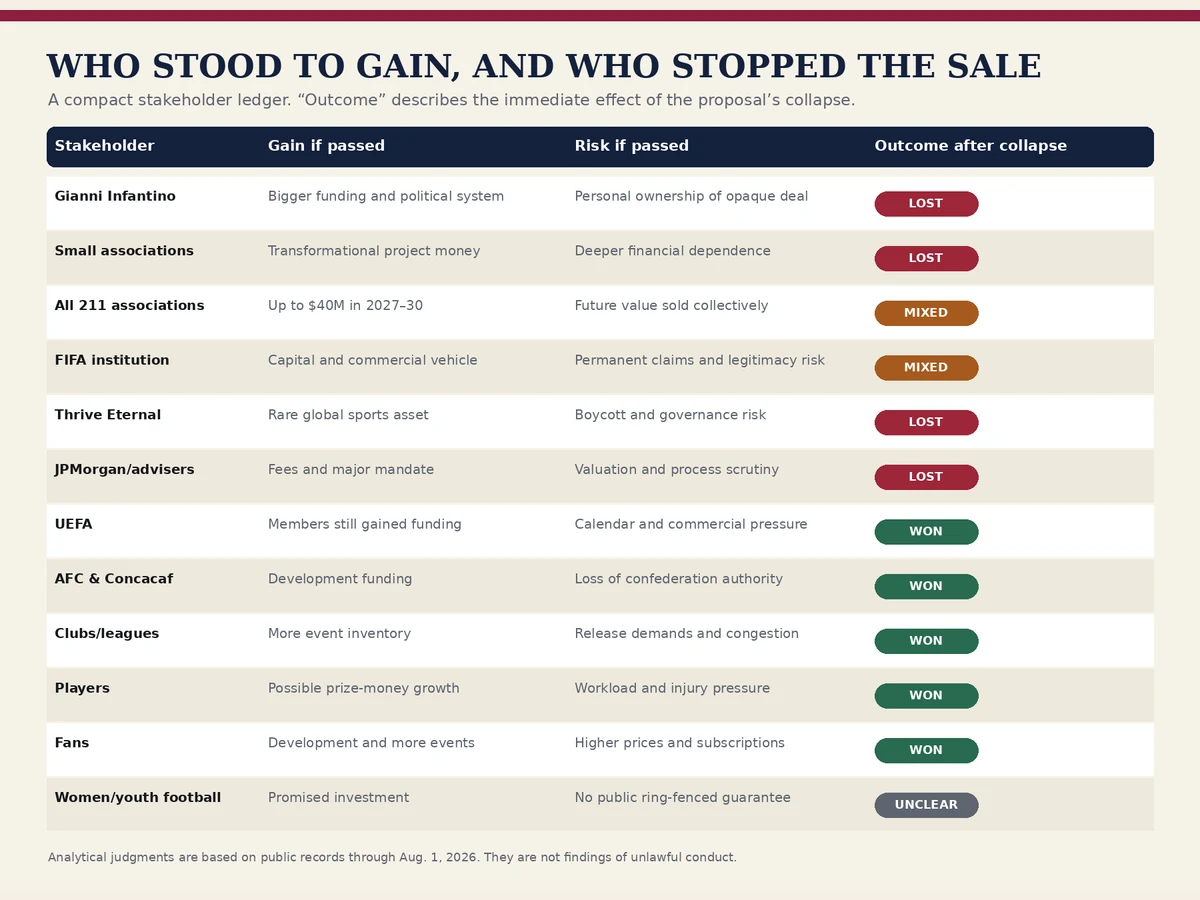
| Stakeholder | Gain if passed | Risk if passed | Collapse result | Immediate effect |
|---|---|---|---|---|
| FIFA as a nonprofit association | Immediate capital, a focused commercial subsidiary and possible future revenue growth. | Permanent investor claims, governance conflict, transaction liabilities and institutional damage. | Mixed | Avoided immediate privatization but suffered a severe credibility crisis. |
| Gianni Infantino | A larger funding system, a new commercial structure and greater political leverage over member associations. | Personal ownership of the transaction, election exposure and conflict questions. | Lost | His authority, internal support and reelection position were damaged. |
| FIFA Council | Authority to approve a new capital structure and global development package. | Loss of practical authority, fiduciary exposure and responsibility for an inadequately reviewed deal. | Mixed | Formal powers survived, but the episode exposed how little some members knew. |
| FIFA senior executives and staff | Potentially larger operating budgets, staffing and incentive compensation. | Restructuring, personal accountability and execution of a project they said was concealed from them. | Won | Avoided implementation while the internal revolt became public. |
| All 211 member associations | Up to $40 million each during 2027–2030 when regular and one-time funding were combined. | Collectively surrendering part of FIFA’s future commercial value and increasing financial dependence. | Mixed | Lost proposed funding but retained full collective ownership. |
| Small and low-revenue associations | Transformational infrastructure and operating money far beyond local commercial capacity. | Greater patronage dependence, project oversight exposure and little influence over investor policy. | Lost | Lost the largest relative financial benefit. |
| Large and wealthy associations | The same nominal allocation as smaller associations and possible global development benefits. | Disproportionately large calendar, commercial and reputational exposure for relatively modest cash. | Won | Protected national teams, commercial markets and confederation influence. |
| Thrive Eternal | Access to a scarce global sports asset through a permanent-capital vehicle. | Political scrutiny, uncertain governance rights, boycott risk and reputational exposure. | Lost | Lost the investment while avoiding an increasingly impaired asset. |
| Joshua Kushner | Prestige, influence and economic exposure to FIFA’s global commercial rights. | Scrutiny from family political connections and the absence of a disclosed competitive process. | Lost | Lost the transaction and became a central conflict-of-interest subject. |
| JPMorgan | Advisory and possible transaction fees, a major sports-finance mandate and future work. | Valuation scrutiny, process criticism and reputational damage. | Lost | Lost the transaction; fee and termination exposure remain unknown. |
| Greg Maffei and BANN Ventures | Influence over designing a Formula One-style commercial growth vehicle. | Responsibility for aggressive monetization assumptions and process failures. | Lost | Lost a potentially powerful advisory or operating role. |
| OpenEconomics | Investor-sourcing work and possible placement compensation. | Due-diligence and reputational exposure from an aborted process. | Lost | Lost the fundraising assignment. |
| Other prospective investors | Minority access to World Cup-related cash flows and sponsorship inventory. | Weak minority protections, political conflict, boycott and uncertain exit rights. | Mixed | Lost access but avoided buying into an institutional civil war. |
| UEFA and its 55 associations | Associations still stood to receive increased development funding. | Investor pressure on calendars, competition formats and UEFA’s commercial territory. | Won | Won a major power struggle and proved it could impair FIFA’s core product. |
| Asian Football Confederation | Large funding increases for many developing associations. | Being bypassed, loss of confederation authority and calendar disruption. | Won | Helped eliminate FIFA’s majority path and strengthened bargaining power. |
| Concacaf | Development funds across a region containing many small associations. | Governance bypass, disruption and reputational damage after hosting the World Cup. | Won | Protected its authority and joined the decisive coalition. |
| Confederation of African Football | Enormous relative development benefits across 54 FIFA associations. | Deeper dependence on FIFA distributions and reduced confederation leverage. | Mixed | Lost potential funding but avoided committing before full review. |
| CONMEBOL | Funding plus possible alignment with expansion of the 2030 World Cup. | Investor-driven calendar and competition pressure. | Mixed | Potentially lost expansion leverage while avoiding ownership risks. |
| Oceania Football Confederation | Exceptionally large funding relative to local association revenue. | Dependence on FIFA and minimal influence over investor governance. | Lost | Lost substantial potential development funding. |
| Domestic leagues and clubs | More tournaments could create some commercial opportunities. | More player-release demands, calendar congestion, injuries and competition with domestic products. | Won | Avoided immediate acceleration of FIFA’s tournament inventory. |
| Players and FIFPRO | Potential prize money and development investment. | Workload growth, injury exposure and exclusion from transaction design. | Won | Preserved leverage over workload and calendar negotiations. |
| Broadcasters and sponsors | More events, inventory, streaming packages and sponsorship opportunities. | Higher rights costs, audience dilution, boycott impairment and contract uncertainty. | Mixed | Lost possible inventory but retained a stable World Cup product. |
| Fans and ticket buyers | Possible global development and additional competitions. | Higher ticket prices, more subscriptions, diluted tournaments and reduced accountability. | Won | Avoided immediate investor pressure but gained no formal governance power. |
| Women’s and youth football | FIFA promised expanded infrastructure, competitions and development funding. | Use as justification without detailed ring-fencing or enforceable guarantees. | Unclear | Lost possible investment but avoided an undefined bargain. |
| 2030 and 2034 host states | Expanded competitions, tourism, infrastructure and political prestige. | More expensive hosting obligations and investor-influenced requirements. | Mixed | Lost possible expansion upside while avoiding new commercial commitments. |
| Trump administration and Kushner political network | Potential soft-power access and prestige through FIFA and a Kushner-linked investment. | Cronyism allegations and congressional or ethics scrutiny. | Mixed | The transaction disappeared, but scrutiny of FIFA’s U.S. relationships increased. |
| FIFA Ethics Committee and Swiss oversight bodies | No direct transaction benefit. | Institutional credibility damage if conflicts, recusals or authority questions are ignored. | Mixed | The deal ended, but process and ethics questions remain. |
| Public-interest and congressional investigators | A stronger factual basis for reviewing FIFA governance and political relationships. | Overclaiming unproven criminal links could undermine legitimate oversight. | Won | The controversy expanded the scope and urgency of scrutiny. |
The transaction created radically different incentives across football.
No stakeholder was entirely virtuous. UEFA’s defense of football also defended UEFA’s own competitions and commercial power. FIFA’s development offer could have produced real public benefits even while serving Infantino’s political interests. Private investors could have brought expertise even while demanding returns.
The point of the ledger is not to assign saints and villains. It is to show why the coalition formed. The plan concentrated immediate benefits among associations while spreading long-term costs across institutions that controlled the players, teams, tournaments and audiences needed to generate investor returns. Once those institutions coordinated, the deal’s apparent simplicity disappeared.
The corruption question
FIFA’s history makes suspicion rational. It does not make every suspicious arrangement a proven crime.
The public record supports several serious findings:
- The member associations whose majority support was required were collectively offered access to an outside-financed pool almost exactly equal to the proposed capital raise.
- The transaction had advanced through advisers, valuation work and an expected lead investor before major governing bodies said they were properly consulted.
- FIFA did not disclose a competitive process explaining why Joshua Kushner’s Thrive Eternal was expected to lead the investor group.
- FIFA did not disclose adviser contracts, fees, success payments, conflicts, recusals or proposed investor rights.
- A senior executive said the project had been concealed from FIFA staff, while a senior adviser resigned over the process and economics.
The public record does not currently establish:
- Personal cash payments to delegates.
- Secret kickbacks to FIFA officials.
- A criminal agreement between Infantino, Joshua Kushner, Jared Kushner or the Trump administration.
- That Infantino was promised a future paid role in FFE.
- That support for a 64-team 2030 World Cup was traded for support of FFE.
- A formal finding that anyone violated FIFA’s ethics code or Swiss law.
The distinction is not timidity. It is the difference between investigating corruption and manufacturing it.
FIFA’s ethics code makes the undisclosed records important. It requires officials to act diligently in financial matters, avoid the appearance of improper conduct, honor fiduciary duties and manage conflicts of interest. It separately regulates gifts, benefits, commissions, abuse of position, bribery and misuse of funds.
The selection of Thrive Eternal deserves scrutiny because Joshua Kushner is the brother of Jared Kushner, President Donald Trump’s son-in-law, and because Infantino’s relationship with Trump has already generated political and ethics controversy. Trump has said he did not discuss FFE with Infantino. Family ties and access are not proof of a corrupt transaction.
The precise question is narrower: Was Thrive selected through a fair process based on financial and strategic merit, or was the transaction organized around a preferred investor with privileged access?
FIFA’s announcement said investor demand came from every major region and that investors would be selected under clear governance and strategic criteria. It did not publish the criteria, shortlist, bidding process or selection memorandum. If demand was as extensive as FIFA claimed, the absence of a visible competition becomes more difficult to explain.
Another lead concerns Infantino’s future. Sky News reported speculation that FFE could provide him with a role after his FIFA term ends, while FIFA said a proposed chief executive position for Infantino had not been discussed. No employment agreement, compensation plan or board document establishing a promised role has become public.
The responsible conclusion is that the issue is unproven and highly material. Draft organization charts, compensation studies, investor presentations and communications about post-2031 management could resolve it.
A third lead concerns tournament expansion. The leaked materials reportedly relied on a much larger competition portfolio, while FIFA has separately studied a 64-team men’s World Cup in 2030. More teams and matches could increase revenue and benefit the South American countries staging centenary games, potentially affecting political support inside CONMEBOL.
That relationship is a hypothesis, not evidence of a quid pro quo. Any communication tying FFE support to the 2030 format would change the story substantially.
The records FIFA has not released
The proposal is dead. The accountability questions are not.
A complete investigation requires at least the following records:
- The full 25-page FIFA Forward Enterprise Member Materials presentation.
- Every JPMorgan valuation model and comparable-company analysis.
- JPMorgan’s engagement letter, fee schedule and any success fee.
- The Thrive Eternal expression of interest, commitment letter and term sheet.
- The complete list of investors contacted by FIFA, JPMorgan and OpenEconomics.
- Draft FFE articles, bylaws, shareholder agreements and board structures.
- Investor veto, information, dividend, transfer, redemption and exit rights.
- FIFA Council agendas, minutes, written resolutions and legal opinions concerning FFE.
- Conflict declarations and recusals by FIFA officials and advisers.
- Infantino’s full communication to all 211 associations and every response.
- Any preliminary vote count or support pledge.
- Draft management charts, employment agreements and compensation plans for FFE.
- Records connecting the valuation to tournament expansion, ticket prices, subscriptions or debt.
- Communications involving FIFA, Thrive Eternal, Joshua or Jared Kushner, U.S. officials and World Cup host organizations.
- Any player-workload, women’s-football, youth-football or fan-affordability assessment.
The adviser contracts are especially important. They would show who authorized the project, what FIFA has already paid, whether fees were contingent on association approval or closing and whether any adviser expected equity or a continuing management role.
The association responses could reveal whether the public revolt interrupted a support campaign already underway. Infantino left the World Cup with letters pledging reelection support from about 200 associations. That does not prove those associations supported FFE. It demonstrates the scale of the political network into which the funding offer was introduced.
Why it really collapsed
The sale failed through a chain reaction:
- The leak exposed the maturity of the transaction. What FIFA called consultation looked to critics like late-stage ratification.
- Confederations coordinated the electorate. The proposal’s individually attractive benefits could no longer be considered in isolation.
- The opposing coalition eliminated the plausible majority. Europe, Asia and North and Central America contained more than enough FIFA voters to block approval.
- UEFA impaired the asset. Its boycott threat put the World Cup product and the $20 billion valuation at risk.
- FIFA’s management revolt undermined execution. Investors could not assume the proposed company had institutional support from the people expected to run it.
- The financing case remained unexplained. FIFA did not show why permanent equity was superior to reserves or borrowing.
- The investor relationship intensified conflict concerns. Thrive Eternal’s expected lead role arrived without a disclosed competition amid scrutiny of Infantino’s political relationships.
- FIFA’s response demonstrated loss of control. It blamed inaccurate reporting, reaffirmed consultation and withdrew the plan within one day.
No single objection necessarily killed FFE. Together they made it uninvestable.
A transaction can survive public anger if it has the votes, a deliverable asset, stable management and defensible economics. FFE had lost all four.
The proposal is dead. The system remains.
Infantino’s withdrawal prevented the immediate sale of a minority interest in FIFA’s commercial future. It did not answer who authorized the project, why an anchor investor was already expected, what the advisers were promised, what rights investors would have received or whether the $20 million offer was designed partly to secure a political majority.
It also did not solve the underlying inequality that made the offer so tempting. Many member associations need development money. FIFA controls the principal mechanism that provides it. The president seeking support controls the administration proposing how much is distributed. That concentration creates a patronage risk even when every dollar funds a legitimate football project.
The failed transaction exposed the mechanism in unusually clean arithmetic: FIFA proposed raising $4.2 billion from private investors and making up to $4.22 billion available across the 211 institutions whose collective approval was required.
There is no public proof that FIFA bought an individual’s vote.
There is ample evidence that it designed a deal in which approval and money moved together.
The sale collapsed because the rest of football recognized the bargain before FIFA could close it.