Global merchandise trade remained above its recent trend in the first half of 2026, but the World Trade Organization’s latest leading indicator shows momentum beginning to cool.
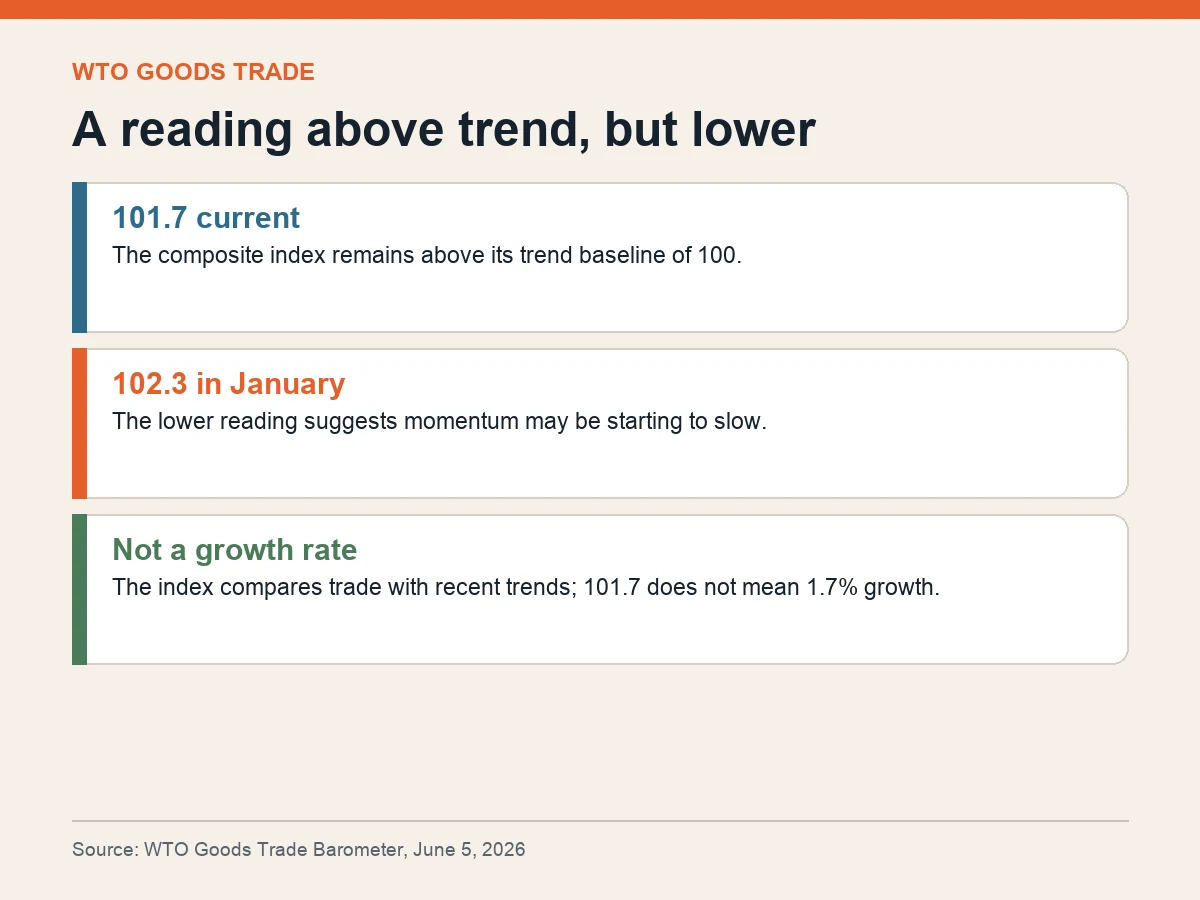
The WTO Goods Trade Barometer registered 101.7, down from 102.3 in January. Because 100 is the indicator’s trend baseline, the new reading points to above-trend trade volume with a weaker signal than at the start of the year.
The number is not a growth percentage. The barometer combines several forward-looking measures to show direction relative to recent trends; it does not mean world trade grew 1.7% or guarantee that the next quarterly volume report will match the signal.
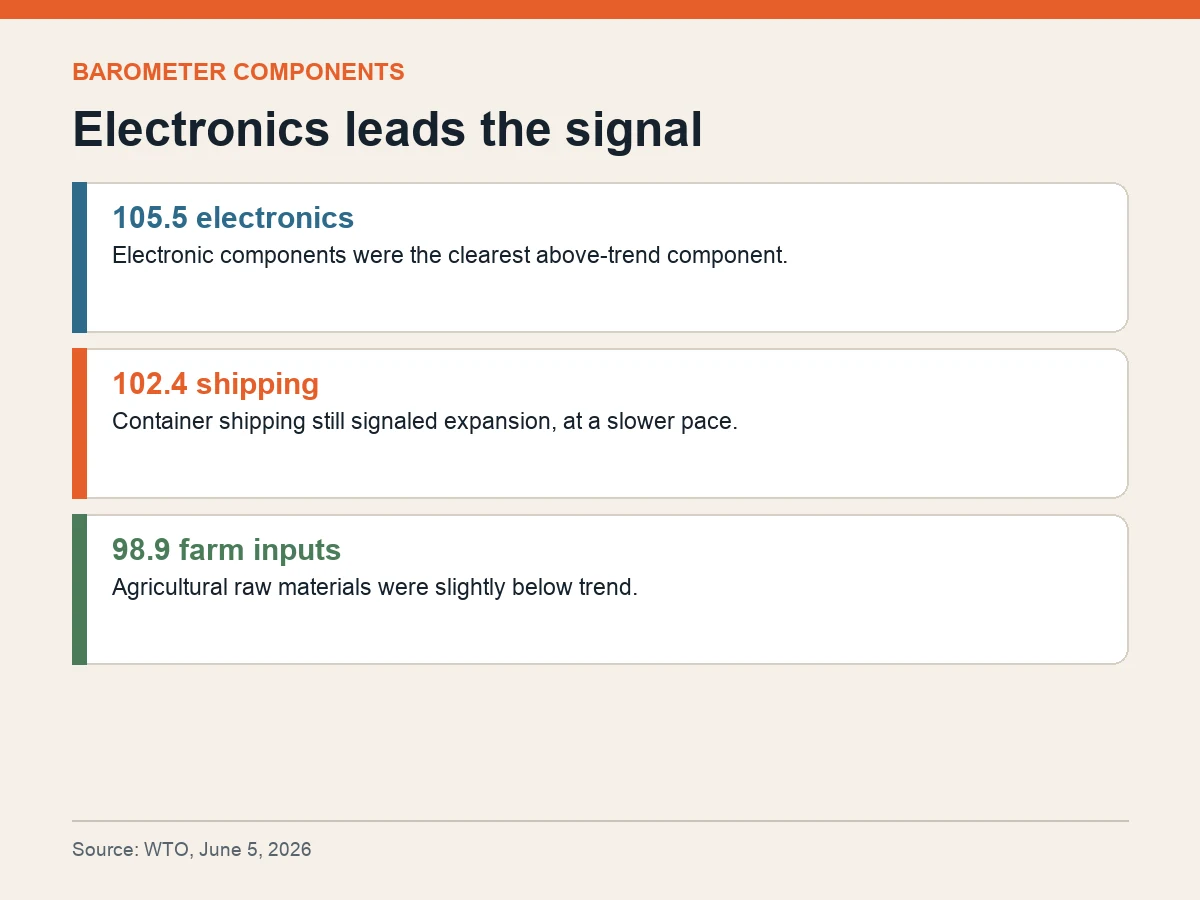
Electronic components were the clear outlier at 105.5. The WTO connected that strength to demand associated with artificial-intelligence investment, which helped offset other pressure on trade during the first half of the year.
Transport measures still pointed to expansion. Container shipping stood at 102.4 and air freight at 102.2, although the WTO said both were expanding more slowly than a few months earlier. Export orders were only slightly above trend at 100.5.
Two goods-producing components were below the baseline: agricultural raw materials at 98.9 and automotive products at 99.8. The mix describes resilience rather than synchronized acceleration across every part of the trading system.
The WTO’s separate March outlook projected merchandise-trade growth of 1.9% in 2026 under its baseline and 1.4% in a high-energy-price scenario. It said sustained AI investment could add 0.5 percentage points, a scenario contribution rather than growth already booked.
The organization also noted that importers accelerated purchases before anticipated tariff increases in early 2025. That timing boosted year-over-year growth before it slowed later in the year, complicating comparisons with 2026.
The next trade forecast is scheduled for October. Until then, the barometer’s message is carefully bounded: world goods trade is holding above trend, electronics are doing unusual work in the index, and the aggregate signal is softer than it was in January.