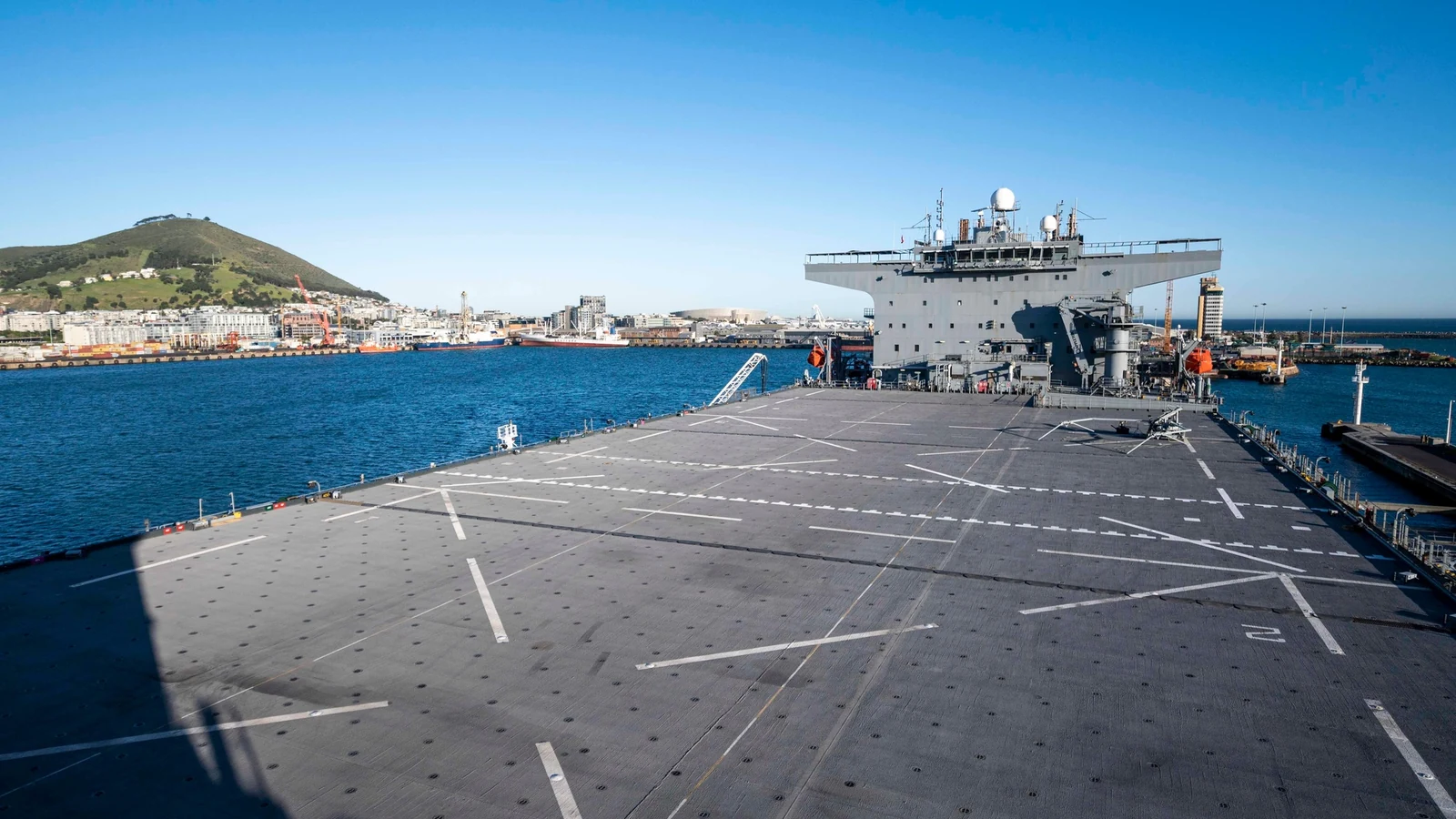
The World Bank has approved a $1.5 billion development-policy loan for South Africa aimed at electricity, freight transport, ports, water and sanitation reforms rather than one standalone construction project.
The International Bank for Reconstruction and Development operation is the fourth in a series of standalone policy loans to South Africa since 2022. It is the first in that sequence to extend support into water and sanitation.
In electricity, the program backs a competitive wholesale market and more private investment in transmission. A concrete service target calls for 300,000 new household electricity connections by December 2027.
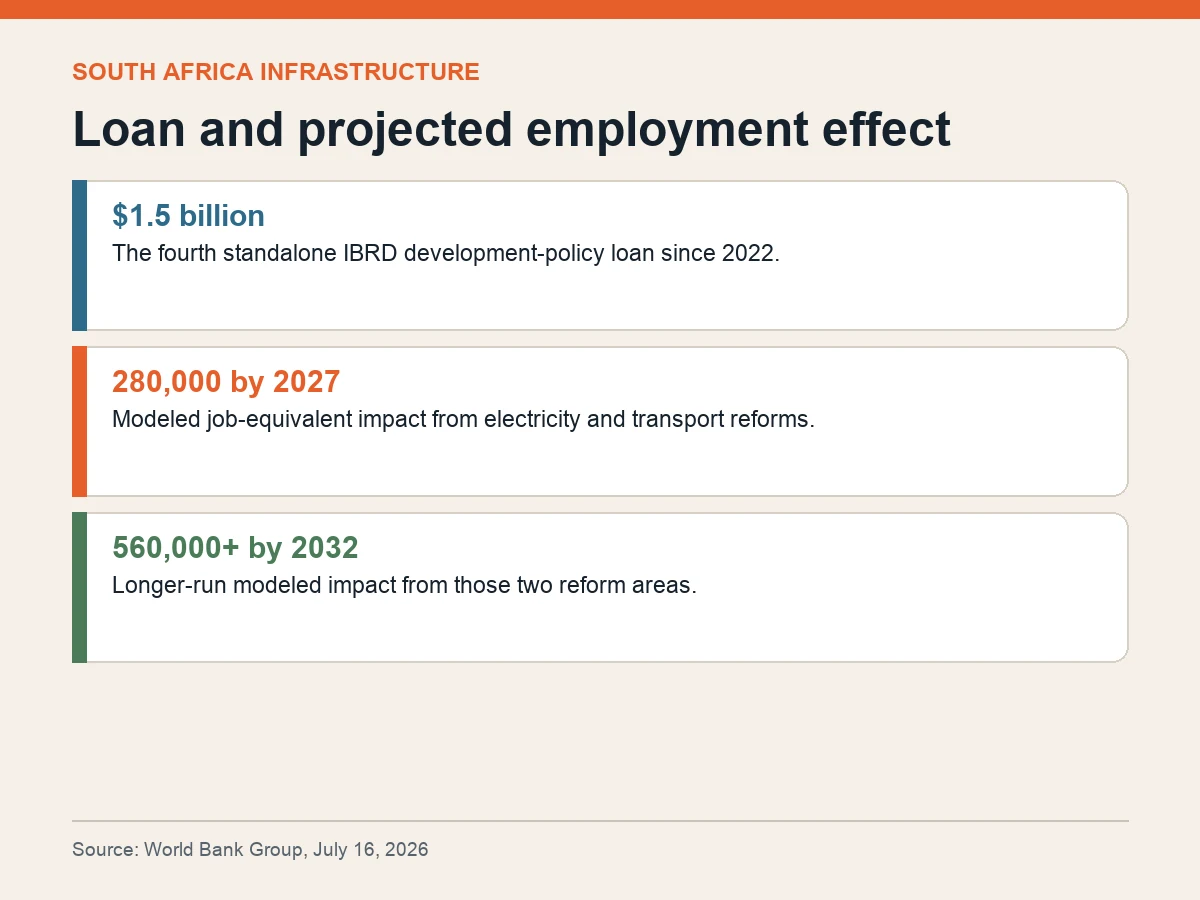
The announcement says load shedding has been virtually eliminated for a year and a half and private renewable-energy investment has increased sixfold. Those claims describe progress preceding the new loan and do not prove that every reform target has already been achieved.
Freight measures support competition among private rail operators and the country’s first port-terminal concession in Durban. The World Bank says rail and port freight volumes have risen by more than 50% since 2023.
Water reforms strengthen regulatory oversight, allow private service providers and give the new National Water Resources Infrastructure Agency more autonomy to invest in bulk-water systems. The World Bank expects household benefits even though it does not model large direct job creation from that sector.
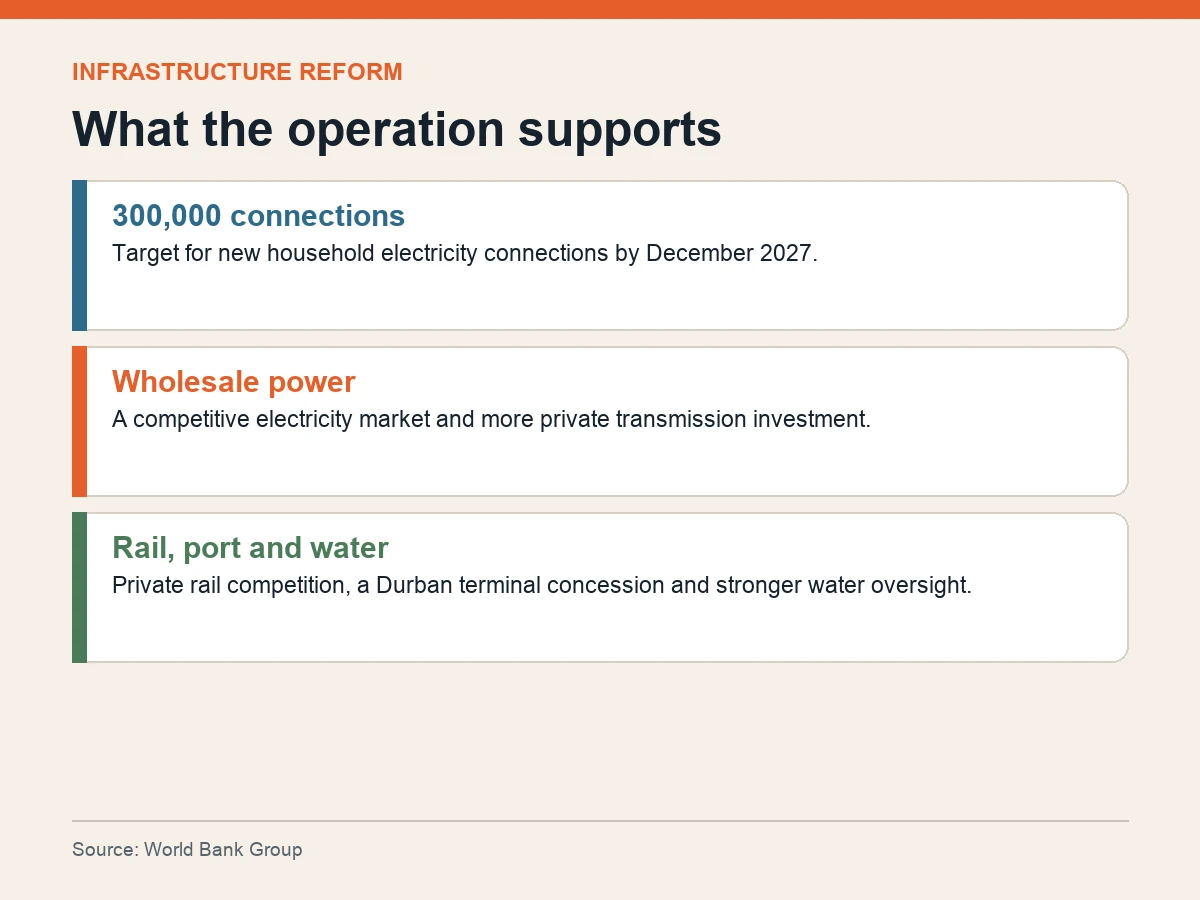
Most of the employment effect comes from electricity and transport in the bank’s economic model: the equivalent of about 280,000 jobs by 2027 and more than 560,000 by 2032. The broader headline of nearly 600,000 includes modeled ripple effects and is not a guarantee.
Development-policy lending releases financing against agreed institutional and policy actions. It differs from a project loan with a fixed list of tracks, substations or pipes, making public reporting on implementation and outcomes especially important.
The measurable checkpoints are therefore the connection target, market and concession changes, infrastructure performance and household service improvements. The $1.5 billion approval is real now; the employment and service gains remain projections that South Africa and the World Bank will need to verify over time.