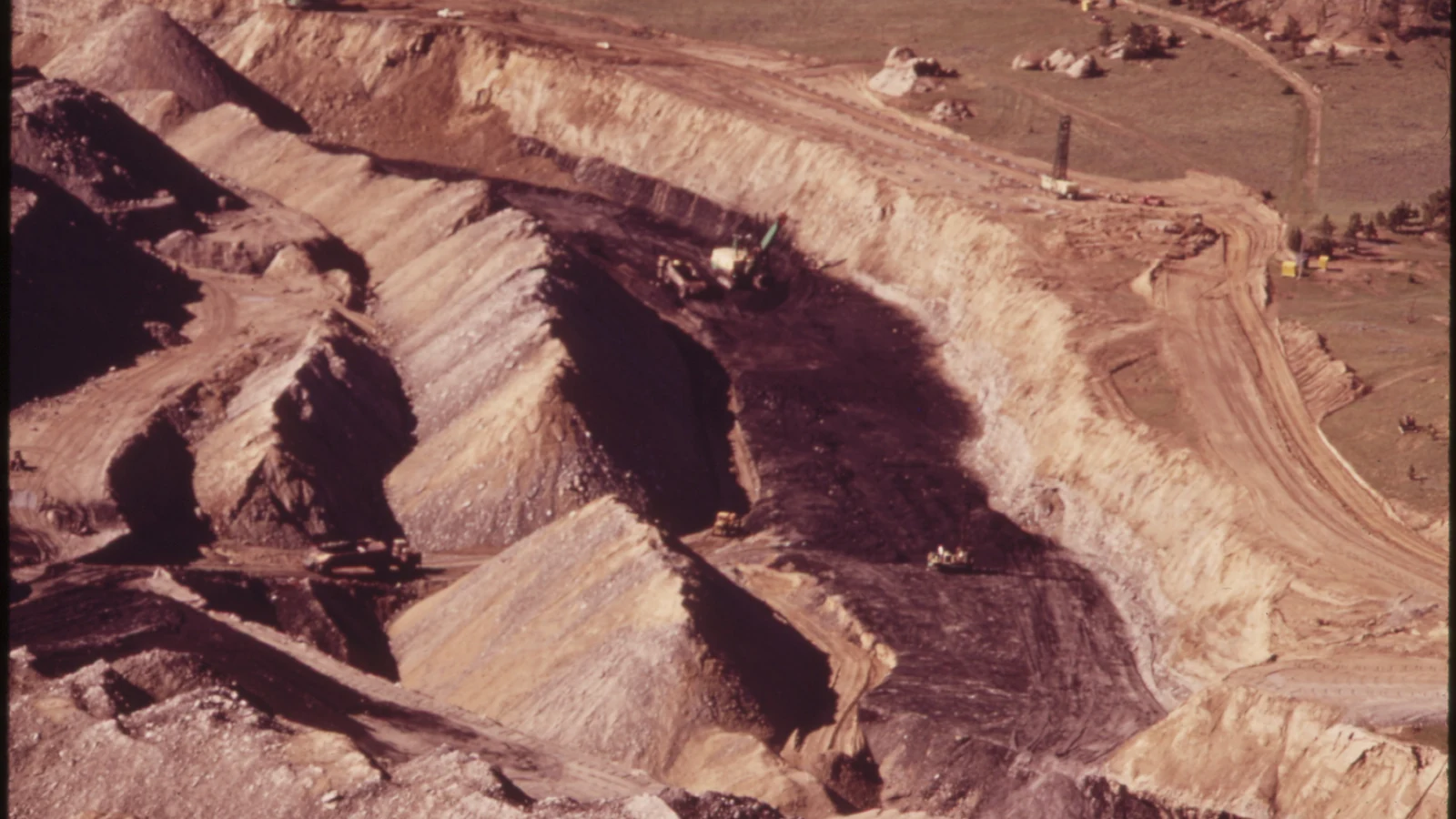
A new U.S. Geological Survey inventory puts two very different numbers side by side: about 355.8 billion short tons of available coal resources beneath federal lands in the lower 48 states, but only a little more than 4.2 billion short tons of reported reserves controlled by current federal-land mines.
The distinction is the story. A resource estimate describes coal known or inferred to exist under stated geologic and land constraints. A reserve is the smaller portion demonstrated as recoverable under existing economic and operating conditions. Treating the larger number as ready-to-mine supply overstates what the report establishes.
USGS counted 34 coal mines operating on federal lands in 2024. They produced 261,690,308 short tons, equal to 51.06% of total U.S. coal production that year, and 23 of the mines used surface methods while 11 operated underground.
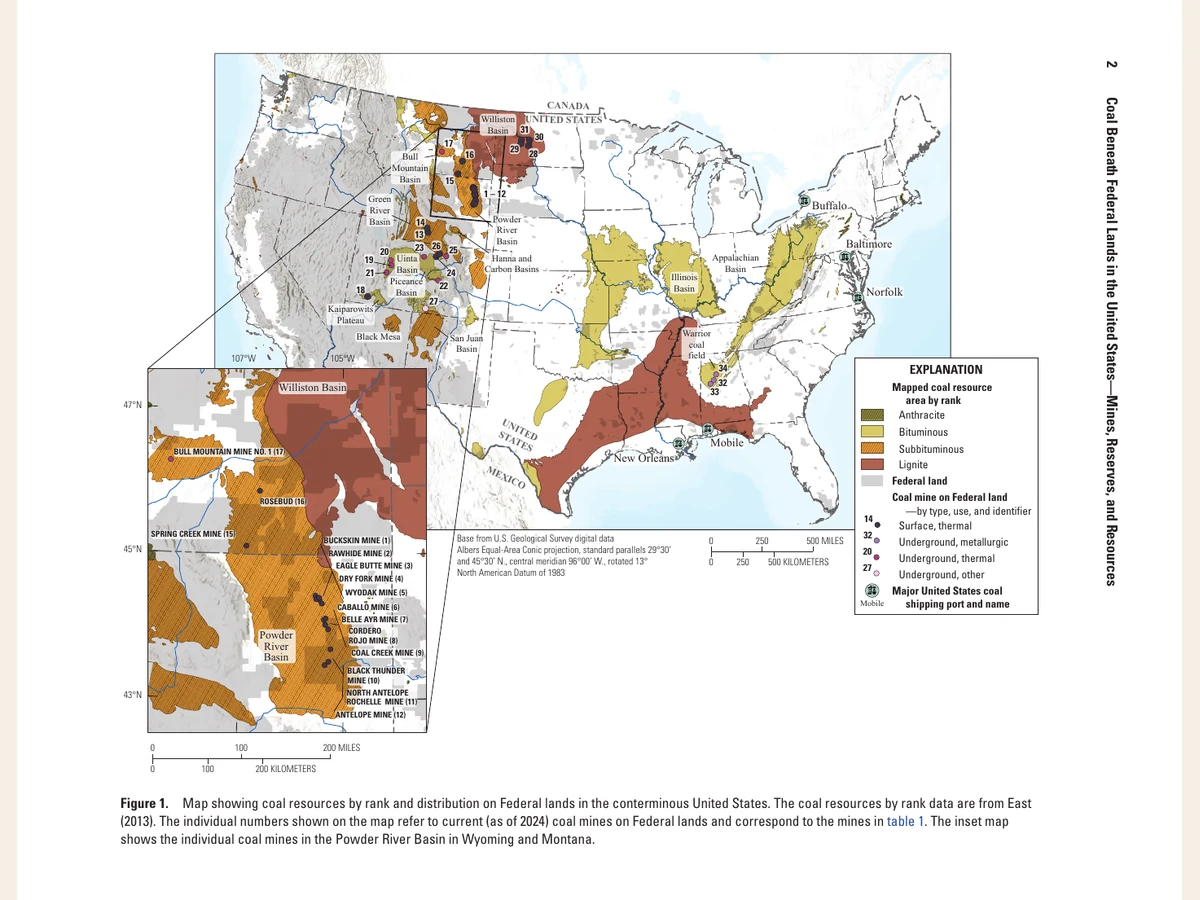
The geography is concentrated in the West. Thirty-one of the 34 mines and more than 98% of reported reserves were west of the Mississippi River. Wyoming alone had 14 federal-land coal mines, including 12 in the Powder River Basin.
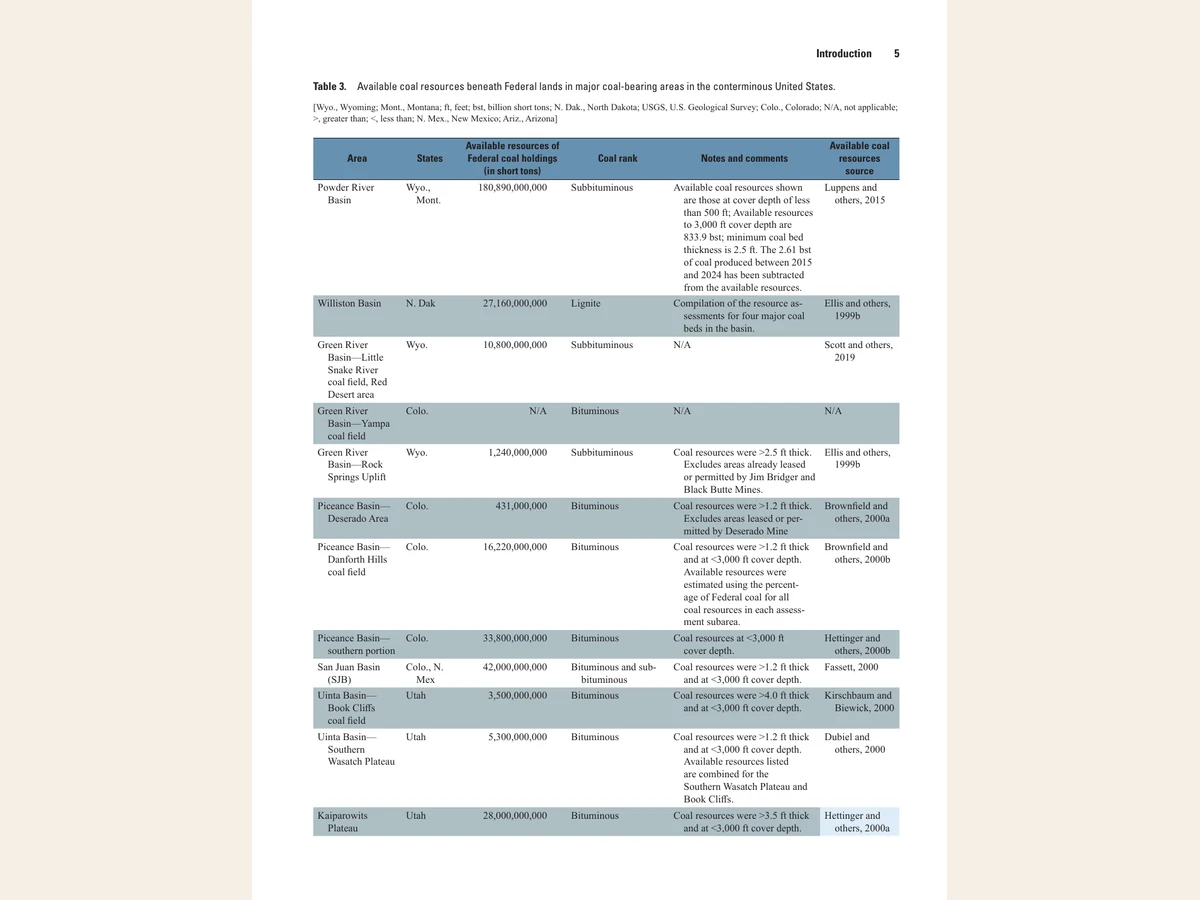
For the conterminous United States, USGS compiled 355.771 billion short tons of available federal coal resources. The Powder River Basin was the largest listed area at 180.89 billion short tons, followed by the Williston Basin at 27.16 billion and the Kaiparowits Plateau at 28 billion.
Those basin figures depend on the thresholds and exclusions in earlier assessments. Table notes vary by area, including limits on seam thickness, depth of cover, existing leases and permitted mine areas. The sum is therefore an inventory assembled from studies with different definitions, not one uniform mine plan.
Alaska adds still larger uncertainty. USGS identified at least 140 billion short tons of available coal resources there and said total identified and undiscovered resources may be as high as 5.5 trillion short tons. The report also says much of Alaska has not been adequately assessed.
Interior compared the resource totals with current annual coal consumption to describe centuries of potential supply. That arithmetic is a scale comparison, not a forecast that the coal will be permitted, financed, mined or burned at a constant rate for centuries.
Market demand, mine economics, transportation, environmental review, land-use decisions and energy policy all determine how much of a geologic resource can become a reserve and then production. The new report does not convert those contingencies into an extraction schedule.
The clean reading is narrower and more useful: federal lands contain a very large geologic coal endowment, current mines remain responsible for roughly half of U.S. output, and the portion reported as reserves is far smaller than the headline resource estimate.