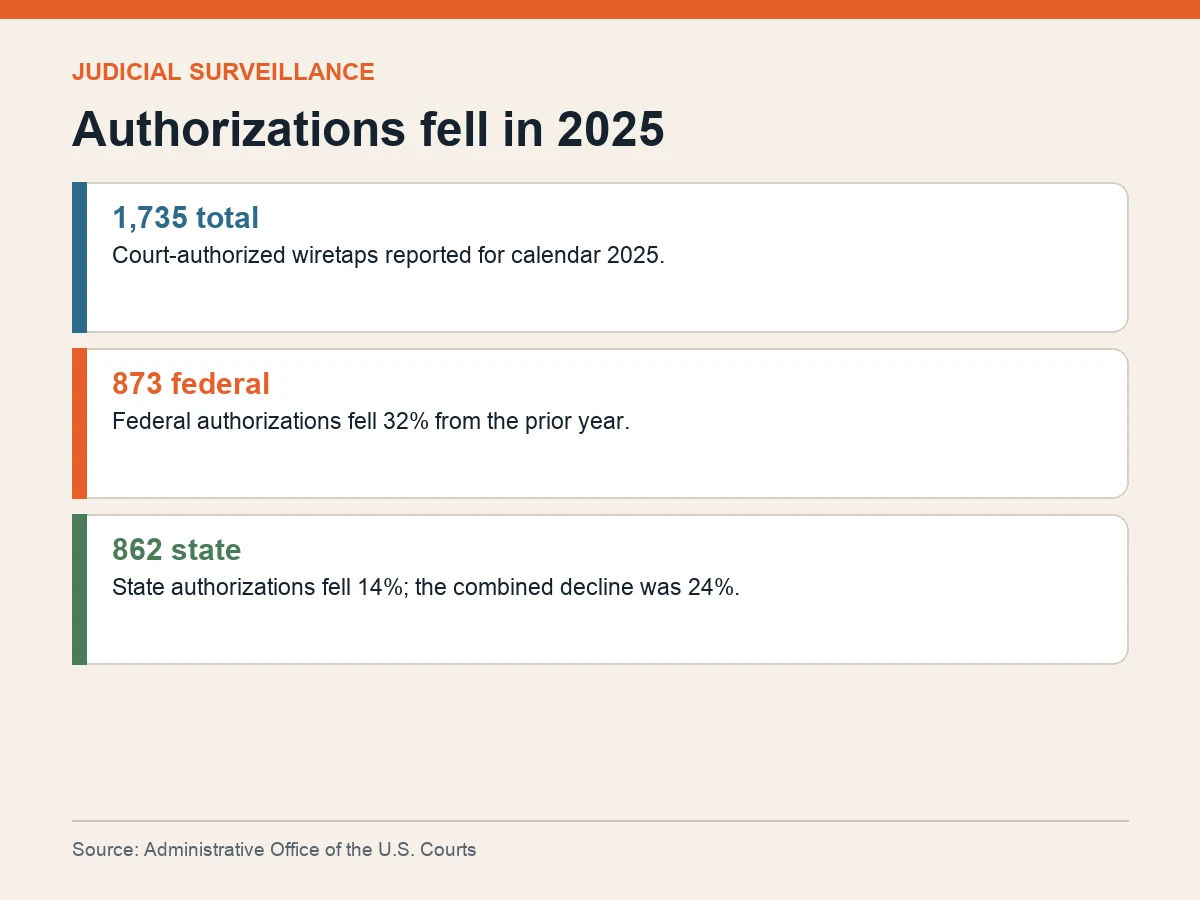
Federal and state judges reported authorizing 1,735 wiretaps in 2025, a 24% decline from the previous year, according to the federal judiciary’s annual accounting of court-approved wire, oral and electronic surveillance.
The total was almost evenly divided: federal judges authorized 873 wiretaps and state judges 862. Federal approvals fell 32% from 2024, while state approvals declined 14%, making the federal side the larger driver of the combined drop.
The Administrative Office of the U.S. Courts said the Drug Enforcement Administration’s count fell from 1,157 authorizations in 2024 to 416 in 2025. DEA attributed the comparison partly to clearing a historic backlog of cases in 2024, after which the total returned toward its operational baseline.
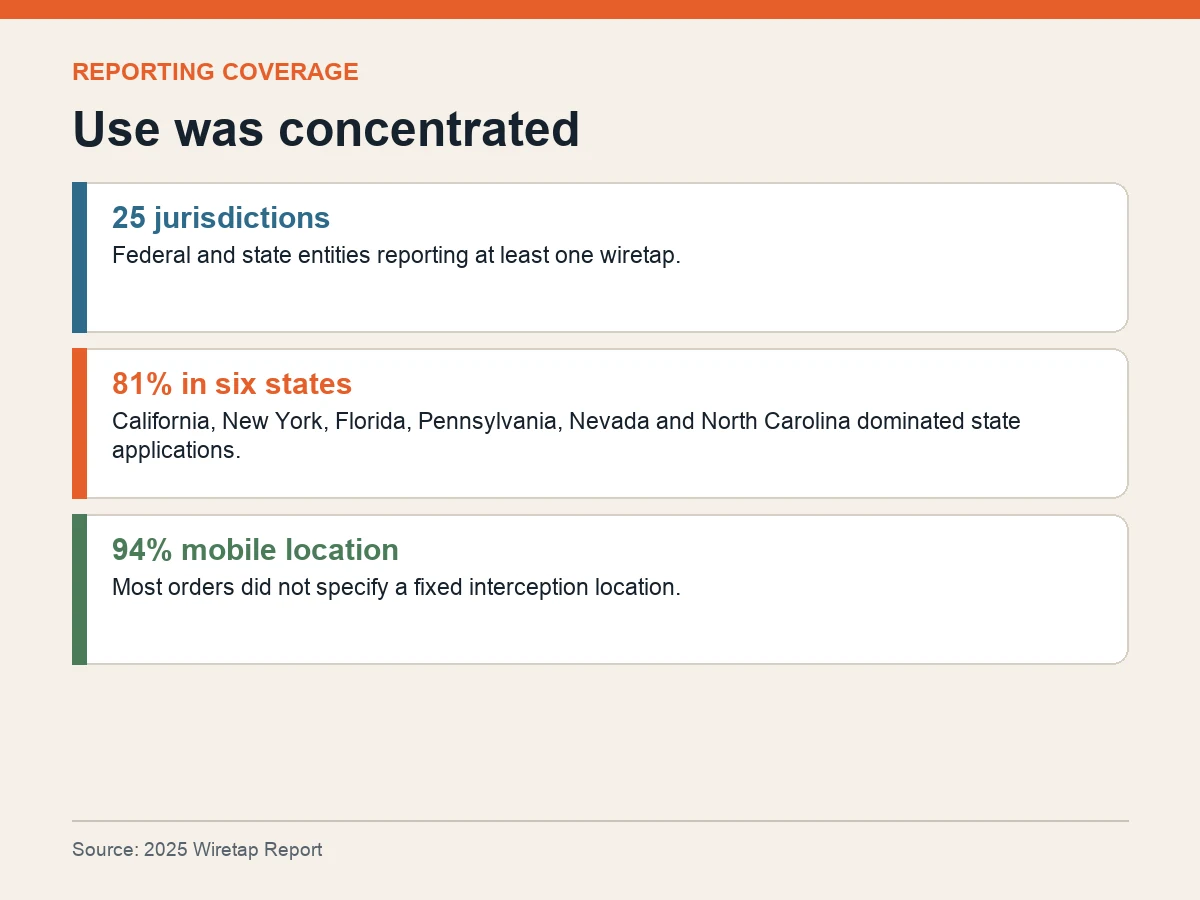
Use remained geographically concentrated. Twenty-five federal and state jurisdictions reported at least one wiretap, while California, New York, Florida, Pennsylvania, Nevada and North Carolina together accounted for 81% of state applications.
Mobile communications shape how the numbers are recorded. Ninety-four percent of authorized wiretaps—1,633 orders—did not specify the location of the intercepted communication, consistent with orders involving cellular or mobile phones whose locations can change.
Original orders are limited to 30 days, but judges may grant extensions when additional time is justified. The report counted 1,242 requested and authorized extensions, down 22%, and said the average reported length of both original orders and extensions was 30 days.
The report is an authorization ledger, not a complete measure of surveillance intensity. One order can run for different lengths, reach different numbers of communications and produce different investigative results. A lower order count therefore does not establish a proportional decline in intercepted calls or messages.
Coverage also has reporting limits. Judges submitted reports for 249 federal and 80 state wiretaps for which the Administrative Office had not received corresponding prosecutor data. Some late or incomplete information may appear in future reports.
The most defensible conclusion is narrow but significant: judges approved fewer reported wiretaps in 2025, the federal decline was steeper, and the remaining state activity was heavily concentrated. What the count cannot answer alone is how those orders affected the scale or outcome of investigations.