
Nearly two-thirds of the sustainable-development targets the United Nations can measure are moving too slowly or have slipped below their 2015 baselines, leaving the 2030 agenda with less than five years to turn broad gains into faster progress.
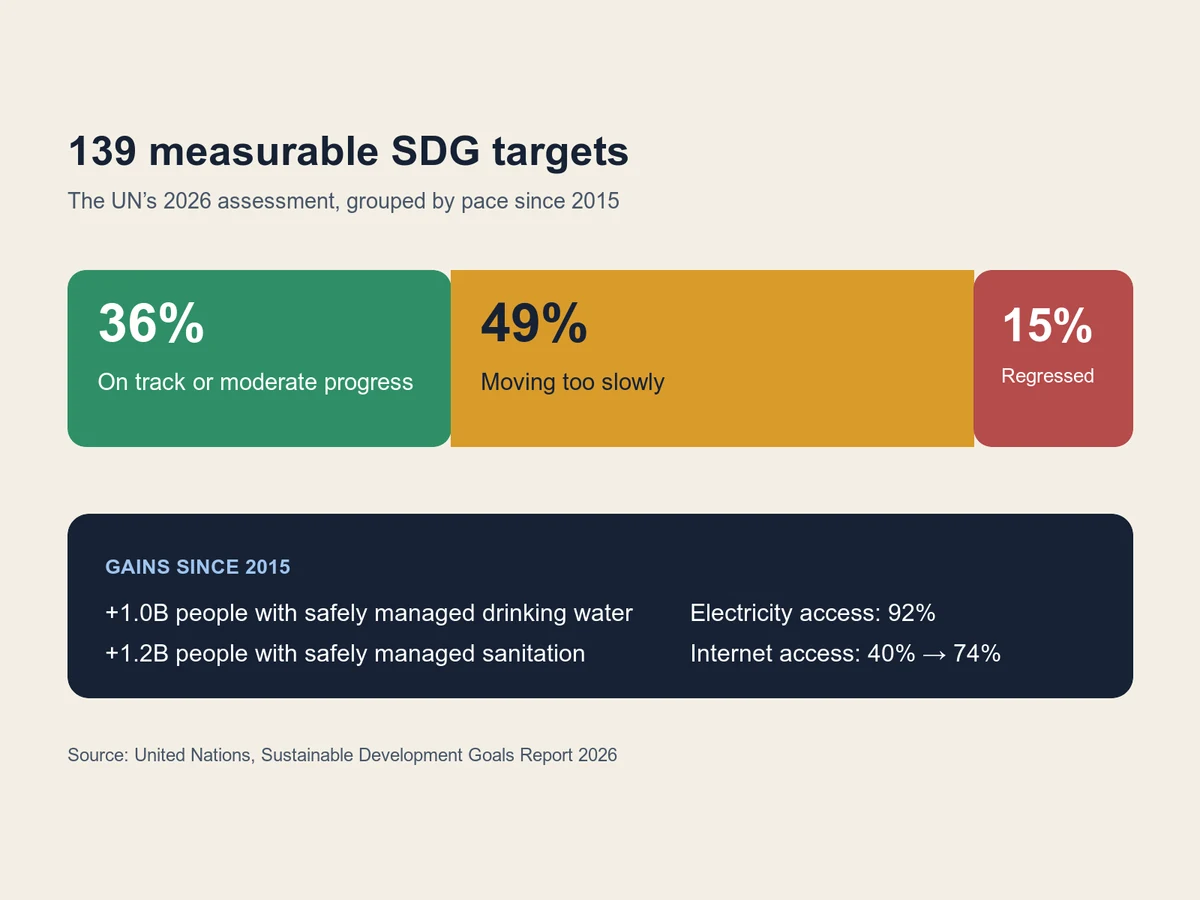
The Sustainable Development Goals Report 2026 evaluates 139 targets with sufficient trend data. It classifies 36% as on track or making moderate progress, 49% as moving too slowly and 15% as below their 2015 baselines.
Those shares add to 100% because they sort the measurable targets into three progress bands. They are not the percentage of countries succeeding, and they do not mean 64% of individual people are worse off.
The gains are large even when the pace is not
The report says nearly 1 billion people gained access to safely managed drinking water since 2015, while 1.2 billion gained safely managed sanitation. Global electricity access reached 92% in 2024.
Digital access expanded even faster: the UN puts internet use at 74% in 2025, up from 40% in 2015. Those are consequential changes across a decade, and they explain why the report describes the goals as producing results at scale rather than as a uniform failure.
.jpg)
Aggregate progress still leaves enormous gaps
The same report estimates that 2.3 billion people experienced moderate or severe food insecurity in 2024. It says 273 million children and young people remained out of school even after 110 million more entered education since 2015.
Those figures measure different problems with different methods and reference years. They should not be combined into one population total because people can appear in more than one indicator and the underlying datasets are not synchronized.
Financing moved in the wrong direction
The report says official development assistance fell 23.1% in 2025, the largest annual drop on its measure. It also places the annual financing gap for the goals at roughly $4 trillion.
A financing gap is an estimate of the difference between projected needs and available resources, not an invoice that one institution can settle. Its value is diagnostic: the UN is arguing that progress cannot accelerate at the required rate while concessional finance retreats and debt burdens rise.
What the 64% headline can—and cannot—say
Adding the 49% moving too slowly to the 15% below baseline yields 64% of assessable targets outside the report’s on-track-or-moderate category. That is the clearest summary of pace, but it applies only to the 139 targets for which the UN says reliable historical trends can be computed.
Targets without sufficient trend data are not silently counted as failures. The report is explicit about its assessment base, and changes in data availability or methodology can alter future comparisons as well as real-world progress.
The time horizon is equally important. The goals were adopted in 2015 for achievement by 2030, so an indicator can improve substantially and still be classified as too slow if its observed trajectory does not reach the target. Progress and adequate pace are separate judgments in the UN framework.
The result is neither a victory lap nor a declaration that the agenda is beyond recovery. It is a split-screen: demonstrable gains in water, sanitation, electricity and internet access, paired with a majority of measurable targets still moving too slowly or backward.