
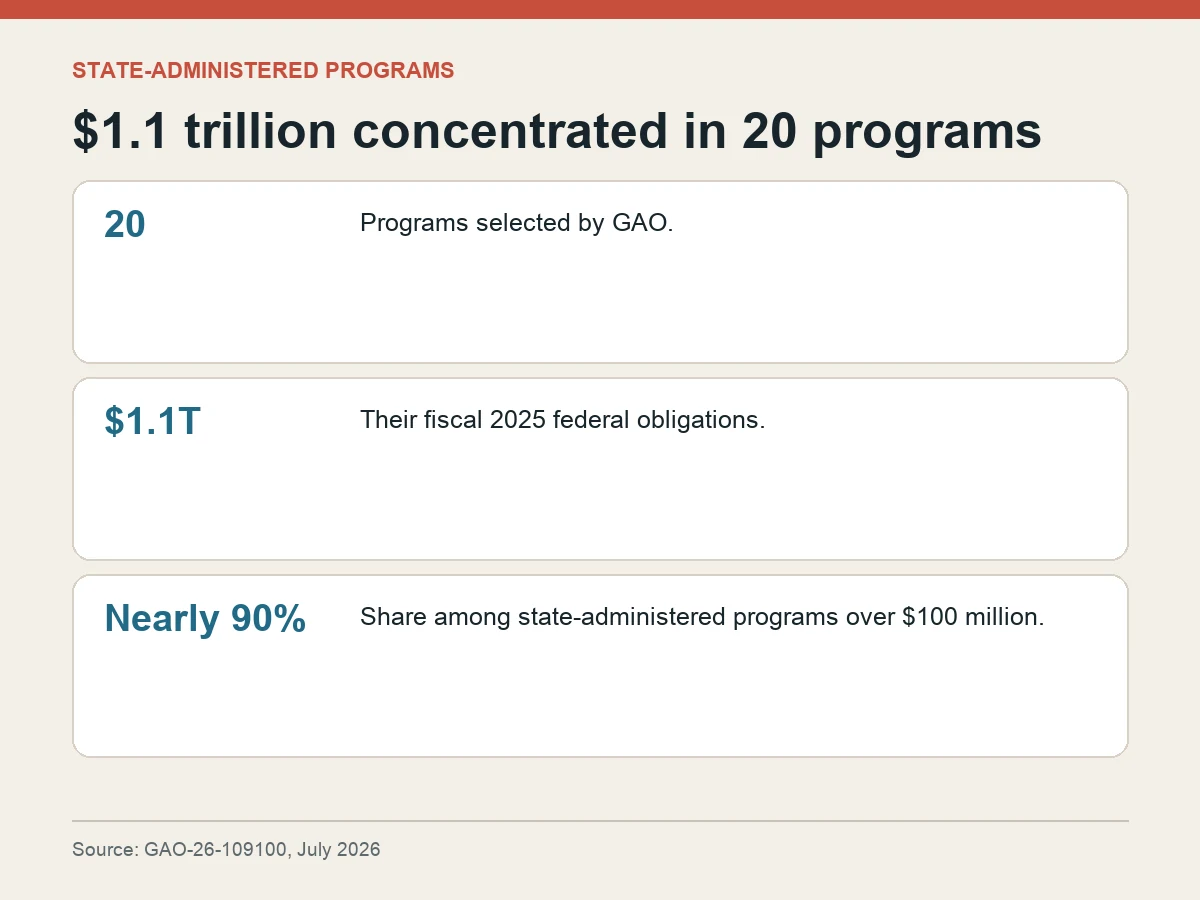
Twenty of the largest federally funded programs administered by states and other governments accounted for $1.1 trillion in obligations last year, but only five documented the fraud-risk assessment work federal auditors looked for, according to a Government Accountability Office review.
GAO selected programs with more than $100 million in fiscal 2025 obligations. Together, the 20 represented nearly 90 percent of obligations in that universe. They span health care, nutrition, housing, education, transportation and disaster assistance, including Medicaid and the Supplemental Nutrition Assistance Program.
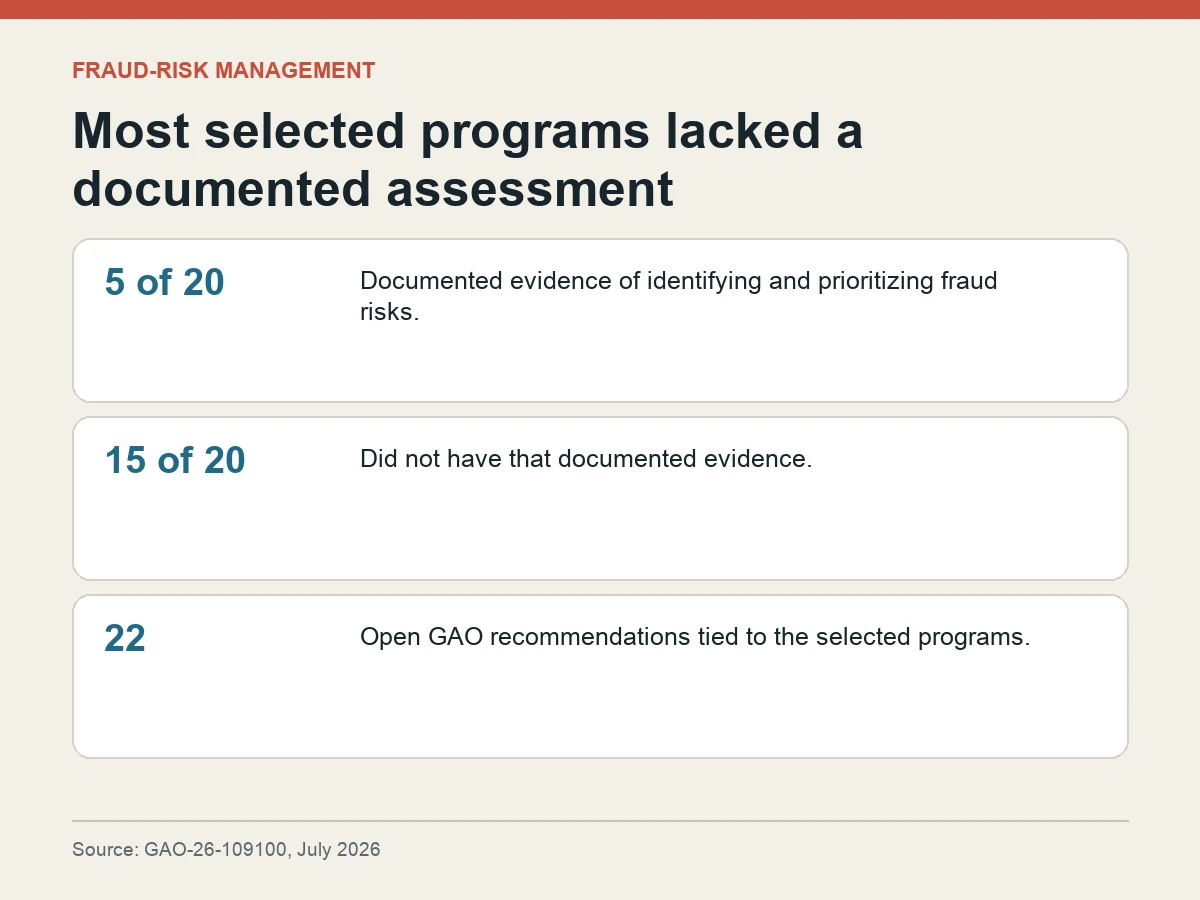
The concentration makes basic controls consequential. Of the 20 programs, five documented evidence consistent with identifying risks and assessing their likelihood so officials could prioritize action. The other 15 lacked that documented evidence, GAO said. That finding concerns a management process; it does not establish that fraud occurred in any particular program.
The delivery chain is unusually distributed. Federal agencies fund programs that states, local governments, subrecipients and contractors may help operate. That structure can improve reach and local delivery, but it also creates more points where false identities, ineligible payments, contractor schemes or manipulated records can enter.
GAO recommended applying its Fraud Risk Framework and improper-payment practices, using federal analytics such as the Do Not Pay program to verify identity and eligibility, and implementing recommendations from inspectors general and other oversight bodies. Twenty-two recommendations tied to fraud-risk management in the selected programs remained open.
The report gives concrete examples of risks identified in prior cases and audits, from falsified permits in an airport project to unreported income in housing assistance and allegedly fraudulent student-aid applications. Those examples illustrate possible schemes; they are not evidence that every program in the review has the same exposure.
The scale figures also require separation. GAO estimates that the federal government as a whole loses $233 billion to $521 billion annually to fraud, based on fiscal 2018 through 2022 data. That is a government-wide estimate, not a loss total for these 20 programs and not a percentage that can be mechanically applied to $1.1 trillion.
For the review, auditors analyzed USAspending.gov data, laws, regulations, agency records, inspector-general and state audit work, adjudicated Justice Department cases and research on fraud controls. The result is a map of where safeguards are documented and where evidence is missing—not an accusation against beneficiaries or administrators.
The practical finding is narrower but important: huge programs can distribute essential services through many layers while still lacking a documented, prioritized view of fraud risk. Closing that management gap would not eliminate fraud, but it would give agencies a clearer basis for prevention, analytics and oversight.