
A Texas producer recalled 1,589,577 dozen shell eggs—roughly 19.1 million individual eggs—after environmental monitoring found a potential for Salmonella Enteritidis contamination, according to a company announcement posted by the Food and Drug Administration.
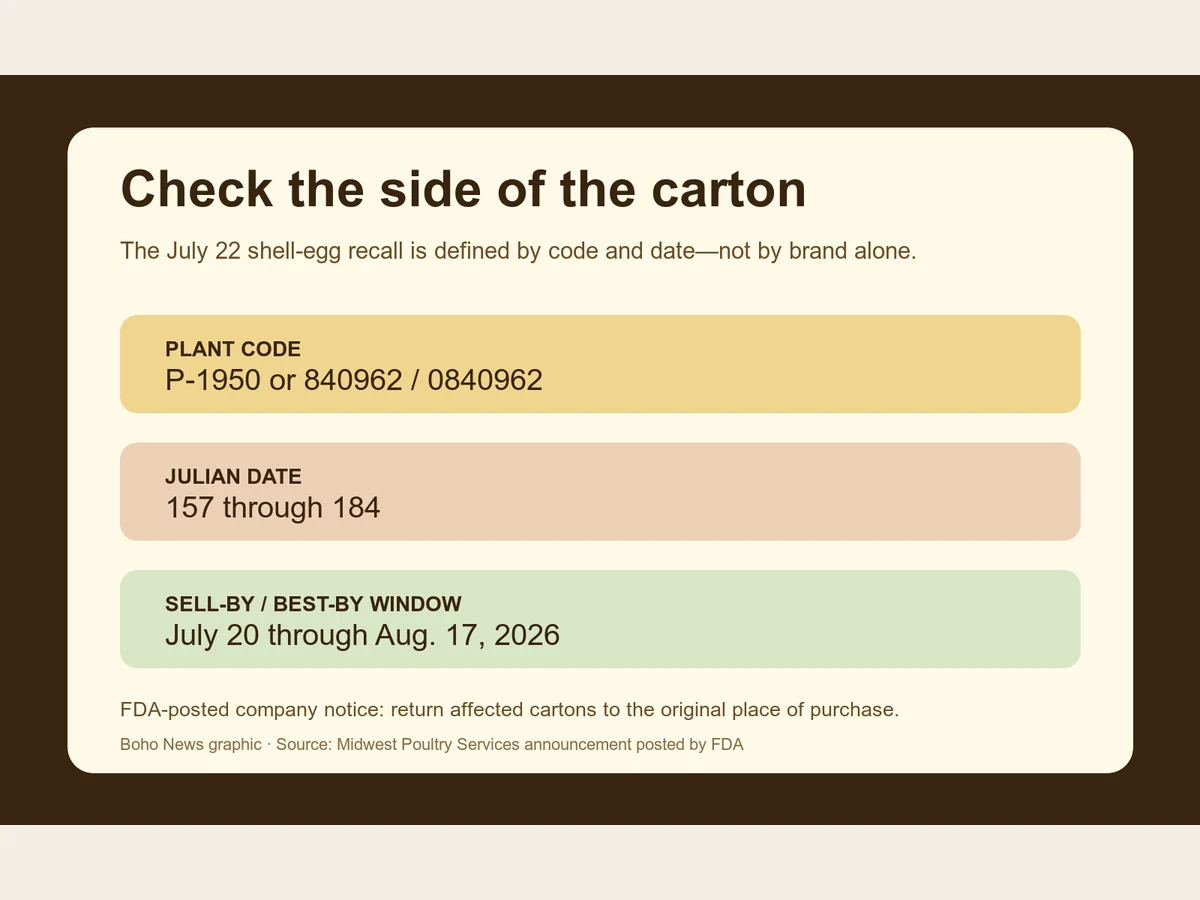
The recall is broad enough to cross brands and package sizes, but it is not a recall of every Kroger, Simple Truth, Brookshire’s, Country Morning or Sunups carton. The controlling identifiers are printed on the side: plant code P-1950 or the numeric code printed as 840962 or 0840962, plus a Julian date from 157 through 184.
Affected cartons have sell-by or best-by dates between July 20 and Aug. 17, 2026. The notice says the eggs were produced at two Texas farms and distributed between June 6 and July 3.
Where the eggs went
Midwest Poultry Services says the eggs went to foodservice and retail customers in Texas, Oklahoma and Louisiana. The notice separately identifies Kroger stores in Texas and Louisiana and Brookshire Grocery stores in Texas, Oklahoma, Arkansas, Louisiana, New Mexico and Mississippi, along with smaller outlets.
That does not mean every carton sold in those states is included. Distribution geography is a first screen; the side code and date are the decisive check.
The list covers retail and bulk cases
The FDA-posted table lists Kroger cartons containing 12, 18, 30 and 60 eggs across large, extra-large, medium and jumbo grades. It also lists Simple Truth cage-free brown eggs in 12-, 18- and 24-count packages.
Brookshire’s entries range from six eggs to 60. Country Morning entries include 12-count, 18-count and 2½-dozen packages. The table also includes a Sunups 2½-dozen package and several 15- or 30-dozen bulk foodservice cases.
The published list contains 33 product rows. Some use UPCs; bulk foodservice cases are marked without a UPC. Every row uses the Julian range 157 to 184 and the July 20–Aug. 17 date window.
What the notice says about the investigation
The company says it identified the issue through environmental monitoring and a root-cause analysis at its two Texas farms. It says it is not distributing fresh eggs produced at those farms while the recall is active.
The announcement says Midwest Poultry Services was not aware of any specific illnesses linked to its products when the notice was published July 22. That is a company statement posted by FDA, not proof that no later reports will emerge.
FDA explicitly labels the page a company announcement and says posting it does not constitute agency endorsement. The recall reason on the federal page is the potential for Salmonella Enteritidis contamination.
The practical check takes three fields
The notice urges consumers not to eat affected products and to return them to the original place of purchase for a refund. The essential comparison is three-part: plant code, Julian date and sell-by or best-by date.
A brand match without those code and date matches is not enough to identify an affected carton. Conversely, a matching code and date should not be dismissed because the package size or store looks unfamiliar; the recall includes foodservice bulk cases as well as household cartons.
The recall quantity converts to 19,074,924 eggs if expressed as individual units. That arithmetic communicates scale, but the company reported the official quantity in dozens, and the carton codes—not the converted total—are what shoppers can use.