Four Senate Democrats reintroduced a proposal July 22 that would create a new Supreme Court appointment every two years and limit participation in the Court’s appellate docket to the nine most recently appointed justices.
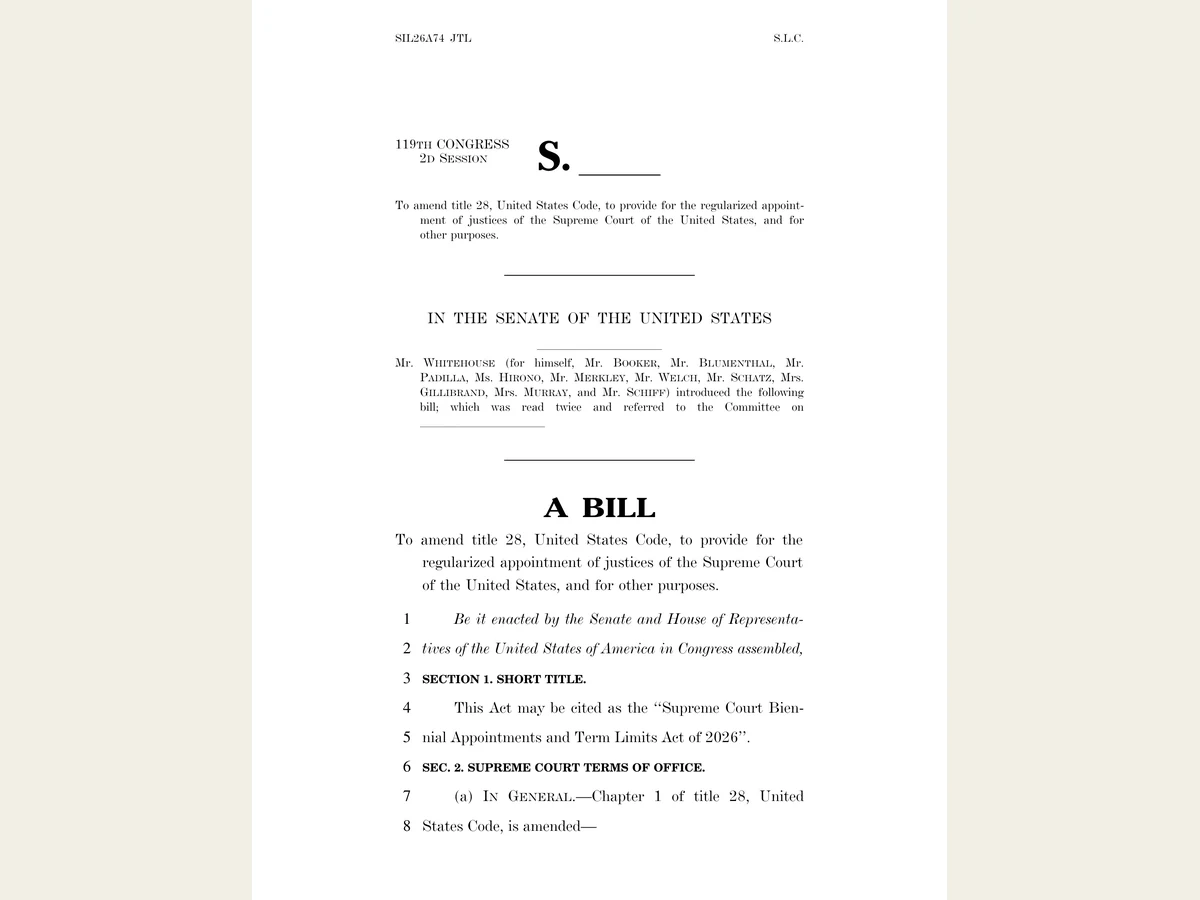
Sens. Sheldon Whitehouse of Rhode Island, Cory Booker of New Jersey, Richard Blumenthal of Connecticut and Alex Padilla of California announced the Supreme Court Biennial Appointments and Term Limits Act of 2026. Seven additional Democratic senators are listed as cosponsors in the draft released by Whitehouse’s office.
The proposal is commonly described as an 18-year term-limit bill, but its legal design is more specific. It would not remove a justice from federal judicial office after 18 years.
| Stage | Proposal |
|---|---|
| Regular appointments | One appointment in the first and third years of each presidential term |
| Active service | 18 years for a new justice |
| After active service | Senior status with limited duties |
| Transition | Existing justices move to senior status in order of service as new justices are appointed |
Instead, only the nine most recently appointed justices who are available would hear cases within the Supreme Court’s appellate jurisdiction. Justices outside that group would continue to hear cases within the Court’s original jurisdiction and could perform other duties required by law.
The practical result would ordinarily give a justice 18 years on the full appellate docket if a new appointment occurs every two years.
The bill would require the president to nominate one Supreme Court justice within the first 120 days of the first and third years of a presidential term, subject to Senate confirmation.
It contains procedures for withdrawn or rejected nominations and for filling vacancies when fewer than nine justices remain.


The proposal would not take effect immediately. The draft says it would begin with the first full presidential term starting after enactment.
Supporters say regular appointments would reduce the political stakes of unpredictable vacancies and prevent a single appointment from shaping the Court for several decades.
The constitutional argument is less settled than the sponsors’ announcement suggests.
Article III says federal judges hold their offices during good behavior, a foundation for life tenure unless a judge retires, resigns, dies or is removed through impeachment. The proposal attempts to preserve that tenure by leaving every justice in office while changing which justices hear appellate cases.
The Constitution also gives Congress authority to make exceptions and regulations concerning the Supreme Court’s appellate jurisdiction. The sponsors rely on that power to argue that Congress can structure participation in appellate cases without constitutionally removing a justice.
Opponents are likely to argue that Congress cannot use its jurisdictional authority to achieve indirectly what would otherwise require a constitutional amendment, especially if the law effectively displaces a sitting justice from the Court’s central work.
That dispute has not been conclusively resolved by the Supreme Court. Similar reform proposals have been debated by scholars and lawmakers, but this specific statutory structure has not been tested through a final judgment.
The draft also raises operational questions. It would allow a justice who ordinarily hears only original-jurisdiction cases to substitute when an active-docket justice is unavailable because of disability, recusal or disqualification.
The measure does not guarantee that the Senate will confirm a nominee on schedule. It requires presidential appointments but cannot erase the Senate’s advice-and-consent power or political conflict over confirmation.
The proposal’s future is uncertain in the current Congress. The announcing senators are Democrats, and the release identifies no Republican sponsor.
Even without immediate passage, the bill defines one of the principal statutory approaches to Supreme Court term limits: preserve formal life tenure, regularize appointments and use appellate jurisdiction to rotate the nine-justice active docket.