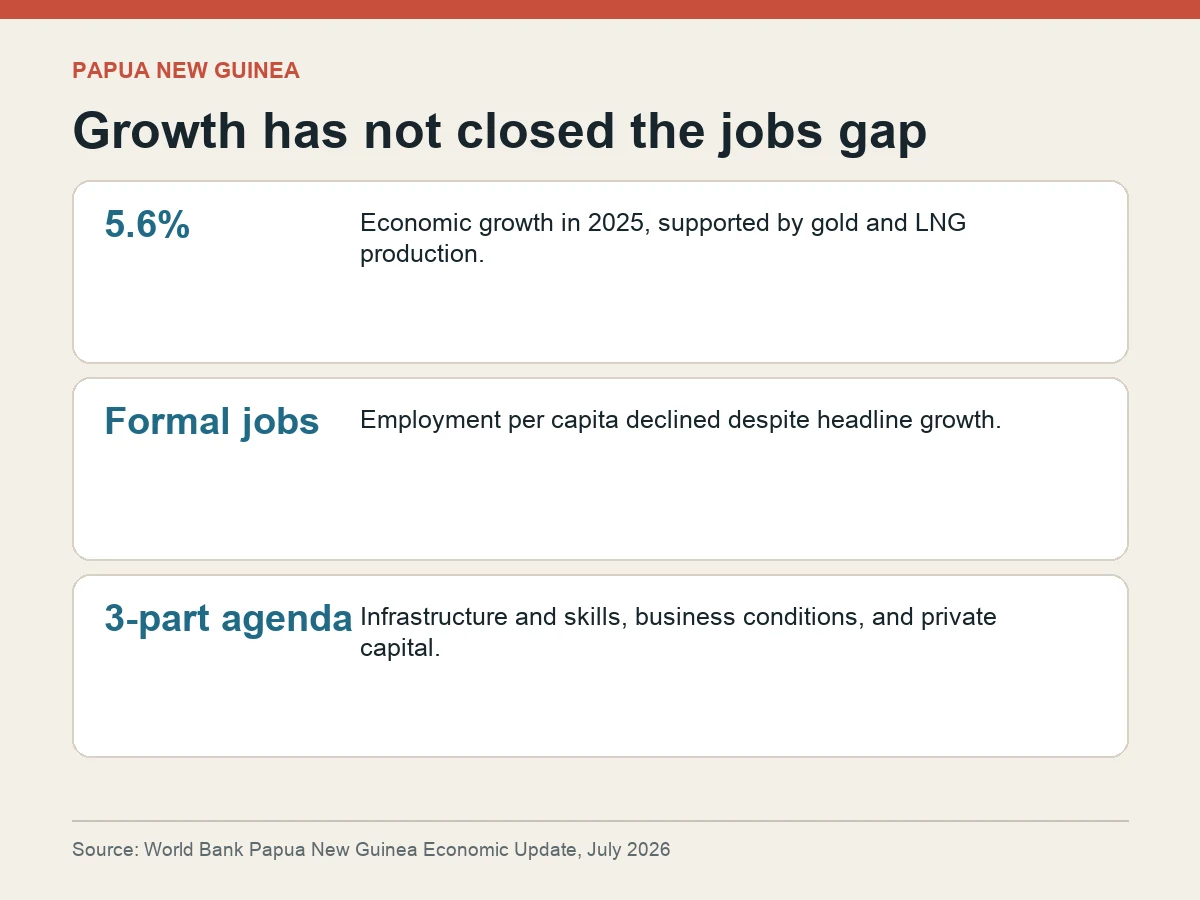
Papua New Guinea’s economy expanded 5.6 percent in 2025, one of the strongest rates in the Pacific, but formal employment per person continued to decline, according to a new World Bank economic update.
The rebound was supported by gold and liquefied-natural-gas production and exchange-rate reforms that improved conditions beyond the resource sector. Headline growth, however, did not produce enough secure work for the country’s fast-growing labor force.
The World Bank found that many new workers entered subsistence farming or informal activity instead of formal jobs. That makes the central policy problem a conversion gap: resource-led output is rising faster than the number of documented, stable employment opportunities.
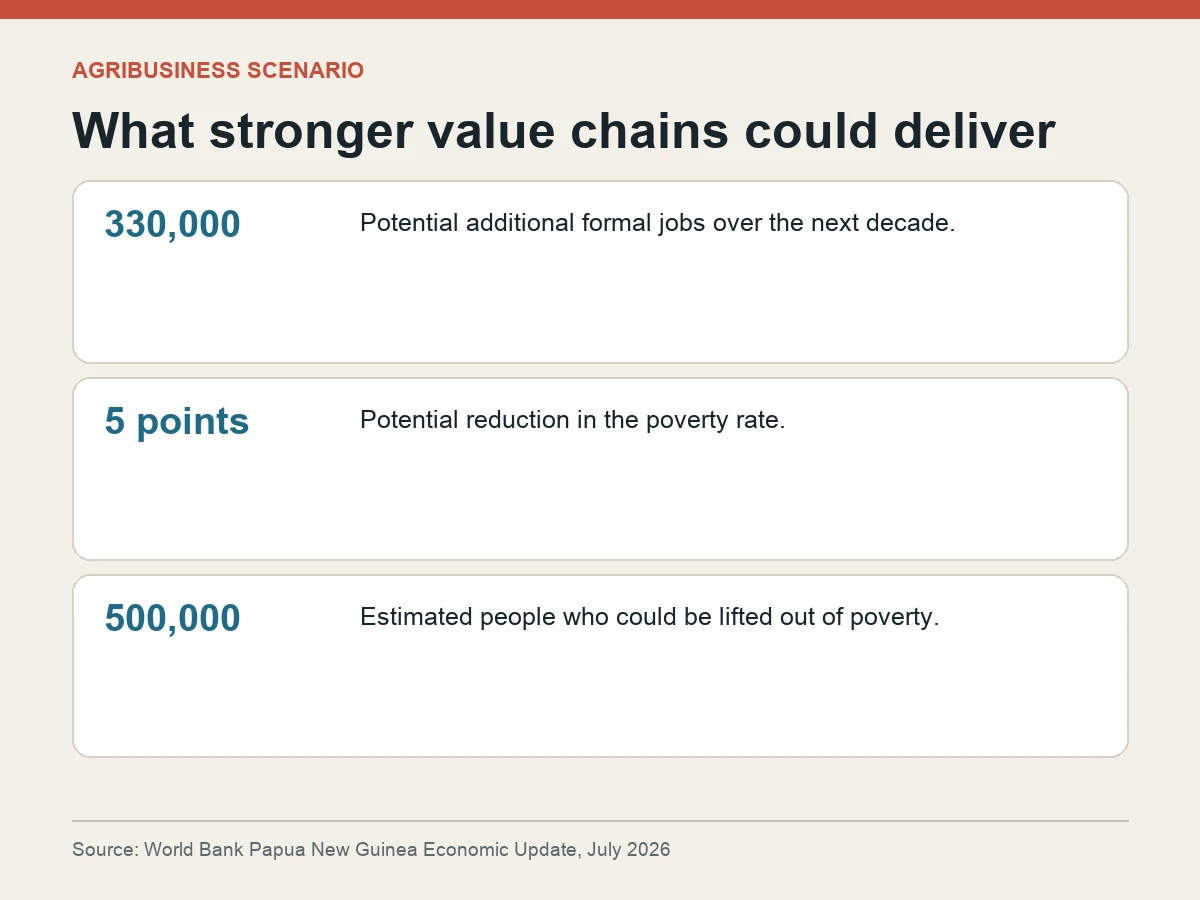
Agribusiness is the report’s largest quantified opportunity. Stronger agricultural value chains could generate about 330,000 additional formal jobs over the next decade, reduce poverty by roughly five percentage points and lift an estimated half-million people out of poverty.
Those figures are a modeled scenario, not current results. Reaching them would require productivity, processing, market access and investment improvements across value chains; none of the 330,000 jobs should be counted before they exist.
The report organizes its response around three areas. The first is stronger infrastructure and human capital. The second is a more predictable business environment and better economic governance. The third is mobilizing private capital while using resource revenue more effectively.
Roads, electricity and digital connectivity are especially important outside Port Moresby and Lae. Nutrition, education and skills investment are the other side of the same constraint because firms need both reliable infrastructure and workers prepared for more productive employment.
Large resource projects could add momentum, including Papua LNG and Wafi-Golpu. They also sharpen the revenue question: agreements and public institutions have to convert resource income into national priorities if extraction is to support broader employment rather than another isolated growth cycle.
The report’s message is therefore not that growth is unreal. The 5.6 percent expansion is the starting fact. The warning is that GDP, formal employment and household welfare are moving on different tracks—and that infrastructure, agribusiness and governance determine whether they converge.