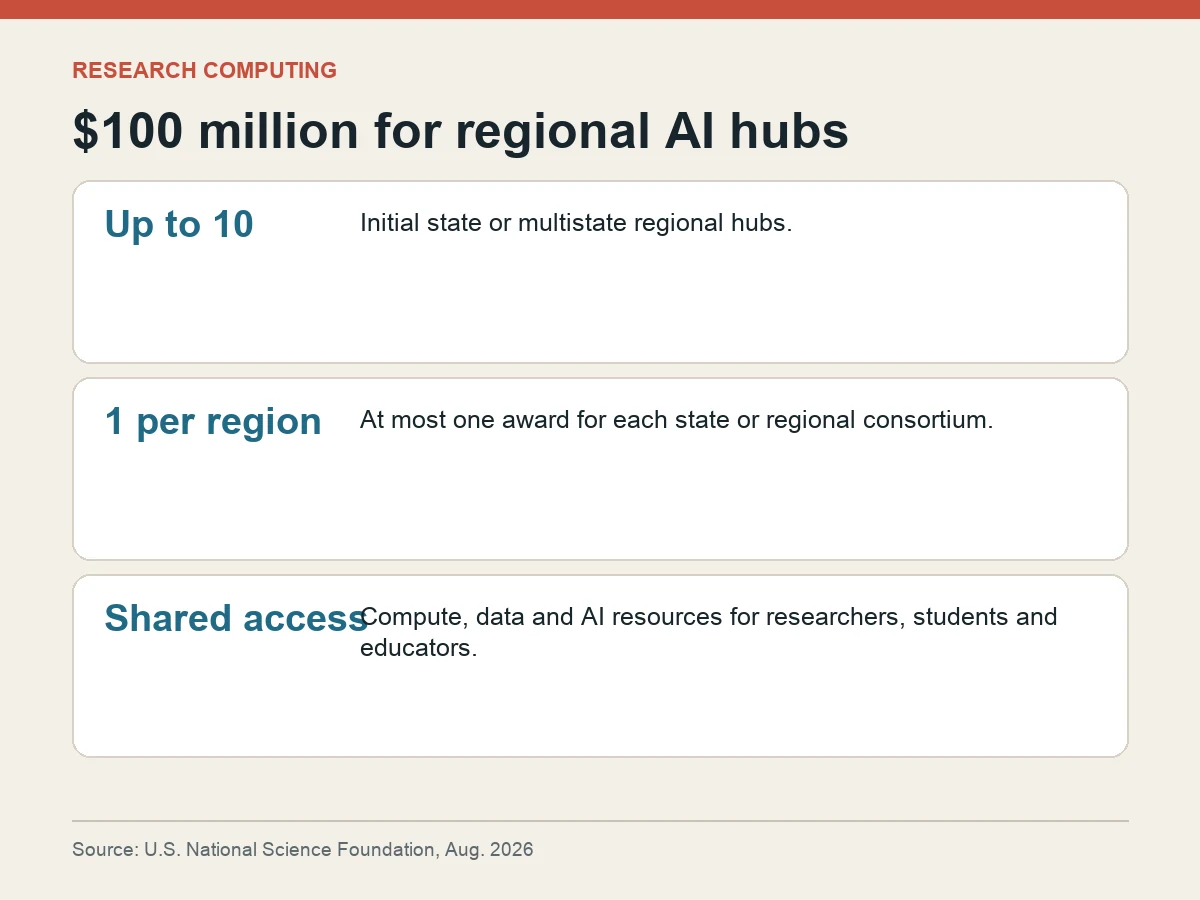
The National Science Foundation launched a $100 million program to establish shared artificial-intelligence computing hubs across states and multistate regions, aiming to give more researchers, students and educators access to advanced compute and data.
NSF will initially support up to 10 State and Regional Artificial Intelligence Infrastructure Hubs, with no more than one award for a state or regional consortium. The announcement opens a competitive program; it does not mean 10 operating centers already exist.
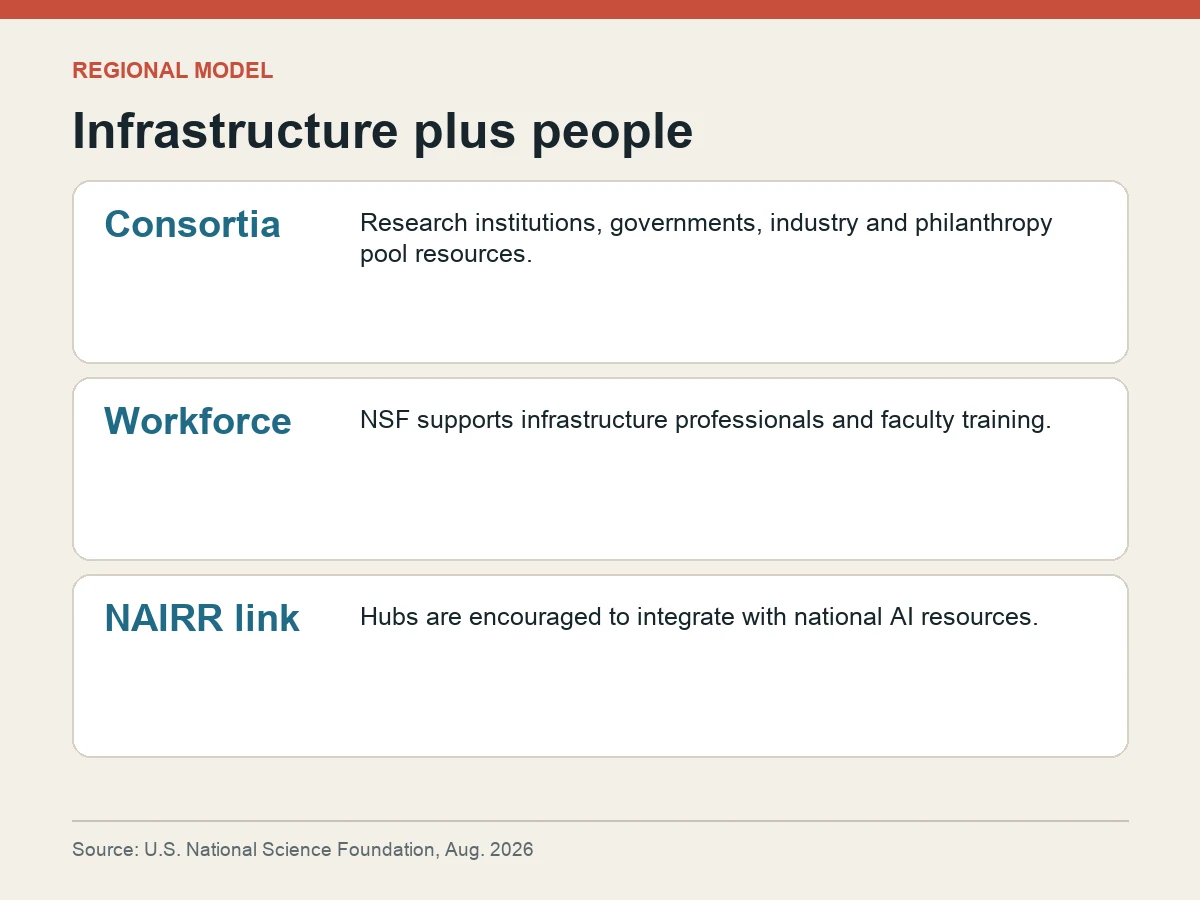
Each hub is designed to combine research institutions with state and local governments, private companies and philanthropic organizations. The partners would pool hardware, funding and expertise to build and operate scientific computing capacity that a single university or locality might not sustain alone.
The federal role extends beyond purchasing machines. NSF says its investment will support consortium coordination, professionals who operate AI infrastructure, faculty and educator training, and curriculum development so researchers and students can use compute, data and software systems effectively.
That distinction matters because access problems are not purely physical. A powerful cluster without staff to maintain it, software to connect researchers, training to design responsible workflows or governance to allocate capacity can remain inaccessible to the communities the program is meant to serve.
The hubs are encouraged to integrate with the NSF-led National Artificial Intelligence Research Resource, allowing them to share datasets and draw on national capacity when local resources are insufficient. NSF also points participants toward existing research-computing networks and its AI workforce initiatives.
Regional industry is expected to help align training with local job needs. NVIDIA, AMD, Intel, Dell Technologies, Hangar and the Secunda Innovation Fund are among the companies and philanthropies that NSF said intend to support participants, though the announcement assigns no guaranteed dollar amount to those contributions.
The $100 million headline is the program total, not a promise of equal $10 million allocations. Final award sizes, consortium matches, technical designs and locations will depend on the competition and the proposals NSF selects.
The initiative tests a regional answer to a national bottleneck: frontier AI research increasingly requires expensive compute, specialized data systems and skilled operators. If the consortia work as designed, access will be distributed through shared infrastructure and people; until awards are made and systems become usable, that remains the program’s objective rather than a delivered result.