The National Science Foundation awarded $83 million for a new layer of research infrastructure intended to connect scientific datasets with computing systems and artificial-intelligence tools, rather than leaving researchers to assemble those links project by project.
The Integrated Data Systems and Services program includes two awards for national-scale systems. Fabric for AI-Driven Science, led by the Morgridge Institute for Research, will build a data fabric connecting repositories and computing resources. The National Data Platform, led by UC San Diego, will integrate distributed data, facilities and AI resources.
Four more projects are moving toward national operations. UCLA’s Interactive Discovery Laboratory will offer browser-based access to computing and data; UC Irvine’s BRIDGE will support reusable workflows; Tennessee’s National Science Data Fabric will connect distributed data; and Arizona’s MESA will use metadata automation to organize cross-disciplinary datasets.
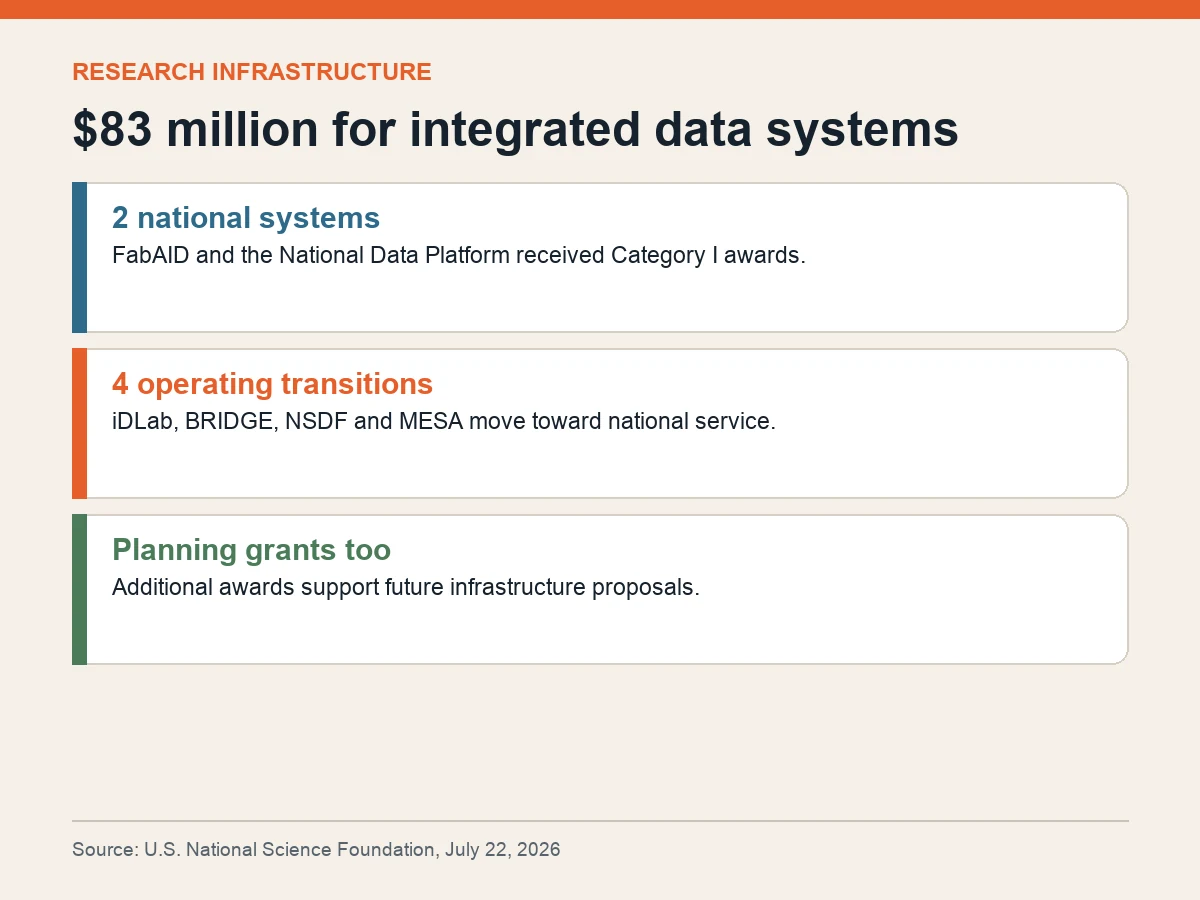
NSF also issued planning grants for future infrastructure proposals. The announcement reports an $83 million portfolio total but does not imply that each project received an equal share.
The technical goal is interoperability: data, instruments, software, models and computing resources should be discoverable and usable together. That matters for AI research because large models and automated workflows require data with enough metadata, access controls and consistency to be reused reliably.
The agency frames the awards as complementary to the National Artificial Intelligence Research Resource and other cyberinfrastructure investments. In that architecture, computing capacity is only one layer; researchers also need stable paths to the data that trains, tests or feeds scientific models.
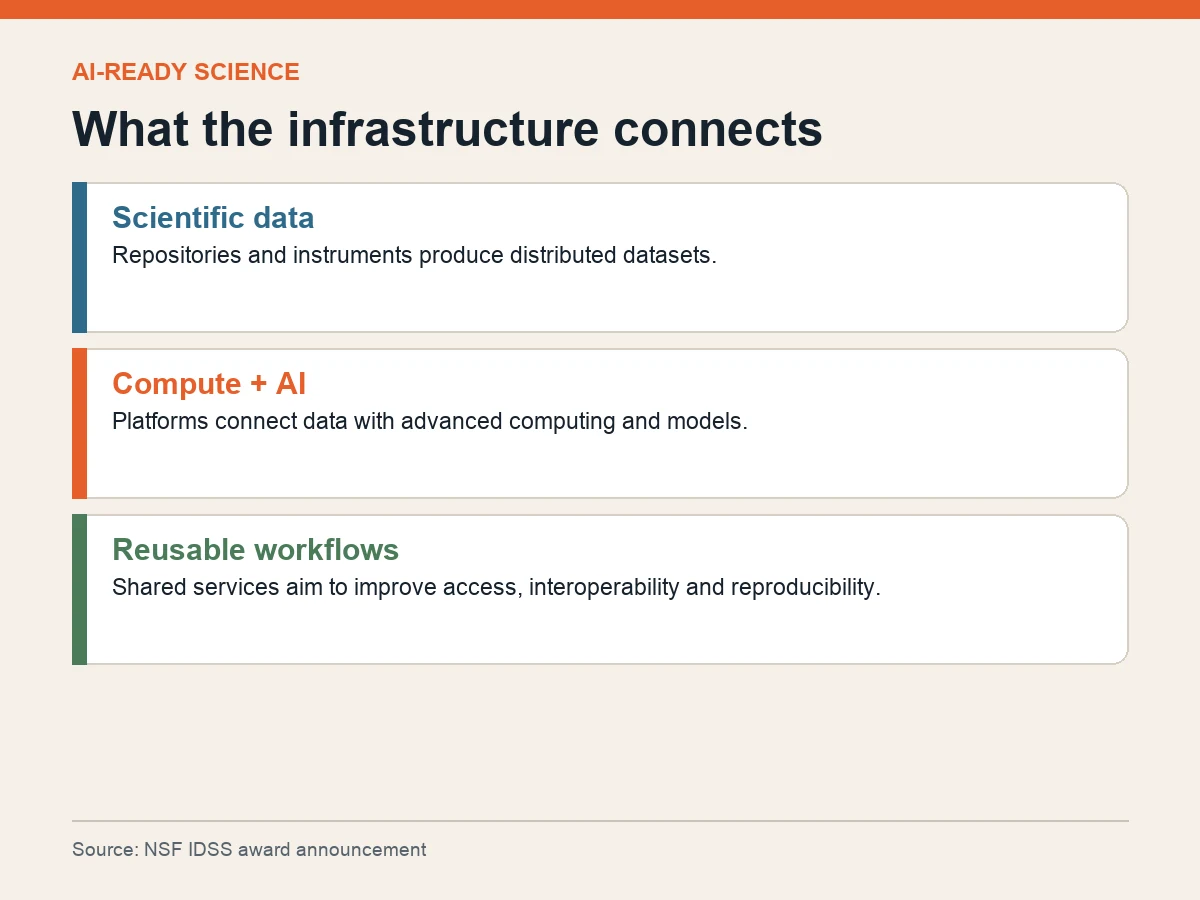
Reproducibility is another stated target. Shared platforms can preserve workflows and make it easier for a second team to find the same data and rerun an analysis, although software versions, permissions and discipline-specific standards still affect whether replication succeeds.
The award announcement describes intended capabilities, not completed national services. The named institutions must still build, integrate and operate the systems, attract users and demonstrate that distributed data can move through the proposed workflows without creating new bottlenecks.
If implementation works, the practical change will be mundane but consequential: scientists should spend less time locating, cleaning and moving data between incompatible systems, and more time testing questions with traceable inputs and reusable methods.