
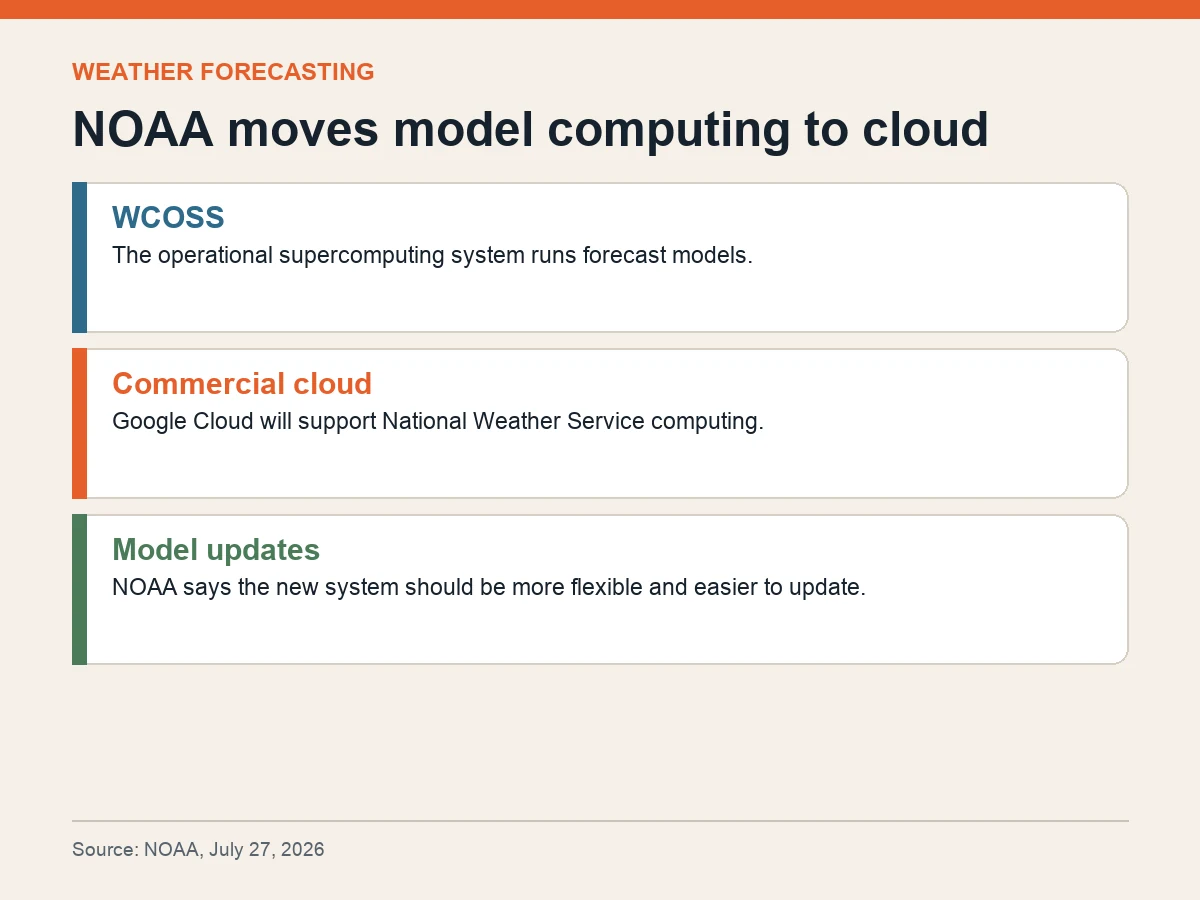
NOAA is moving the high-performance computing behind its operational weather forecast models to commercial cloud infrastructure, with Google Cloud supporting National Weather Service systems under a transition announced July 27.
The change centers on the Weather and Climate Operational Supercomputing System, the computing environment used to run numerical models that turn observations and physical equations into forecast guidance.
NOAA says the new architecture should be more flexible and easier to update. Commercial cloud capacity can be provisioned differently from fixed agency-owned machines, potentially giving model teams more options when testing or scaling workloads.
The announcement does not quantify a forecast-accuracy gain, cost savings or a final migration date. Those omissions matter because a platform change is an infrastructure decision, not evidence that every resulting forecast will immediately improve.
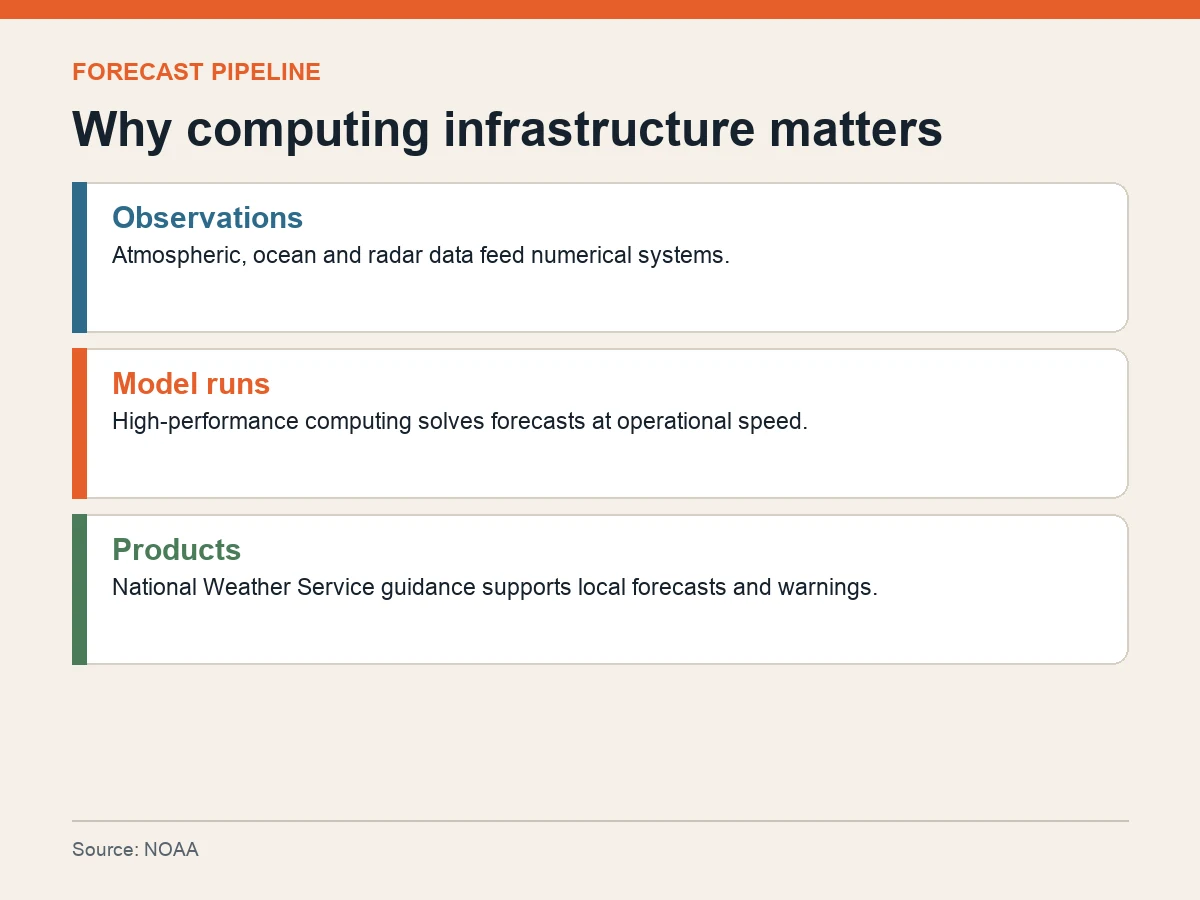
Forecast skill depends on more than processors. Satellites, radar, surface stations, balloons, buoys and aircraft supply observations. Data-assimilation systems combine those inputs, numerical models calculate possible atmospheric states, and forecasters interpret guidance for local products and warnings.
Cloud computing changes the model-run layer of that chain. It does not replace observation networks or National Weather Service forecast offices, and it does not remove scientific uncertainty from predicting a chaotic atmosphere.
Operational reliability will be central. Weather guidance runs on strict schedules, and missed delivery windows can reduce the value of even a sophisticated model. NOAA will need capacity, network performance, security and continuity controls that support recurring national workloads.
Update speed is another test. Forecast systems evolve through new physics, data sources, resolution and software. NOAA’s stated goal of an easier-to-update environment will be meaningful only if validated changes can move into operations without sacrificing reproducibility or uptime.
The public should therefore judge the transition by evidence released after migration: stable model cycles, documented upgrades, latency, cost, outage handling and independently measured forecast skill.
The immediate news is narrower but consequential. NOAA is changing the computing foundation beneath national weather prediction, choosing commercial cloud support for a workload that feeds daily forecasts and warnings across the country.