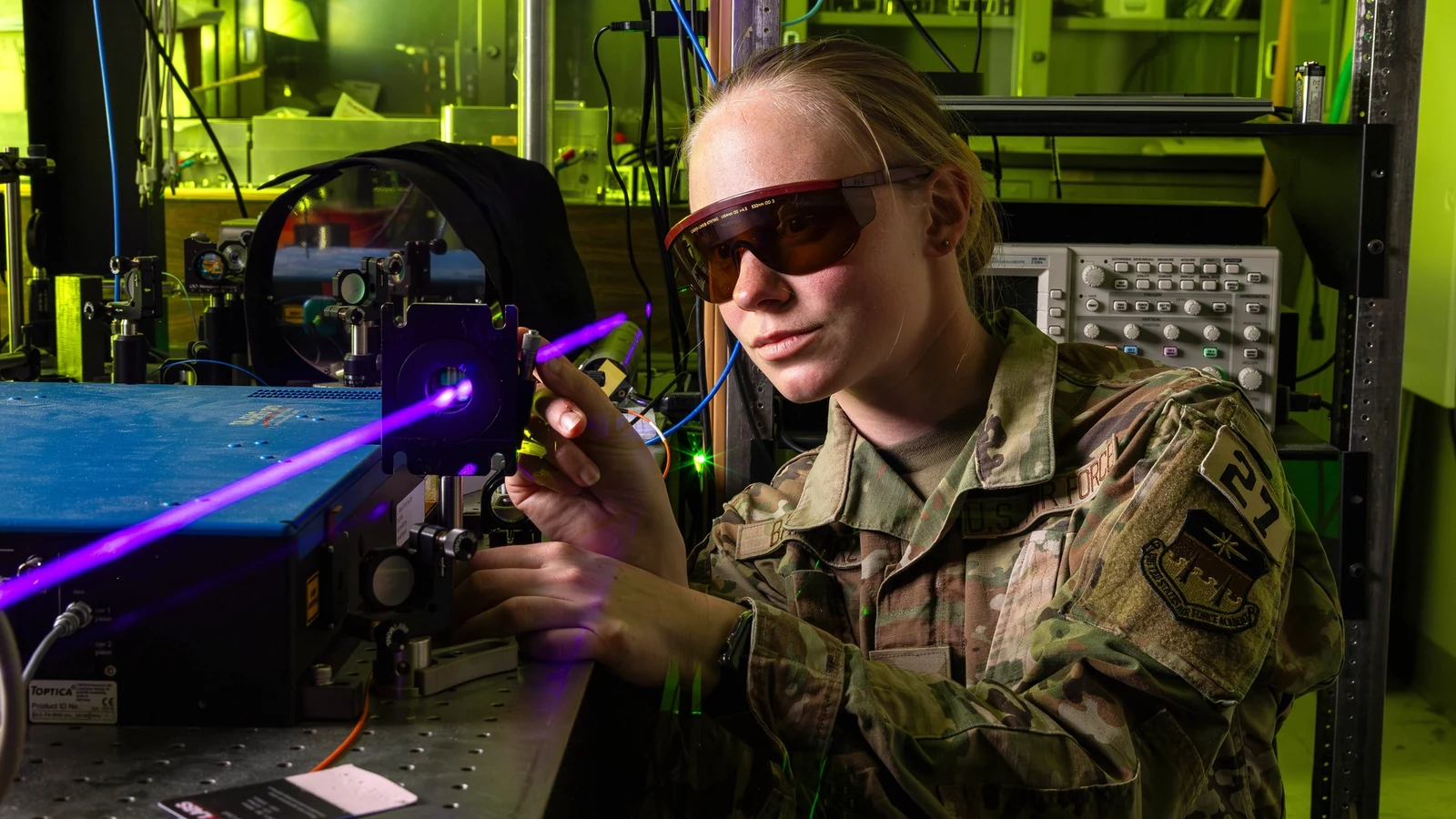
The National Institute of Standards and Technology plans an initial $20 million investment in a new center intended to move quantum hardware from specialized laboratory builds toward repeatable manufacturing.
Under an agreement announced June 29, SRI will establish the Quantum Manufacturing Extension Center. NIST said the center will focus on scalable, high-performance components and systems rather than selecting one winning quantum-computing architecture.
Quantum manufacturing has a different bottleneck from proving that a device can work once. Components must be produced with sufficiently consistent dimensions, materials and interfaces that performance survives across many units and through assembly into a larger system.
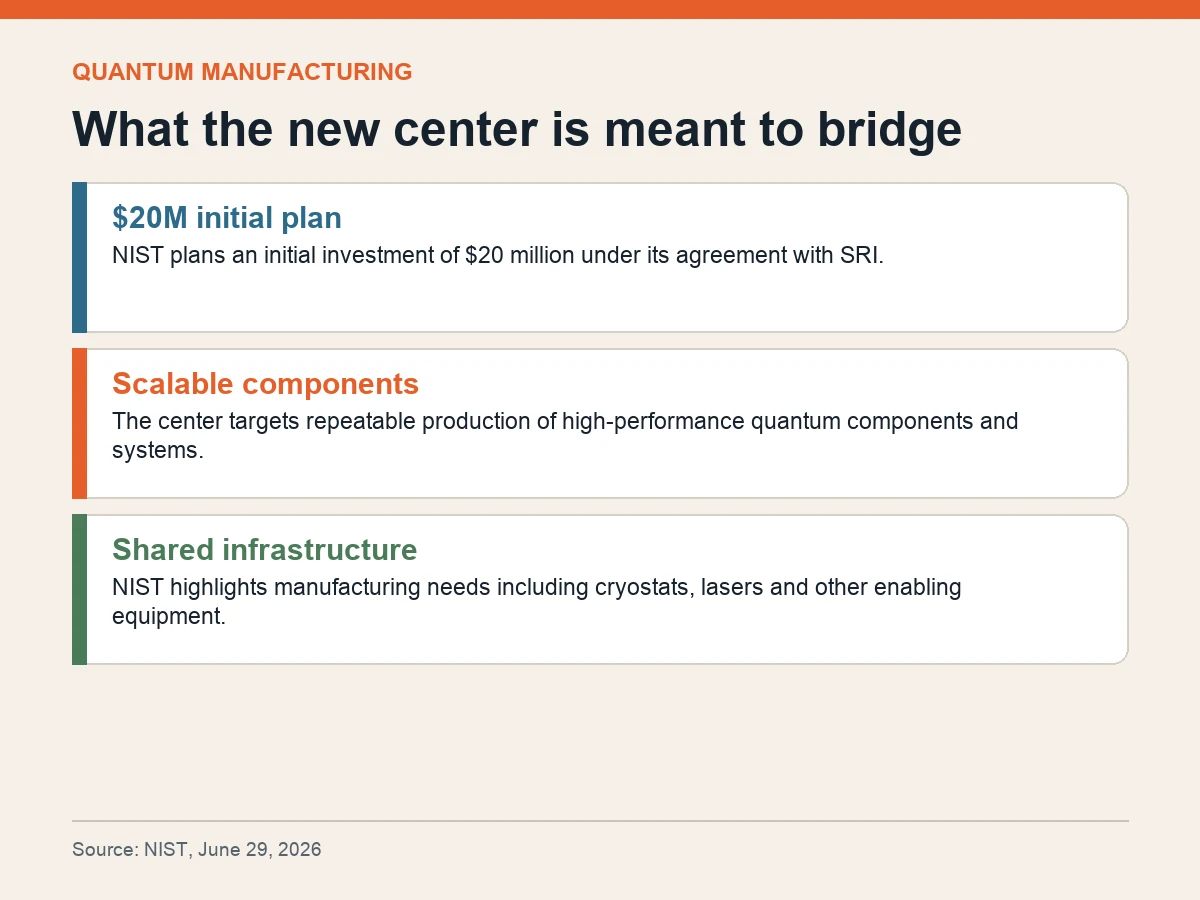
The center’s scope includes enabling infrastructure. NIST specifically pointed to cryostats, which maintain extremely low temperatures for some quantum devices, and lasers used to prepare, control or measure quantum states. Those tools can be as consequential to scale as the qubits or sensors themselves.
SRI is expected to convene developers, manufacturers and users around shared production problems. That model can expose gaps that a single laboratory may not see, including unavailable suppliers, incompatible specifications, slow test cycles and the absence of trusted measurement methods.
The effort builds on the Quantum Economic Development Consortium, a NIST-supported public-private partnership that began in 2019. QED-C participants include technology developers and prospective end users, giving the new center a network through which to identify manufacturing priorities.
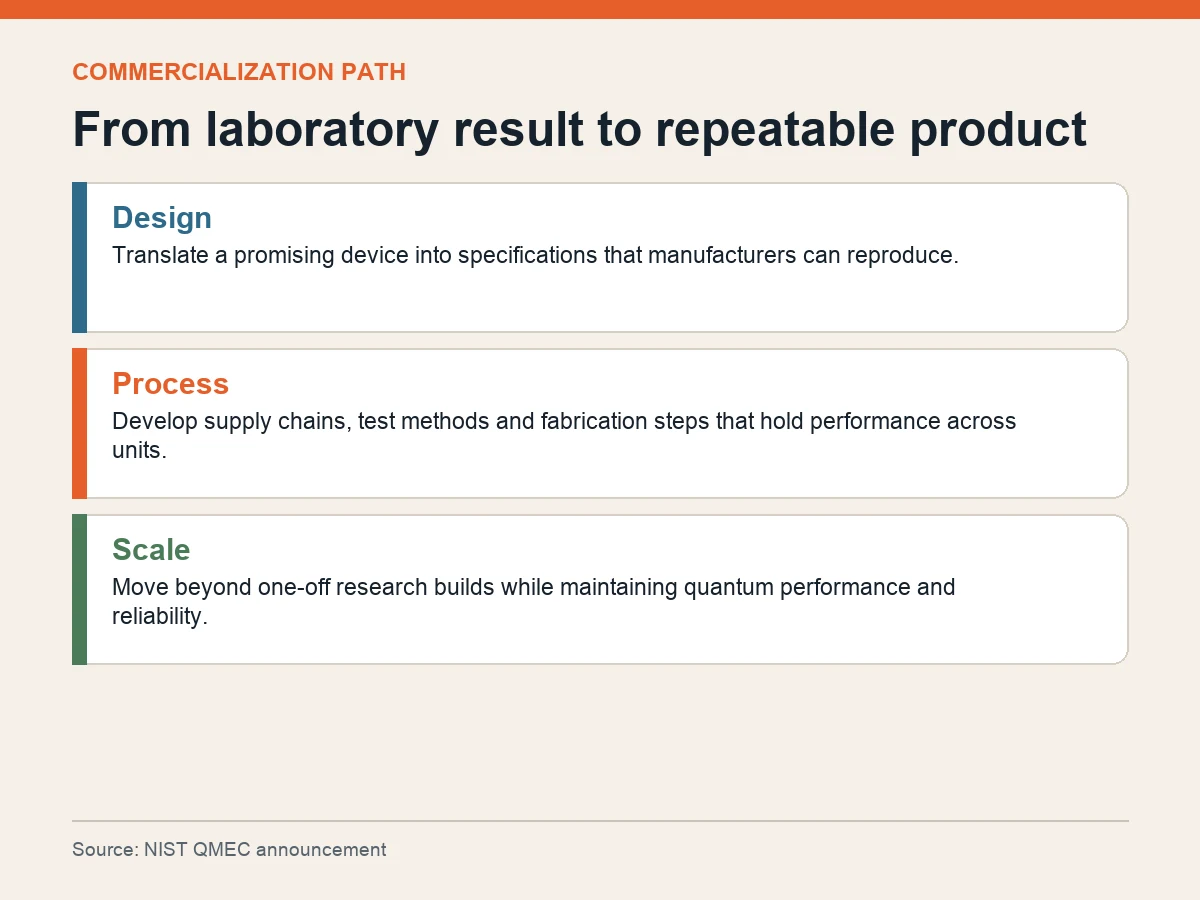
The announcement is a capacity-building decision, not evidence that mass-produced quantum computers are imminent. NIST did not publish a factory-opening date, unit-cost target or production forecast, and different quantum technologies require different materials and operating environments.
The $20 million figure is also framed as an initial planned investment. It should not be treated as the center’s lifetime budget or as money already converted into equipment and commercial products.
The strategic bet is that shared manufacturing knowledge can shorten the distance between a research result and a reliable product. Success will be visible not only in faster devices, but in reproducible processes, qualified suppliers and measurements that let buyers compare whether components meet their claims.