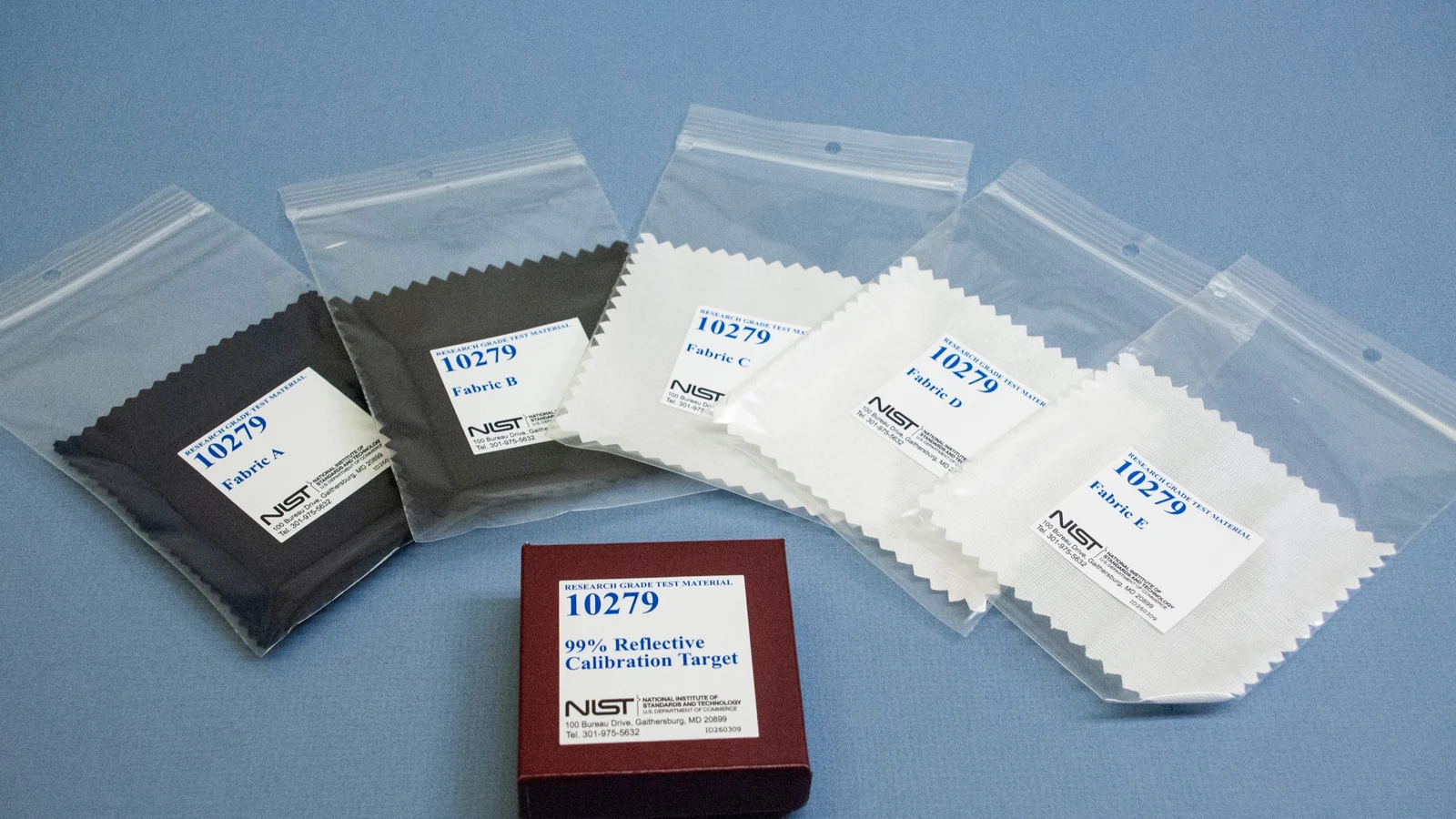
Five squares of fabric—each four inches on a side, some dyed and some undyed—are the center of a National Institute of Standards and Technology experiment in making textile sorting more measurable.
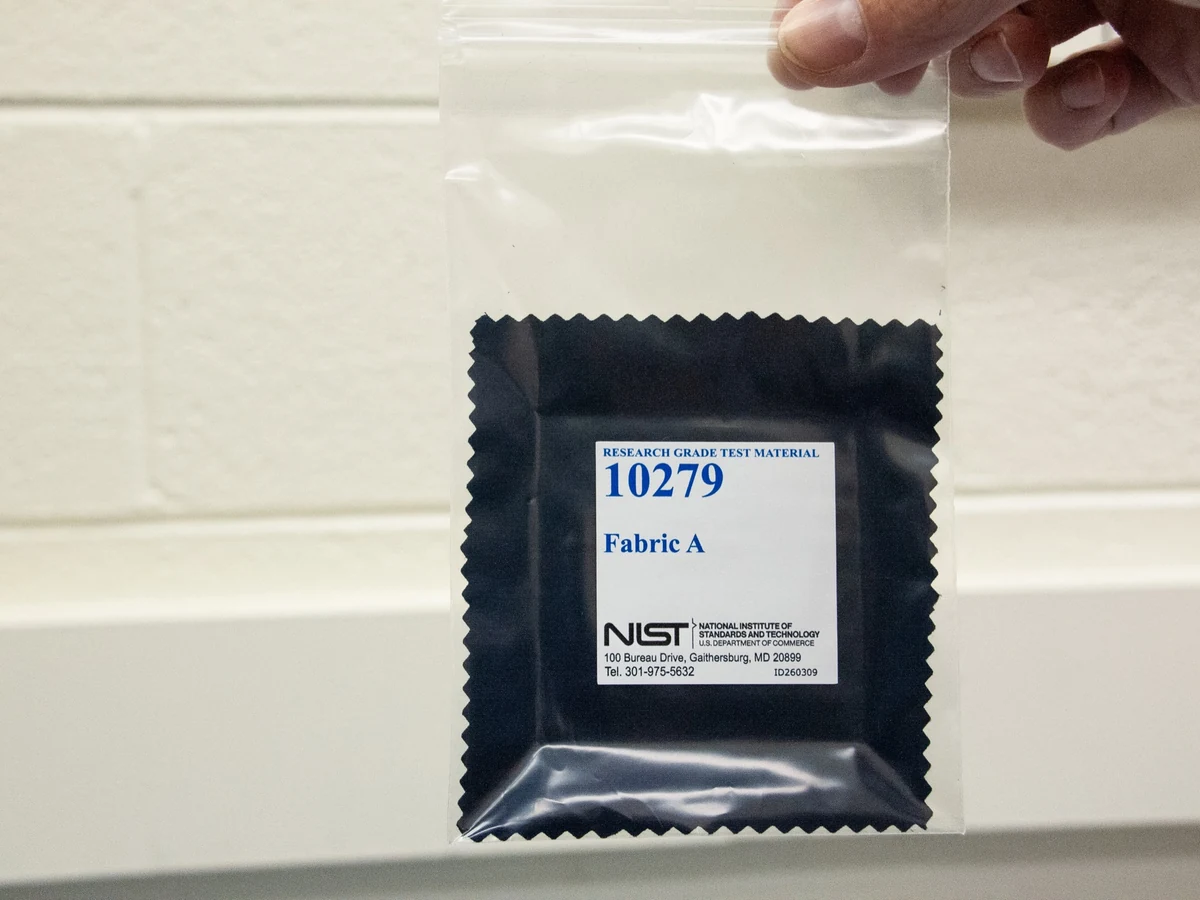
The set is Research Grade Test Material 10279, Textiles for Feedstock Identification. NIST developed it as a common object that laboratories, recyclers and manufacturers can scan with their own equipment, then use to compare how reliably different systems identify fibers.
That comparison matters because textile sorting is increasingly a machine-learning and measurement problem. Clothing can be labeled incorrectly, contain blended fibers or arrive too worn for a tag to settle the question. If one facility's scanner calls a swatch cotton and another reads the same material differently, automated sorting cannot produce a predictable feedstock.
A physical benchmark for machine sorting
A common method is near-infrared spectroscopy. A handheld or conveyor-mounted sensor shines near-infrared light on fabric and records how the material absorbs or scatters it. The resulting spectrum acts like a molecular fingerprint. Classification software then compares that signal with known examples to infer fiber content.
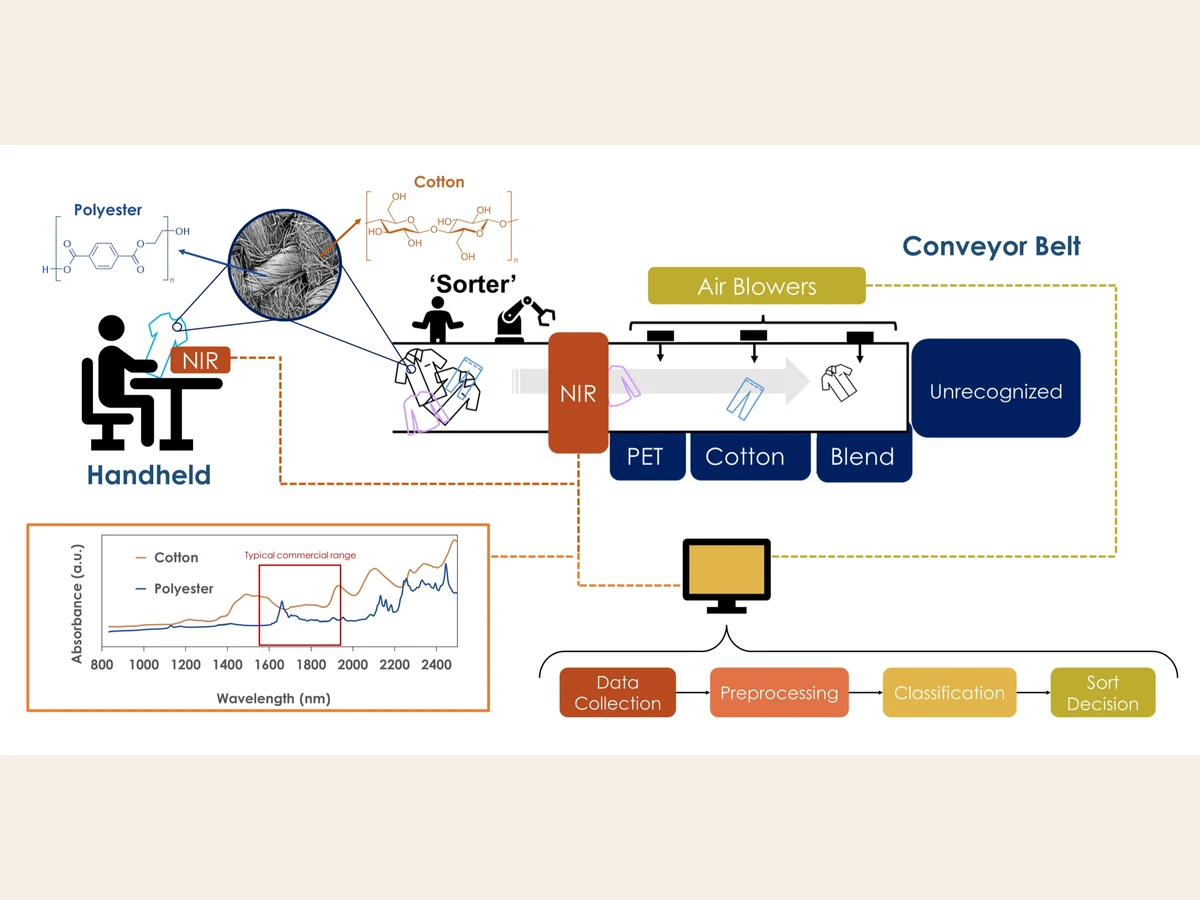
NIST says facilities also use computer vision, which sorts by color and visible appearance, and hyperspectral systems that combine imaging with spectral measurements. The new material is meant to test the measurement layer beneath those tools, not to declare one sorting architecture the winner.
RGTM 10279 contains five fabric types. NIST has deliberately withheld their fiber composition while participating laboratories analyze the squares. That blind structure is the point: researchers can compare reported results without telling participants the answer in advance.
What the study can—and cannot—show
Research Grade Test Materials are faster, more exploratory cousins of NIST's fully characterized standard reference materials. Laboratories receive them in exchange for measurements and feedback that help the agency decide whether the candidate is fit for purpose and what a better-characterized successor should contain.
The agency's study runs through Sept. 30. Its initial free-order window closed July 30. NIST says the results supplied by participating organizations will remain anonymous and will feed into development of a more thoroughly analyzed reference material.
The project also connects physical standards to open data. In March, NIST released NIR-SORT 2.0, an expanded public dataset of near-infrared spectra for textiles. A shared dataset helps researchers train and test classifiers; a shared physical sample lets them check whether instruments and methods agree on the same material in the real world.
NIST researchers say the benchmark could eventually help with production quality control, detecting fiber blends not reported on labels and assessing AI-assisted sorting. They also noted a possible use in fashion authentication, while explicitly saying that authentication is not part of their current work.
The immediate claim is narrower than the supply-chain promise. RGTM 10279 is a candidate under evaluation, not a certified fix for textile waste. The study has not yet published performance results, and NIST has not quantified how much the material might improve sorting accuracy, recycling volume or costs.