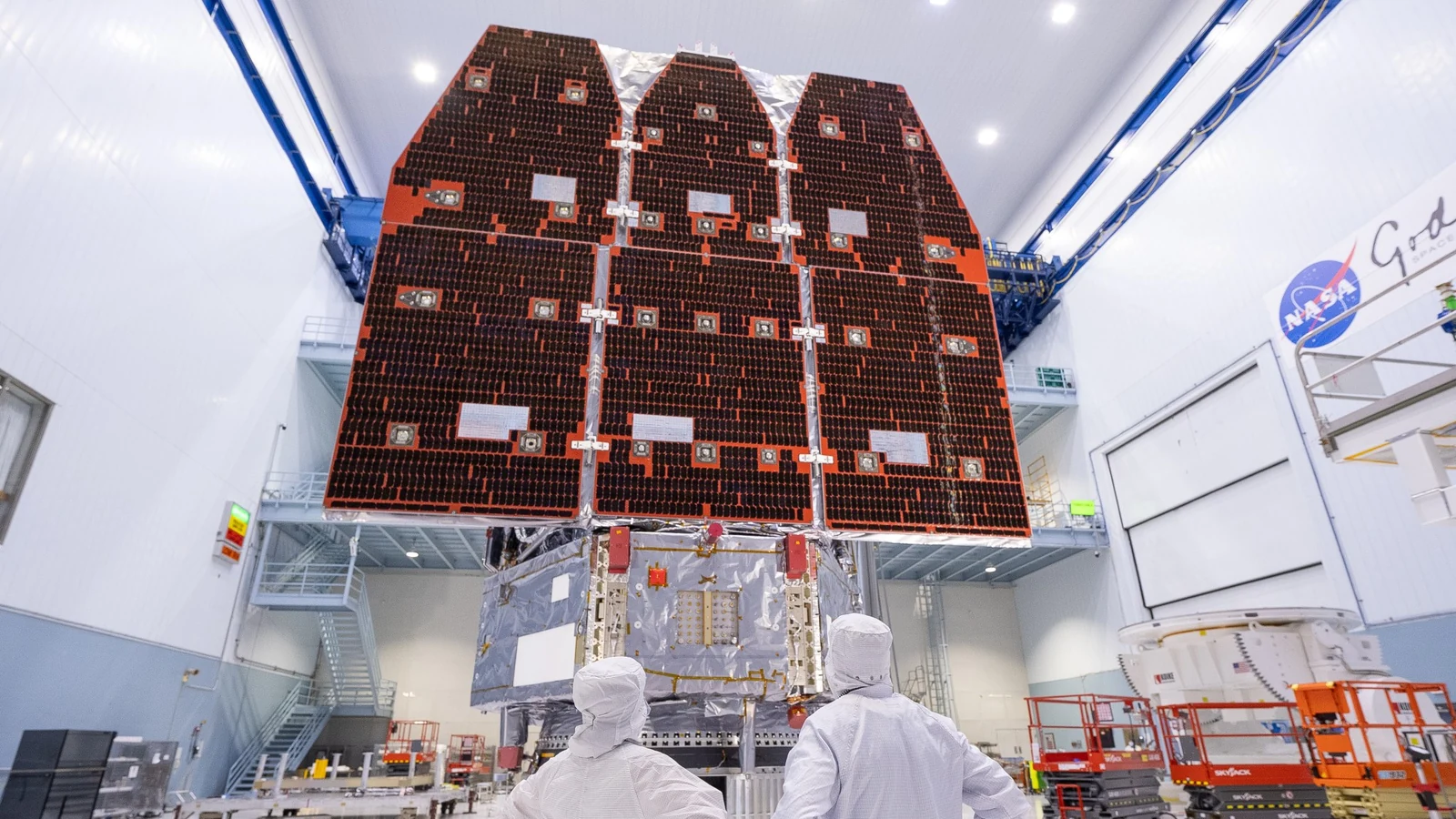
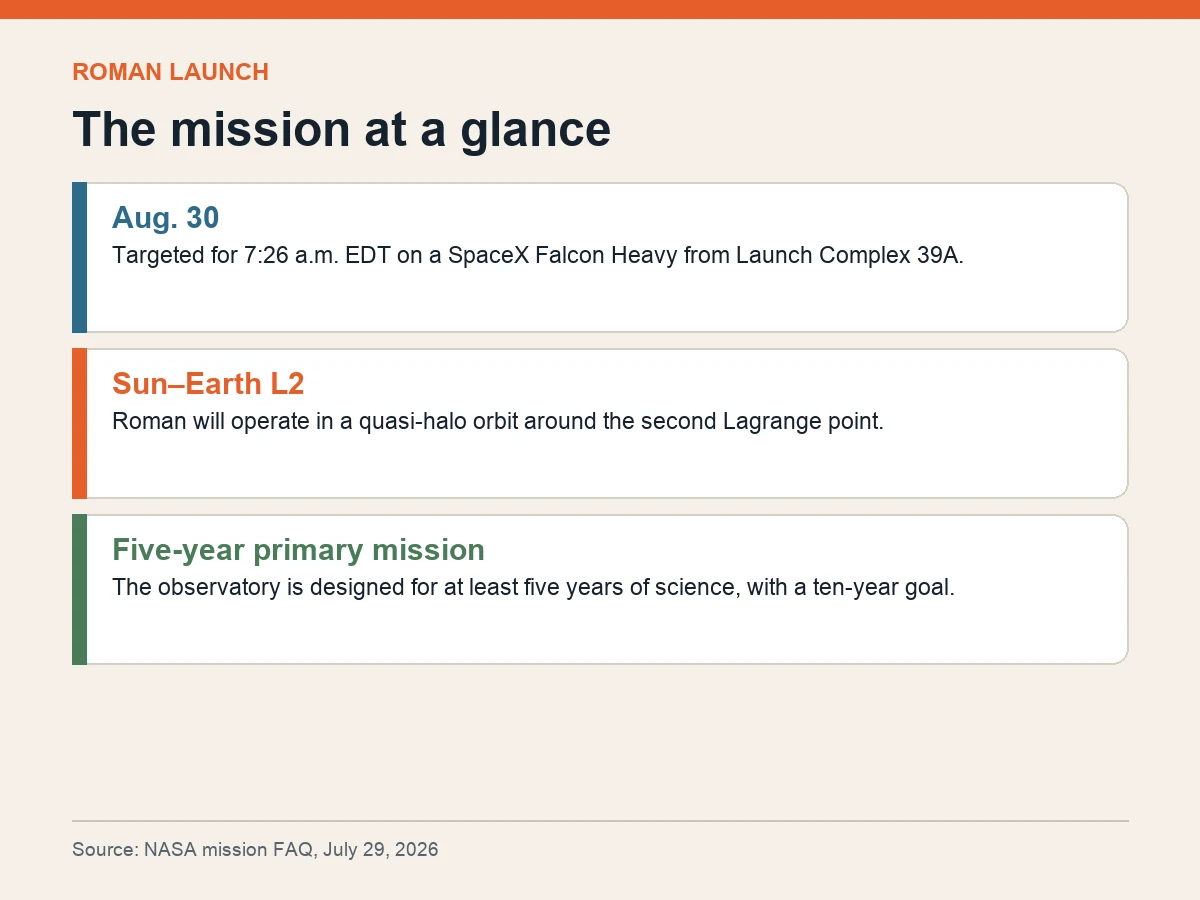
NASA is targeting Aug. 30 for the launch of the Nancy Grace Roman Space Telescope, moving the wide-field infrared observatory from final ground processing toward a five-year survey mission.
The agency lists liftoff for 7:26 a.m. EDT on a SpaceX Falcon Heavy from Launch Complex 39A at Kennedy Space Center in Florida. As with any launch, the date and time remain subject to technical readiness, weather and range decisions.
After launch, Roman will travel to a quasi-halo orbit around the second Sun–Earth Lagrange point, or L2. That location keeps the Sun and Earth in roughly the same direction from the spacecraft, supporting stable observations and thermal conditions far beyond low Earth orbit.
Roman’s 2.4-meter primary mirror is the same diameter as Hubble’s, but the missions are built for different survey scales. Roman’s 288-megapixel Wide Field Instrument will capture near-infrared images with Hubble-like sharpness across a field at least 100 times larger, according to NASA.
That combination is intended to turn deep, detailed observations into panoramic surveys. Roman’s core science includes measuring the growth and expansion history of the universe, mapping matter across cosmic time and finding planets through gravitational microlensing.
A second instrument, the Coronagraph Instrument technology demonstration, will suppress starlight to test high-contrast imaging of nearby planets and debris disks. NASA describes it as a demonstration of techniques for future missions, not the primary engine of Roman’s wide-field surveys.
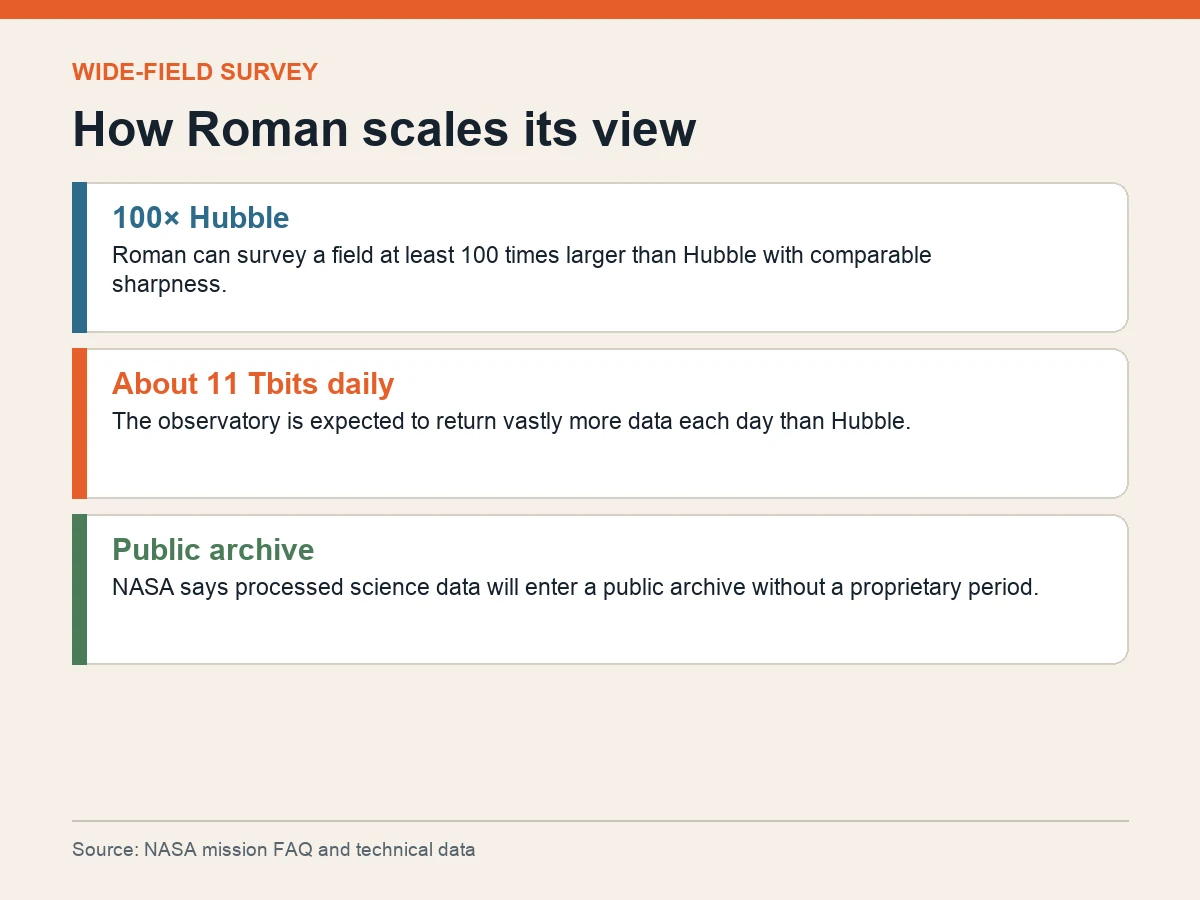
The expanded field creates a data problem as well as a science opportunity. NASA’s technical overview projects about 11 terabits of data per day, while the mission FAQ says the observations will enter a public archive with no proprietary period.
That access policy means multiple teams can analyze the same observations without waiting through an exclusive-use window. It also increases the importance of processing pipelines, searchable archives and computing resources capable of handling the mission’s survey volume.
Roman’s primary mission is approximately five years. The observatory is being designed to support another five years, but an extension will depend on spacecraft health, fuel and future operating decisions rather than the launch schedule alone.
The Aug. 30 target marks the point when years of assembly and testing become a launch campaign. If Roman reaches L2 and completes commissioning, its defining capability will not be a single image: it will be the repeated, public, wide-field record needed to measure how large populations of galaxies, stars and planets change across the sky.