A NASA mission designed to watch the solar wind continuously has passed its first forecasting test: researchers used PUNCH imagery to predict when a coronal mass ejection would reach near-Earth space, and the estimate missed by less than 30 minutes.
That is a striking improvement over the roughly five-hour arrival window NASA says current methods provide. It is also one retrospective proof of concept—not yet an operational forecasting system and not yet a peer-reviewed result.
NASA announced the analysis Aug. 4 after researchers presented it at the Committee on Space Research Scientific Meeting. The work is under review at the journal Space Weather. Those qualifications matter because the result comes from a single eruption whose actual arrival was already known when the team tested its method.
PUNCH fills a long blind stretch between Sun and Earth
Coronal mass ejections are large expulsions of plasma and magnetic field from the Sun. Their effects can disturb satellites, radio links, navigation systems and electric-power infrastructure, but the severity depends on more than arrival time. Direction, speed and the magnetic orientation of the ejected material also matter.
Before PUNCH, NASA says coronagraphs could directly follow an ejection through roughly the first fifth of its trip to Earth. Forecasters then had to infer how the cloud changed across much of the remaining distance.
PUNCH—short for Polarimeter to Unify the Corona and Heliosphere—uses four small spacecraft in low Earth orbit to make continuous three-dimensional observations of the inner solar system. Its combined field of view can track solar eruptions nearly to Earth and produce a new image every four minutes.
What the team tested
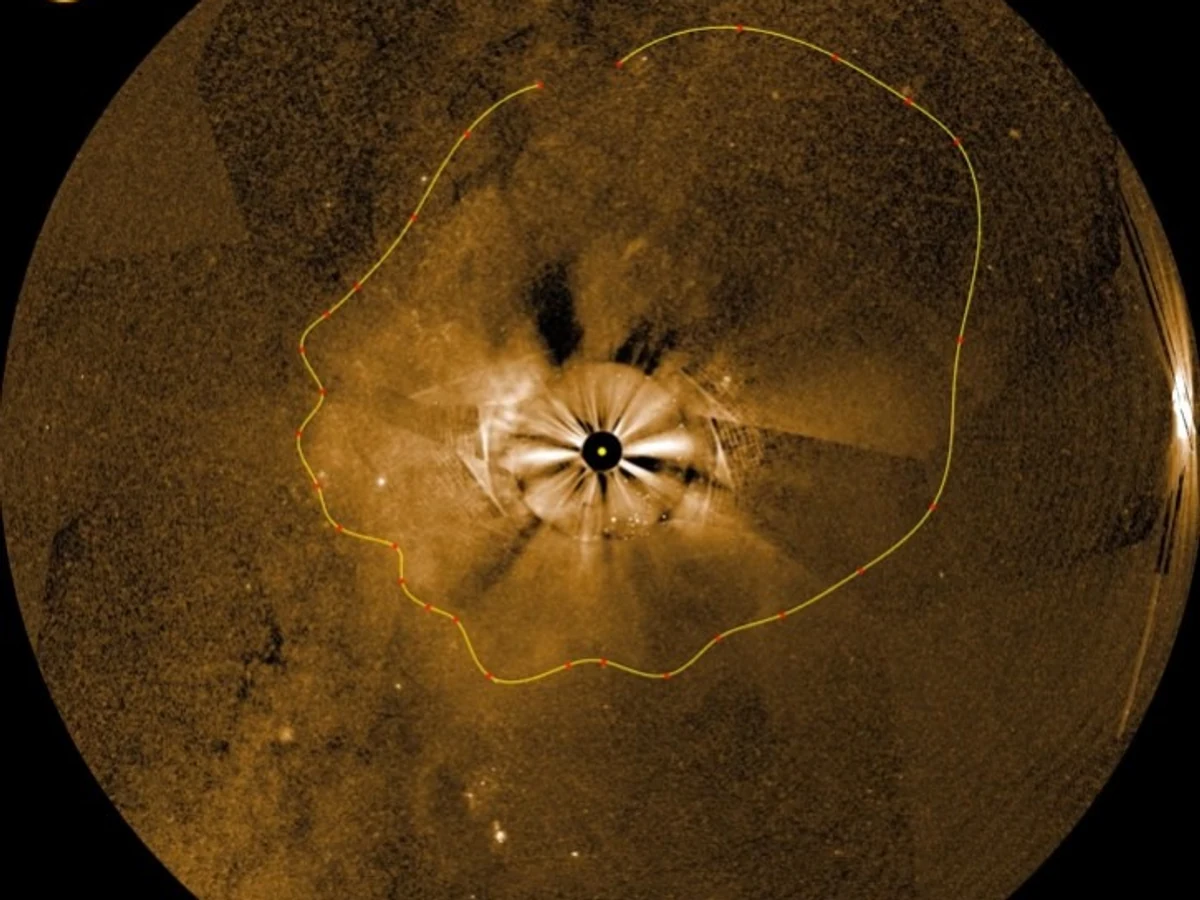
Researchers revisited a coronal mass ejection that left the Sun on May 31, 2025. They fed PUNCH images into a basic computer model that followed the eruption’s leading edge and used changes in speed and geometry to calculate an arrival time.
Twelve hours after the eruption left the Sun, the model’s estimate stabilized. It predicted arrival eight hours later. NASA says the final estimate was accurate to within half an hour—about 10 times tighter than the five-hour window associated with the currently used approach.
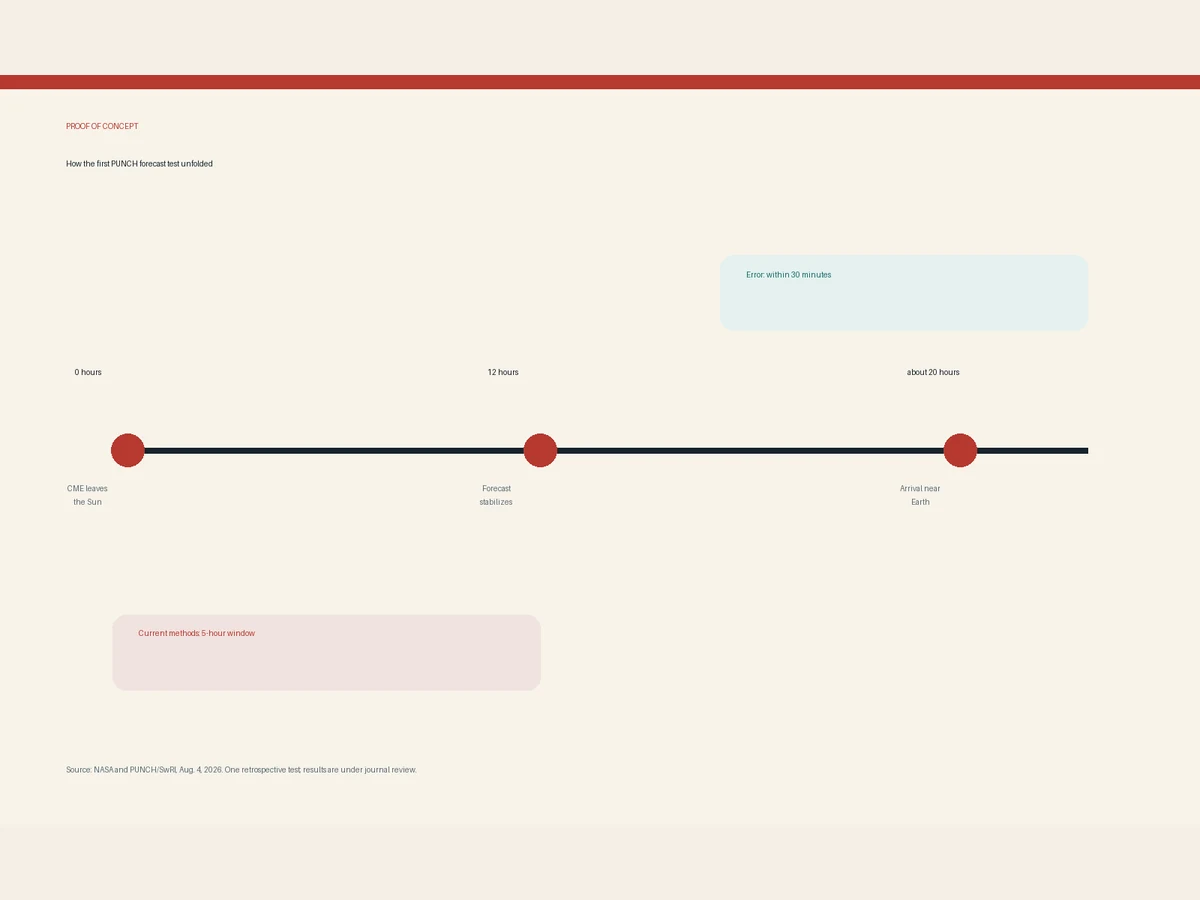
The model also indicated when its answer had stabilized. That is operationally important: a forecast is more useful when forecasters can tell whether the estimate is still moving or has become dependable enough to support planning.
A promising result still has to survive more storms
The first test does not establish a general 30-minute error rate. Coronal mass ejections differ in shape, speed, direction and interaction with the ambient solar wind. A method that performs well on one event can fail on a different geometry.
Researchers will need to repeat the analysis across many eruptions, compare it against independent forecasting methods and complete peer review. Operational forecasters would also have to evaluate data latency, spacecraft coverage, model reliability and failure modes.
The imagery is already yielding scientific information beyond timing. NASA says the observations show more internal structure than earlier views, including clumpy material that continues to evolve as it crosses the solar system. That can improve models of how plasma moves not only around the Sun but in other astrophysical settings.
The honest reading is therefore two-part: PUNCH demonstrated that continuous imaging can sharply improve one arrival estimate, and the mission has not yet demonstrated that performance across the range of storms a real forecast service must handle.