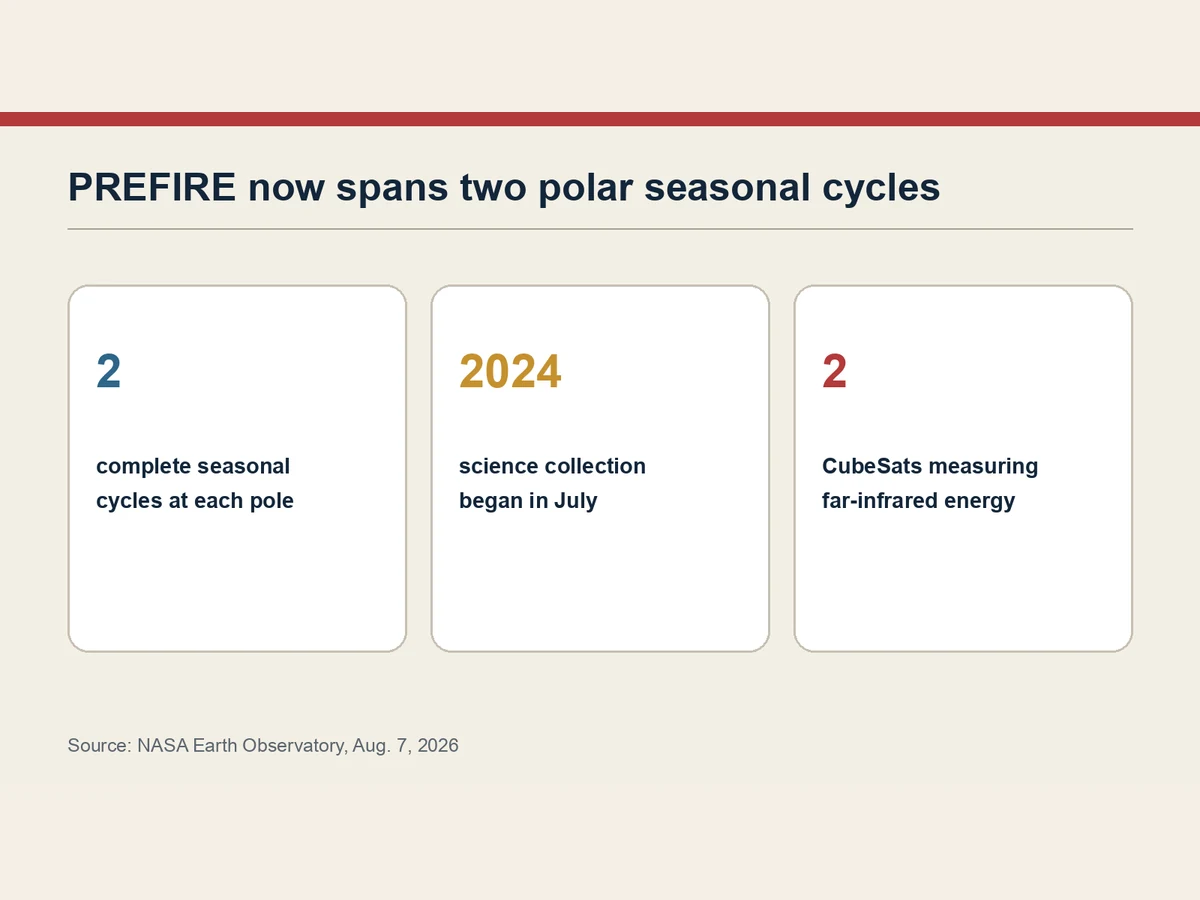
NASA’s twin PREFIRE CubeSats have completed two full years of observations at both poles, turning seasonal surface-temperature swings and invisible far-infrared heat into a continuous record for researchers. The spacecraft began collecting science data in July 2024.
The new NASA animation shows the Arctic and Antarctic pulsing between deep winter cold and comparatively mild summer conditions. Their seasons run opposite each other, but geography also matters: Arctic summers can thaw tundra and sea ice, while much of Antarctica remains below freezing.
PREFIRE stands for Polar Radiant Energy in the Far-InfraRed Experiment. Its core job is to measure heat leaving Earth in wavelengths that human eyes cannot see and that earlier global observing systems did not comprehensively sample.
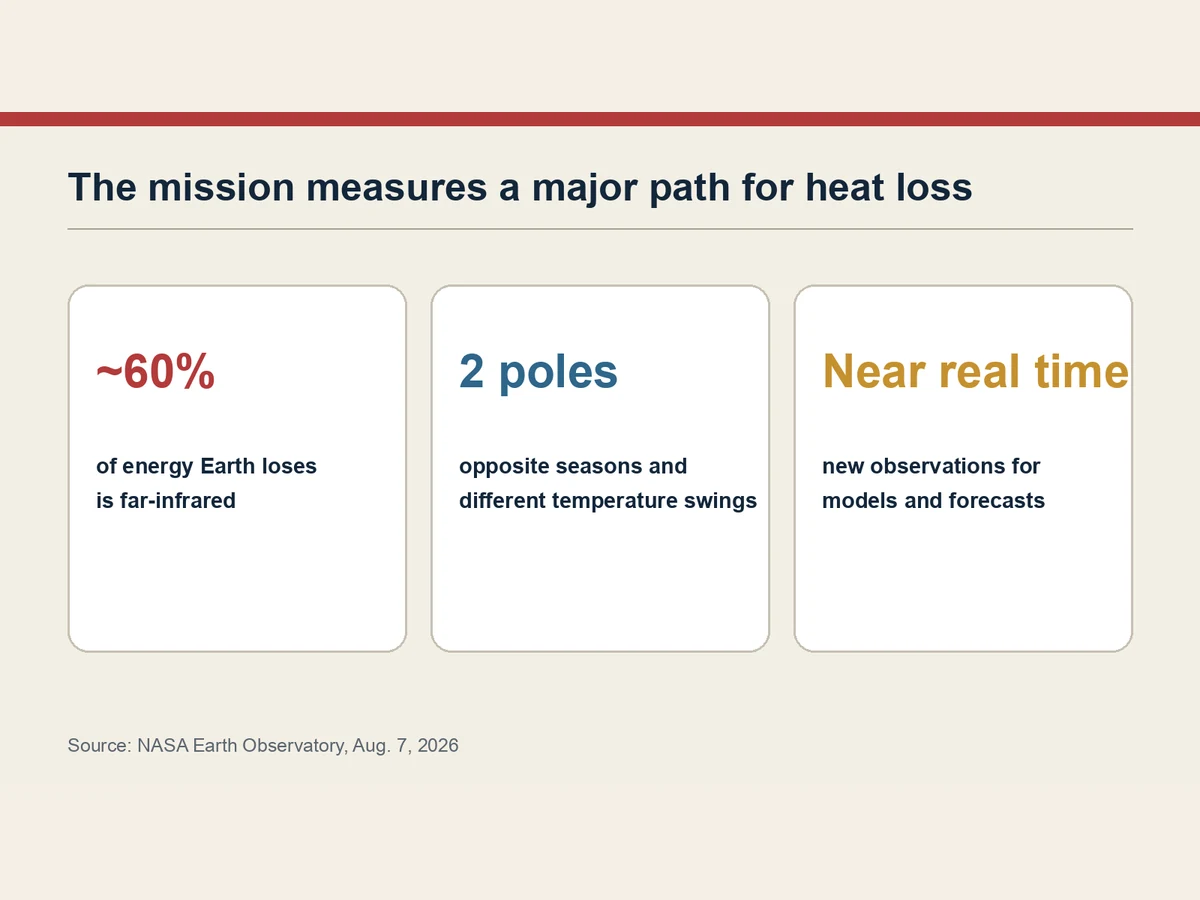
That missing range is consequential. NASA says far-infrared radiation carries nearly 60 percent of the energy Earth loses to space. Heat absorbed in the tropics moves through the atmosphere and ocean toward the poles, where part of it radiates away.
Surface temperature is only one window into that exchange. Clouds, water vapor, sea ice and snow alter how energy moves between the surface, atmosphere and space, so scientists combine PREFIRE measurements with other observations and models rather than reading one color map as a complete climate diagnosis.
NASA says near-real-time measurements can help refine weather and climate models. The agency points to possible relevance for river flows, shipping routes, ice-sheet stability and Arctic communities, all of which depend on how heat moves through polar systems.
The two-year milestone establishes coverage, not a final forecast score. Researchers still must test whether model changes based on the data produce better predictions across seasons, regions and different weather conditions.
The record also should not be read as a simple comparison of which pole is warming faster. The released animation depicts seasonal surface temperatures across two cycles; longer trends and causes require longer records and multiple lines of evidence.
PREFIRE’s immediate contribution is narrower and measurable: two small satellites are now filling a large observational gap in Earth’s energy budget, giving modelers a direct view of heat that had long remained hidden from global measurement.