
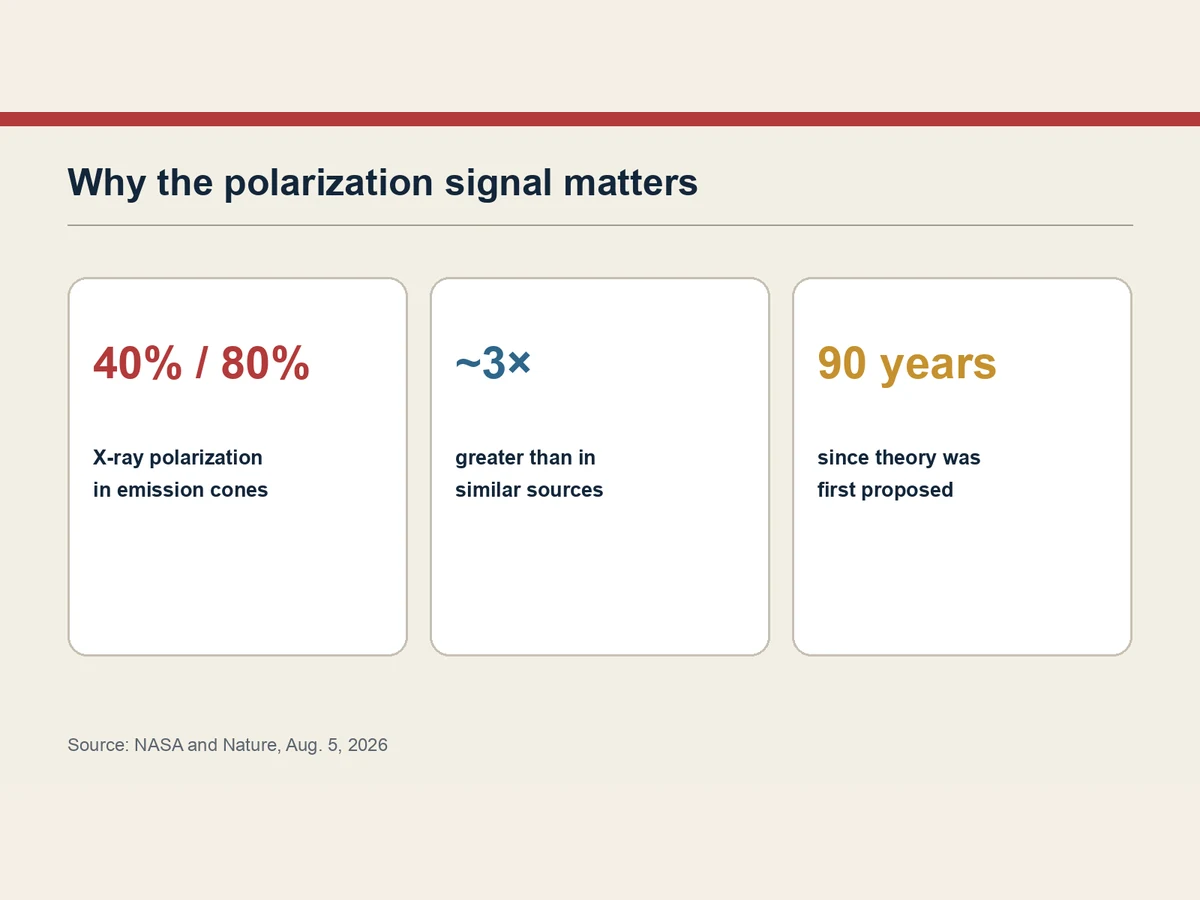
NASA’s Imaging X-ray Polarimetry Explorer may have captured the clearest evidence yet that empty space changes the way light travels inside an extreme magnetic field, a quantum-electrodynamics effect proposed in 1936.
The target was magnetar 1E 1547-5408, a city-sized remnant of a massive star with a magnetic field more than a trillion times stronger than the strongest permanent magnets built on Earth.
IXPE observed the object for more than 140 hours between March and April 2025. NASA’s NICER instrument and Australia’s Murriyang radio telescope joined the campaign, producing the first coordinated radio and X-ray polarization measurement of a magnetar.
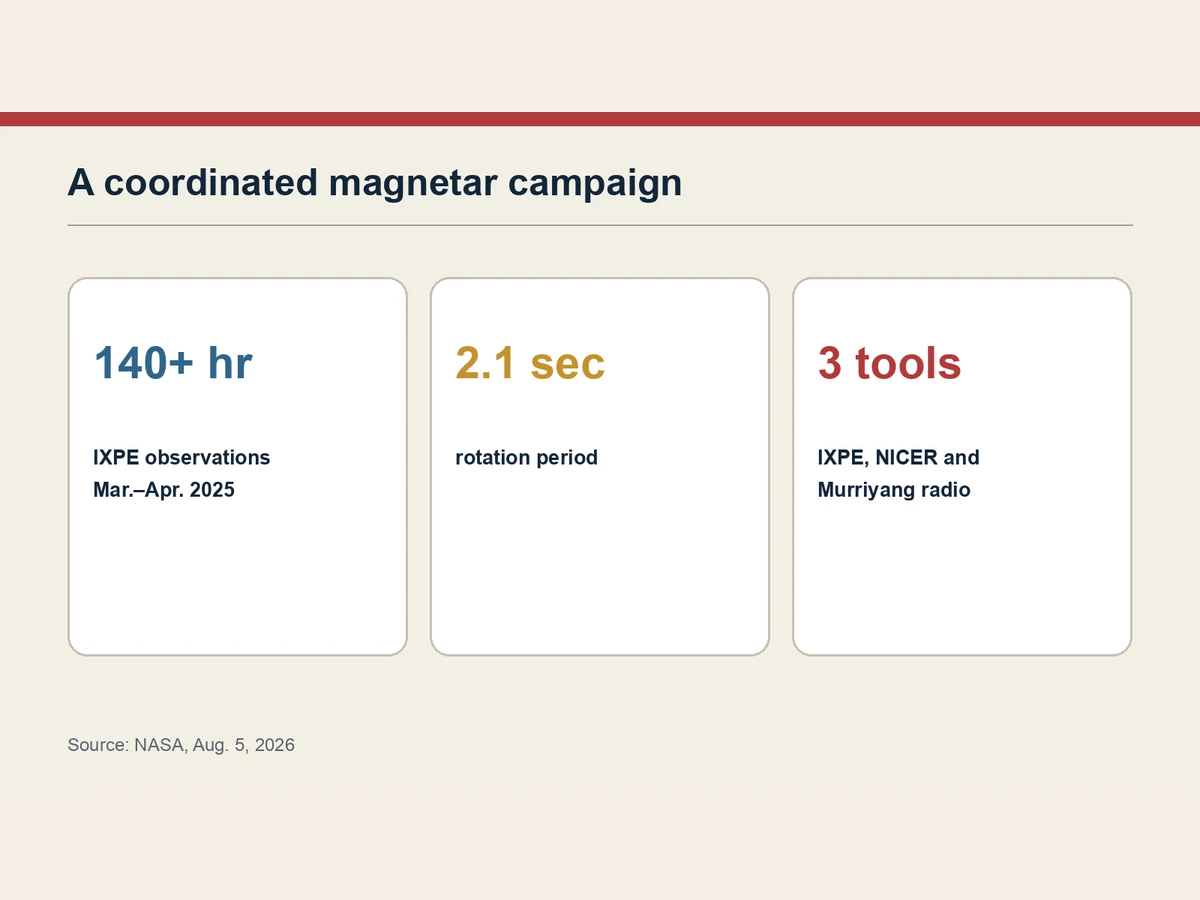
The neutron star rotates about once every 2.1 seconds. Its radio and X-ray peaks do not line up, indicating that the main X-ray hot spot is offset from the magnetic axis.
Researchers reported X-ray polarization degrees of about 40% and 80% in two modeled emission cones. The total polarization was nearly three times greater than measurements from similar sources and could not be reproduced by standard surface-emission models alone.
Vacuum birefringence offers a possible explanation. In a sufficiently strong magnetic field, quantum theory predicts that the vacuum acts somewhat like a lens or prism, filtering light according to its direction and increasing the observed polarization.
The team’s simulations reproduced the combined radio and X-ray signatures only when that effect was included. The result was published in Nature and NASA called it strong support for the long-standing prediction.
The language remains conditional for a reason. A model that requires the effect is not identical to a laboratory-style direct detection, and the researchers want more IXPE observations of this source and other magnetars.
The finding is nonetheless distinctive: an object thousands of light-years away may provide a physics environment impossible to build on Earth, turning X-ray polarization into a test of how the vacuum itself behaves.