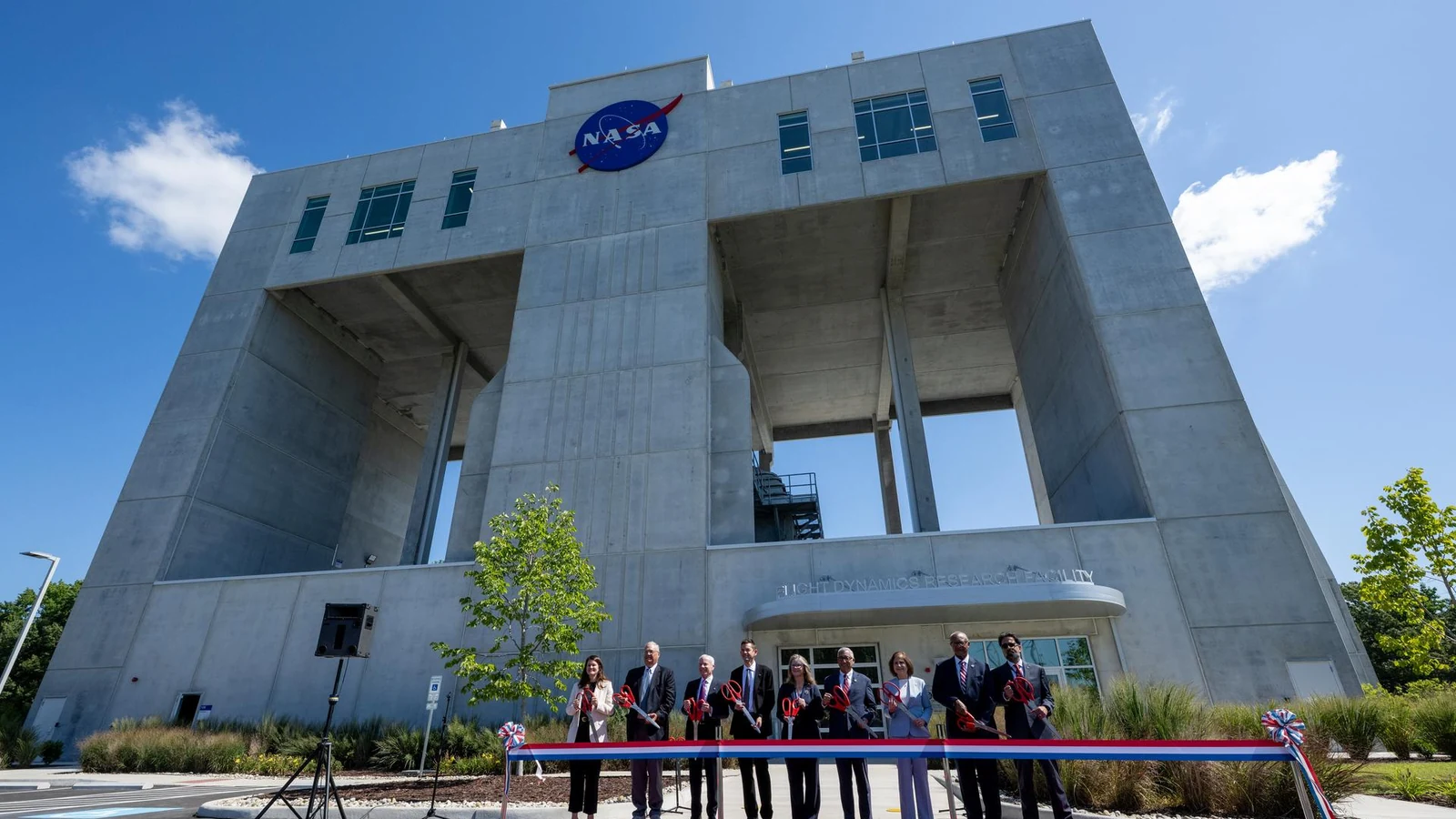
NASA has opened a 25,000-square-foot wind-tunnel facility in Virginia that can suspend free-flying models in a 20-foot-wide vertical column of air moving as fast as 117 miles per hour.
The Flight Dynamics Research Facility began operating July 31 at Langley Research Center in Hampton. NASA describes it as the agency’s first major new wind tunnel in more than 40 years and a replacement for two aging facilities that shaped decades of aircraft and spacecraft testing.
Its purpose is not simply to push air past a fixed wing. Researchers can mount models on test equipment or let them fly freely inside the chamber, then study stability, spins, control, parachutes and the behavior of vehicles descending through an atmosphere.
A 20-foot chamber running at 117 mph
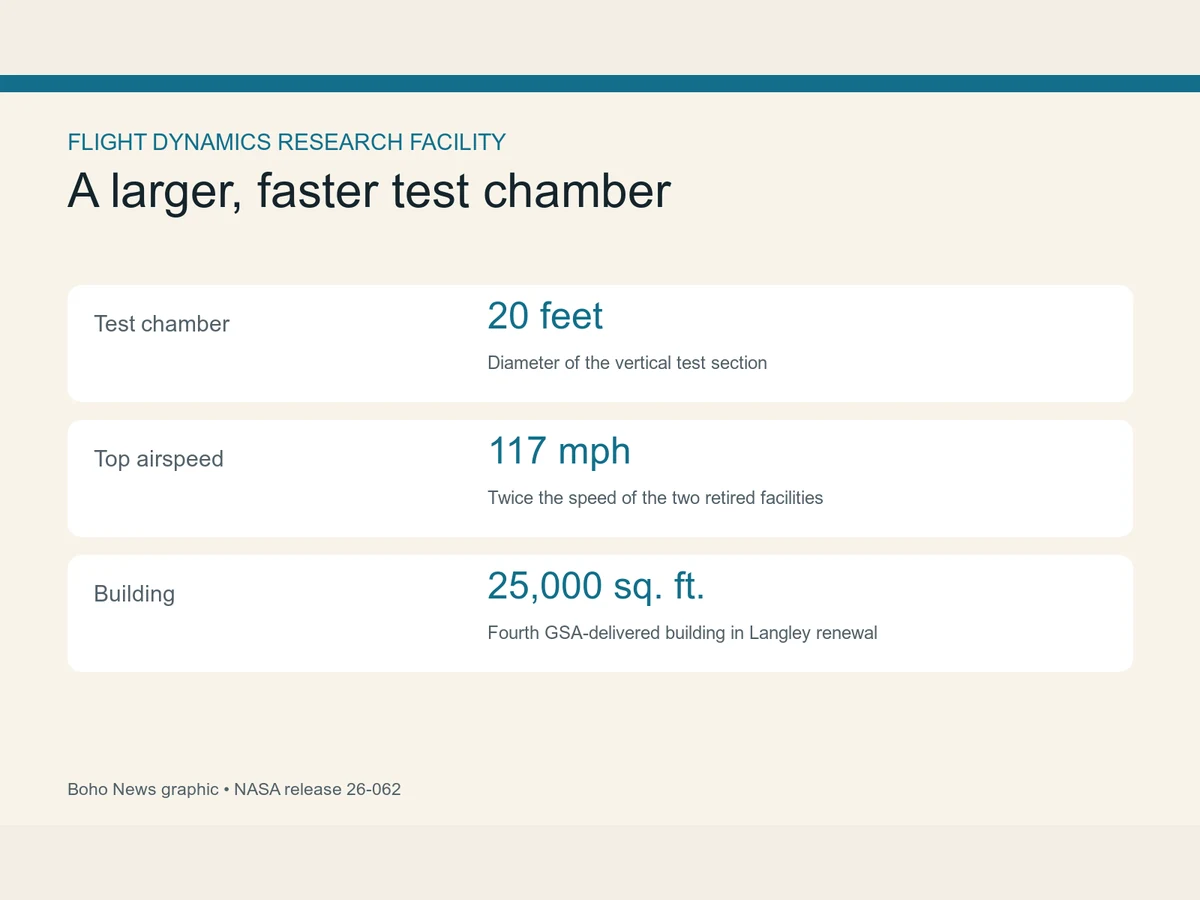
The vertical test chamber is 20 feet in diameter, giving air more room to flow around larger and more detailed models. NASA says that improves the quality of measurements and expands the class of free-flight experiments the tunnel can handle.
Its maximum airspeed is twice that of the facilities it replaces. At 117 mph, researchers can fly heavier scale models and simulate some full-scale vehicles at higher altitude, where thinner air changes the relationship among size, speed and aerodynamic force.
The speed figure is a facility limit, not a claim that every test will run at the maximum. Researchers need controlled, repeatable airflow, and many questions about slow-speed stability or parachute behavior require lower settings.
Four motors and carbon-fiber fans
The airflow comes from four 750-horsepower motors. Each drives a 14-foot-diameter fan with eight carbon-fiber blades, for 32 blades across the wind system and 3,000 horsepower of installed motor rating.
NASA says the lightweight blades allow the system to change airspeed quickly and precisely during free-flight work. That responsiveness matters when a model moves through the chamber and researchers need to keep it inside a safe test envelope.
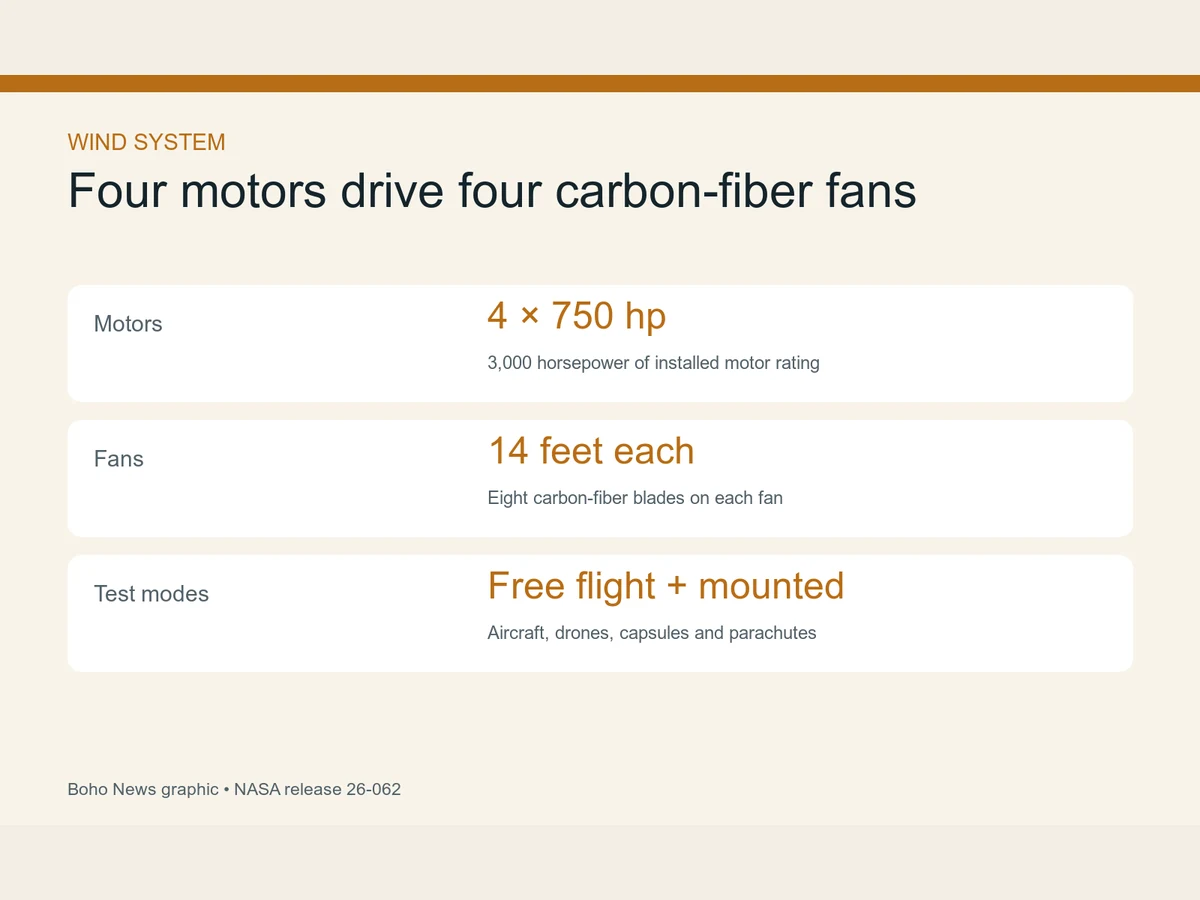
The tunnel can support aircraft-safety studies, experimental X-planes, drones and autonomous vehicles. Its spaceflight work is atmospheric: models of reentry capsules, parachutes and landing systems, along with possible aircraft for Mars or other worlds with atmospheres.
Those uses are capabilities, not completed results. NASA’s opening announcement does not identify a first research campaign or publish validation data from a specific vehicle.
Two historic tunnels under one roof
The new facility combines and improves the roles of Langley’s 20-Foot Vertical Spin Tunnel and 12-Foot Low-Speed Tunnel. The spin tunnel opened in 1941 and became a specialized place to study how aircraft enter and recover from spins; the smaller low-speed tunnel supported free-flight and control research.
Bringing their work into one modern building is meant to reduce maintenance demands and give research teams digital systems and a flexible test space. It is the fourth building delivered through NASA’s long-term Langley partnership with the General Services Administration.
That campus story is important because wind tunnels are infrastructure. Their scientific value depends on calibration, repeatability, model preparation, sensors and the ability to run safely over years—not on opening-day dimensions alone.
The next evidence will come from actual campaigns: what vehicles use the chamber, whether the airflow and controls perform as specified, and what designs change because of the measurements. The opening supplies the tool; experiments will supply the findings.