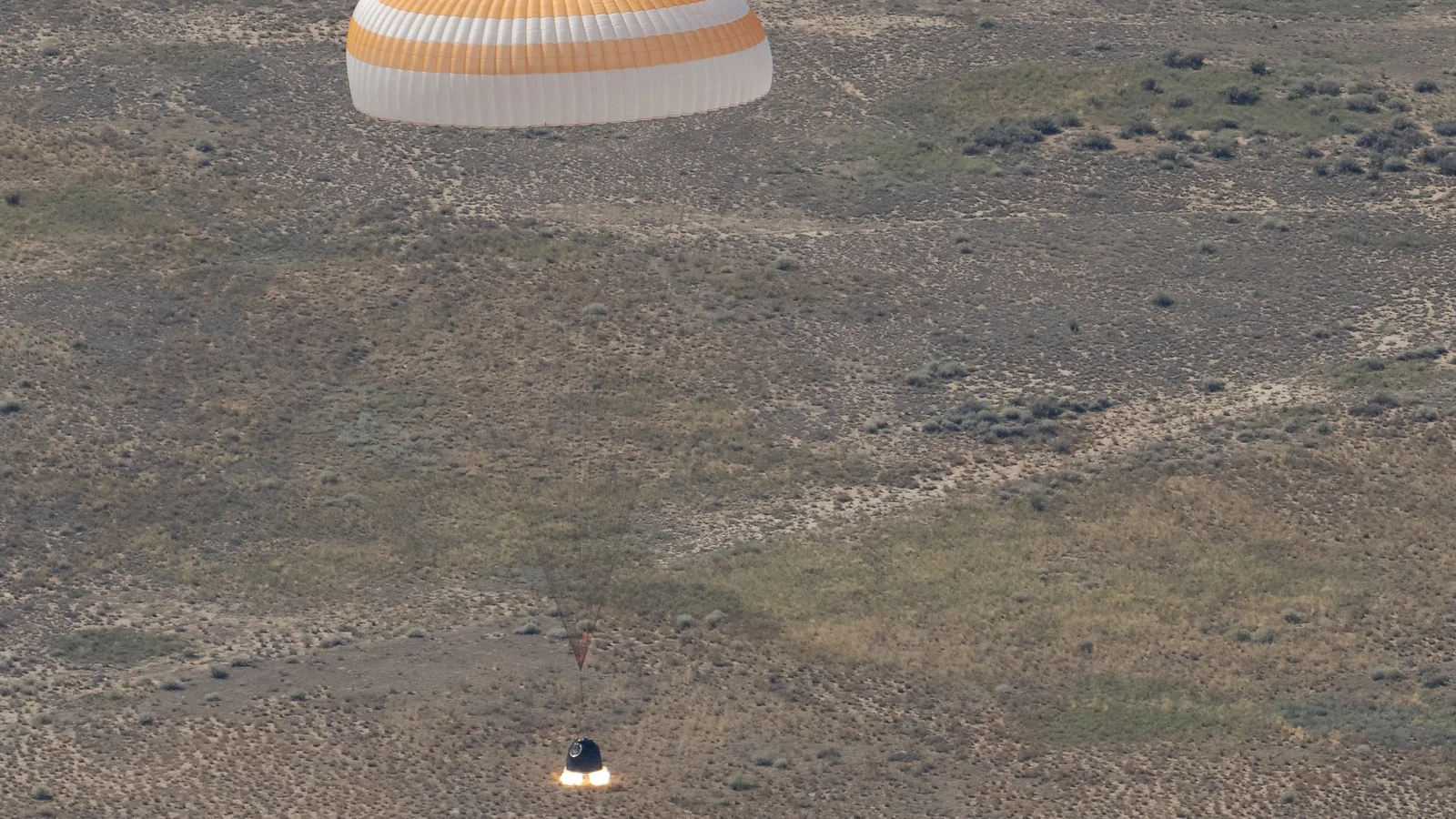
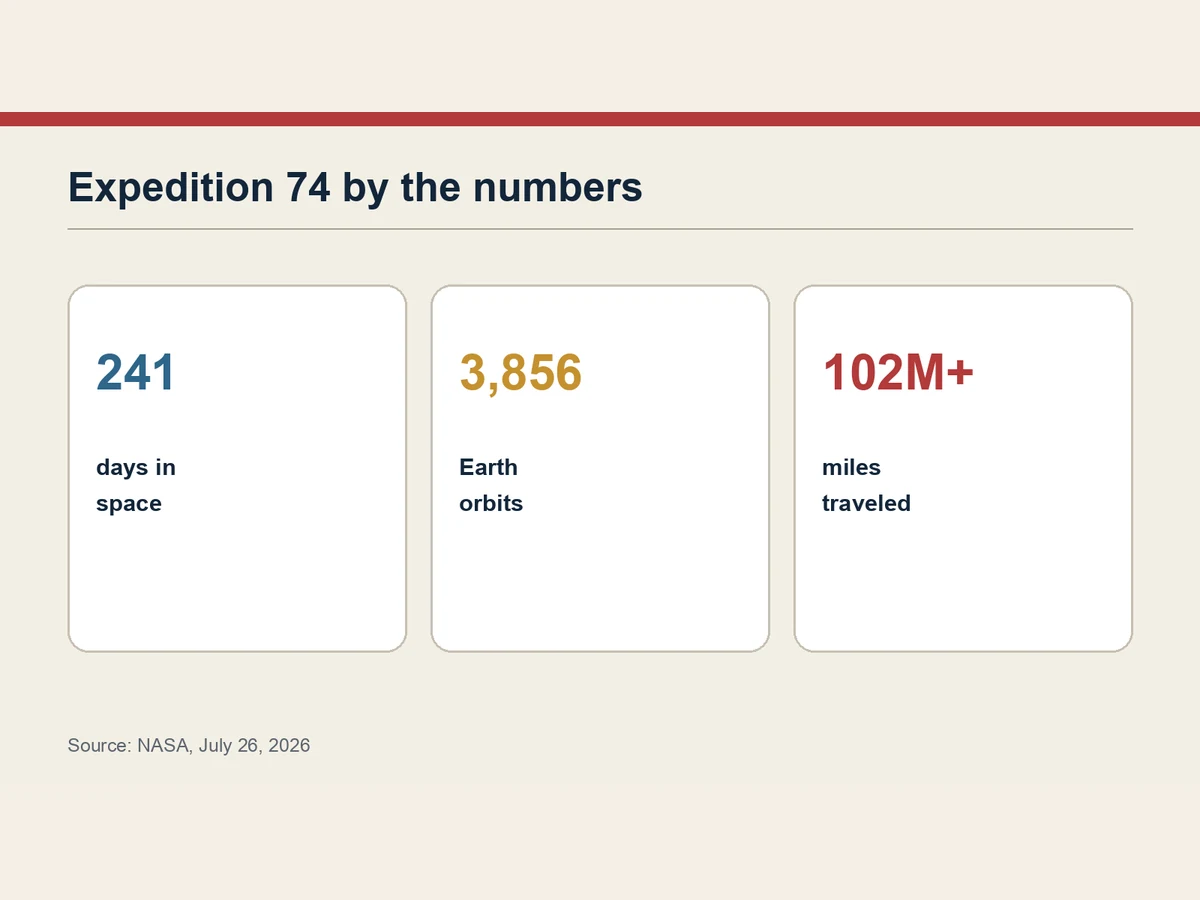
NASA astronaut Chris Williams returned to Earth after 241 days in space, landing in Kazakhstan with Roscosmos cosmonauts Sergey Kud-Sverchkov and Sergei Mikaev after a mission that combined laboratory work with two spacewalks.
Soyuz MS-28 touched down under parachute southeast of Zhezkazgan at 5:27 a.m. Central time on July 26. The spacecraft had departed the International Space Station at 2:03 a.m.
NASA counted 3,856 Earth orbits and more than 102 million miles traveled since the crew launched on November 27, 2025. Those are mission totals, not distance along a straight line between Earth and the station.
The flight was Williams’ and Mikaev’s first. Kud-Sverchkov completed his second mission.
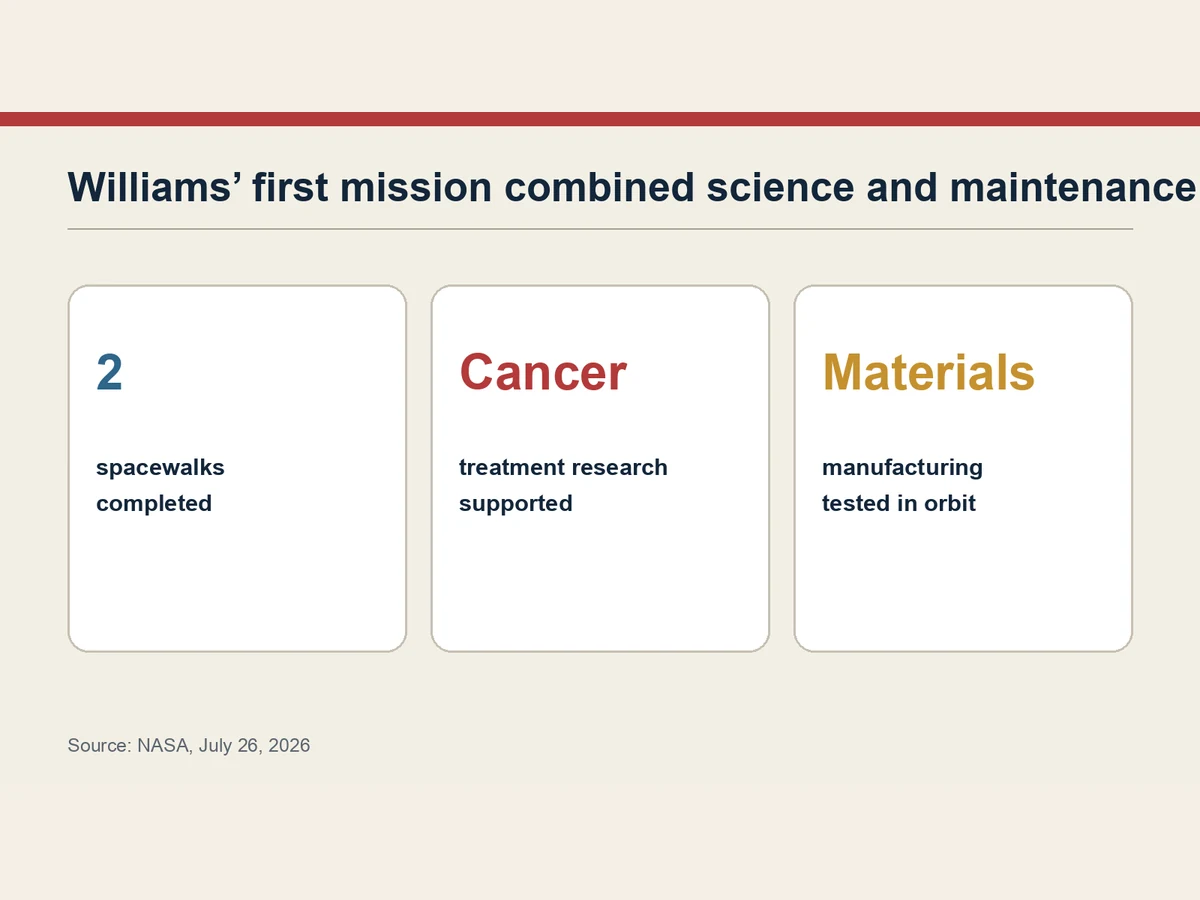
Inside the station, Williams supported research related to cancer treatments and in-space production of materials used in high-performance computers and electronics. NASA describes the work as research progress, not a completed therapy or commercial production line.
Outside the station, Williams completed two spacewalks. The work prepared power-system upgrades and replaced a faulty joint on the Canadarm2 robotic arm.
The landing closed an eight-month assignment but not the crew’s work. Post-landing medical checks and rehabilitation measure how long-duration microgravity affects balance, strength and other systems as the astronauts readapt to Earth gravity.
The mission also adds operational data for future long-duration flights. NASA uses the station to test research, maintenance and human-performance procedures relevant to later Moon and Mars missions.
The compact mission summary—241 days, 3,856 orbits and two spacewalks—captures scale. The substantive record is the combination of science, power-system preparation and robotic-arm repair accomplished during one first flight.Williams returned to NASA’s Johnson Space Center after the Kazakhstan recovery. The agency’s immediate account confirms the crew’s safe return and mission totals; detailed scientific results will depend on later analysis by the individual research teams.
That distinction matters for biomedical reporting. An experiment related to cancer treatment can test cells, materials or processes in microgravity without demonstrating that a treatment is ready for patients. NASA’s release describes the research area, not a clinical result.