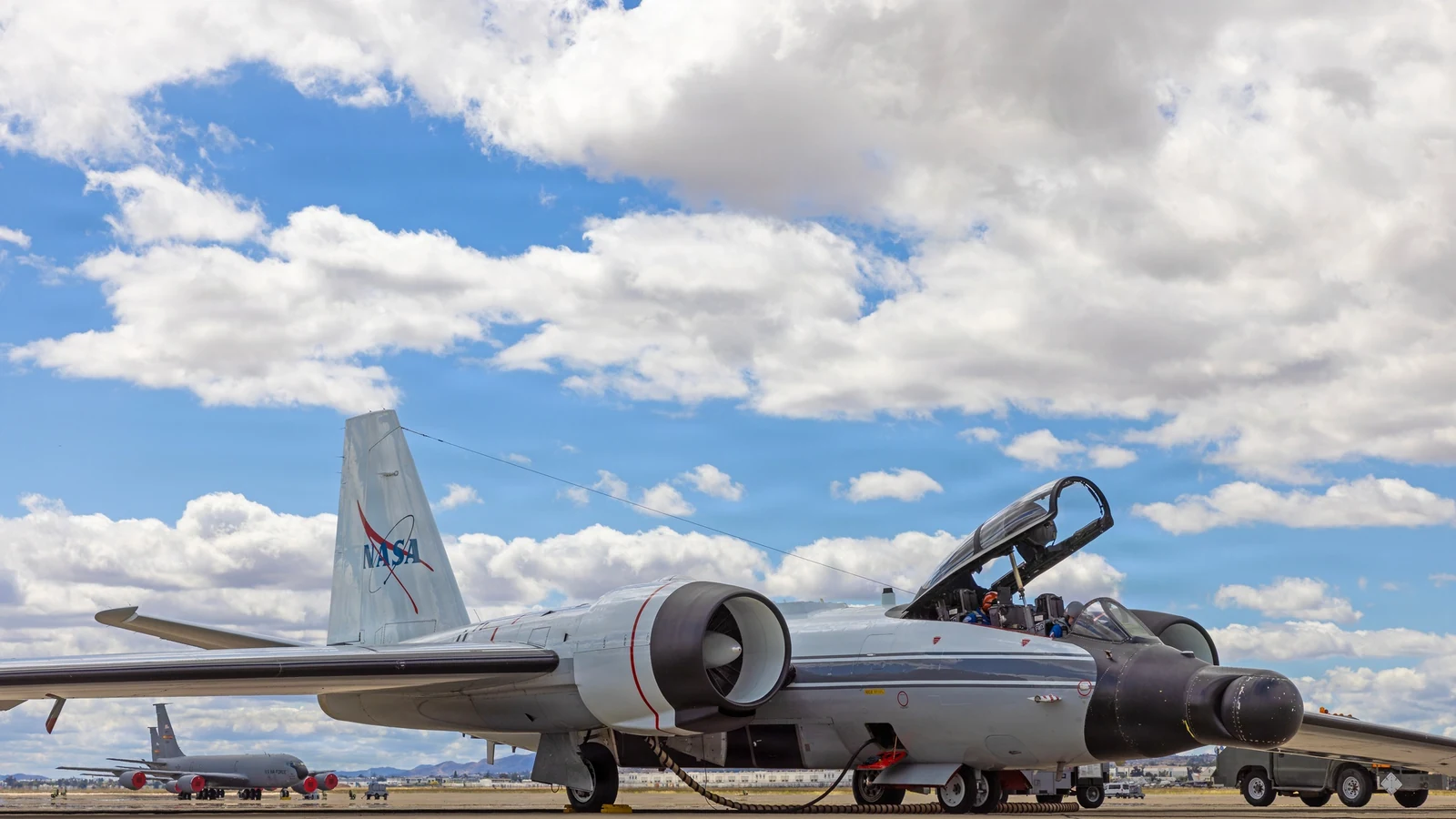
NASA-funded researchers will chase the August 12 total solar eclipse with a high-altitude jet and launch 86 scientific balloons from Iceland and Spain, turning the Moon’s shadow into a coordinated solar and atmospheric experiment.
The eclipse crosses Greenland, Iceland and Spain. A NASA WB-57 will fly along the path at about 460 miles per hour and 50,000 feet, above most clouds and much of the atmosphere that absorbs infrared light before it reaches ground telescopes.
Four cameras in the aircraft’s nose will record at least 20 images per second in multiple visible and infrared wavelengths. Scientists plan to examine fast-changing structures in the solar corona, suspended prominences and the relationship between coronal material and the solar wind.
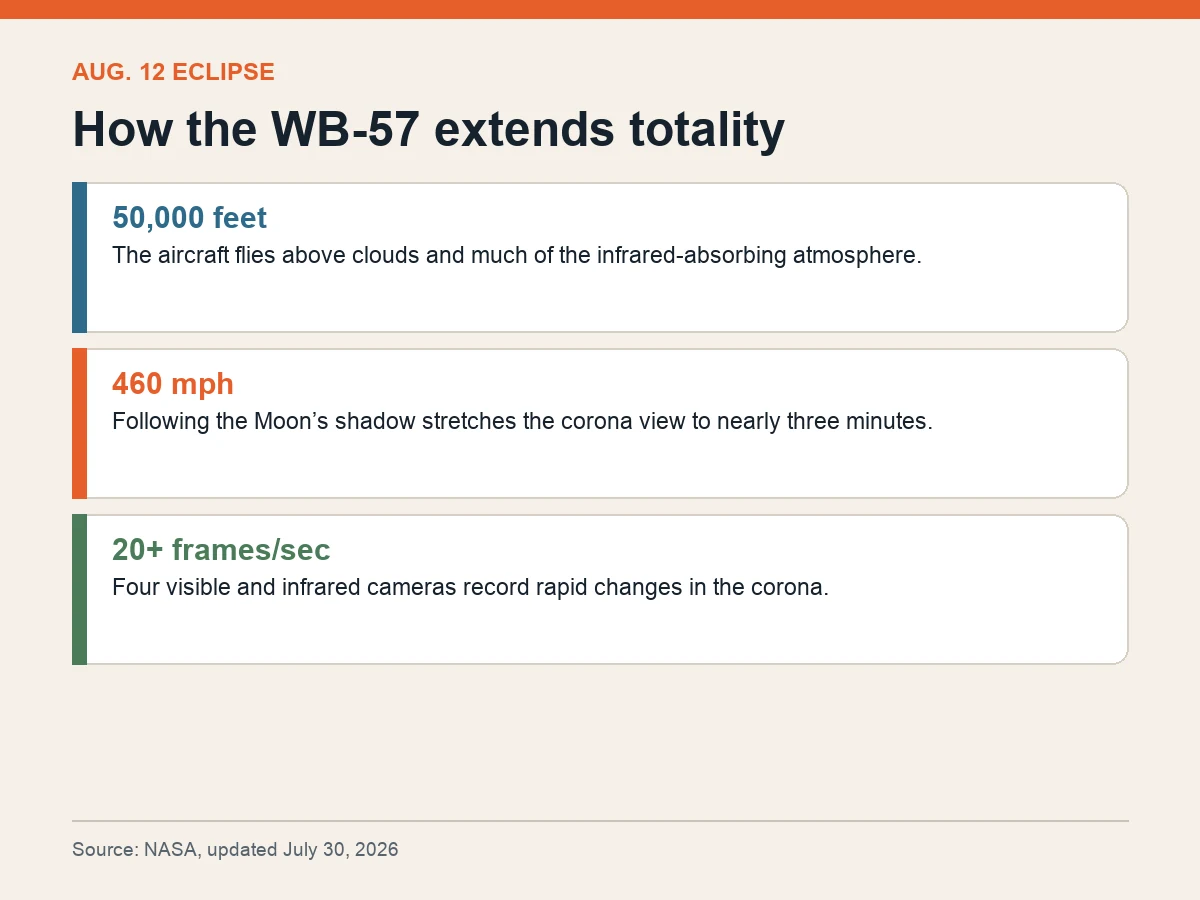
Chasing the shadow extends the observation window. NASA says the longest view of the corona from the ground will be two minutes and 18 seconds, while the aircraft should remain in totality for nearly three minutes. That extra time produces more frames of a phenomenon that cannot be paused or repeated.
The instrument, called the SCIFLI Multispectral Airborne Imager, also flew during the April 2024 eclipse. The team adjusted exposure plans after bright features were overexposed in some earlier imagery and will use newer processing software to analyze the 2026 data sooner.
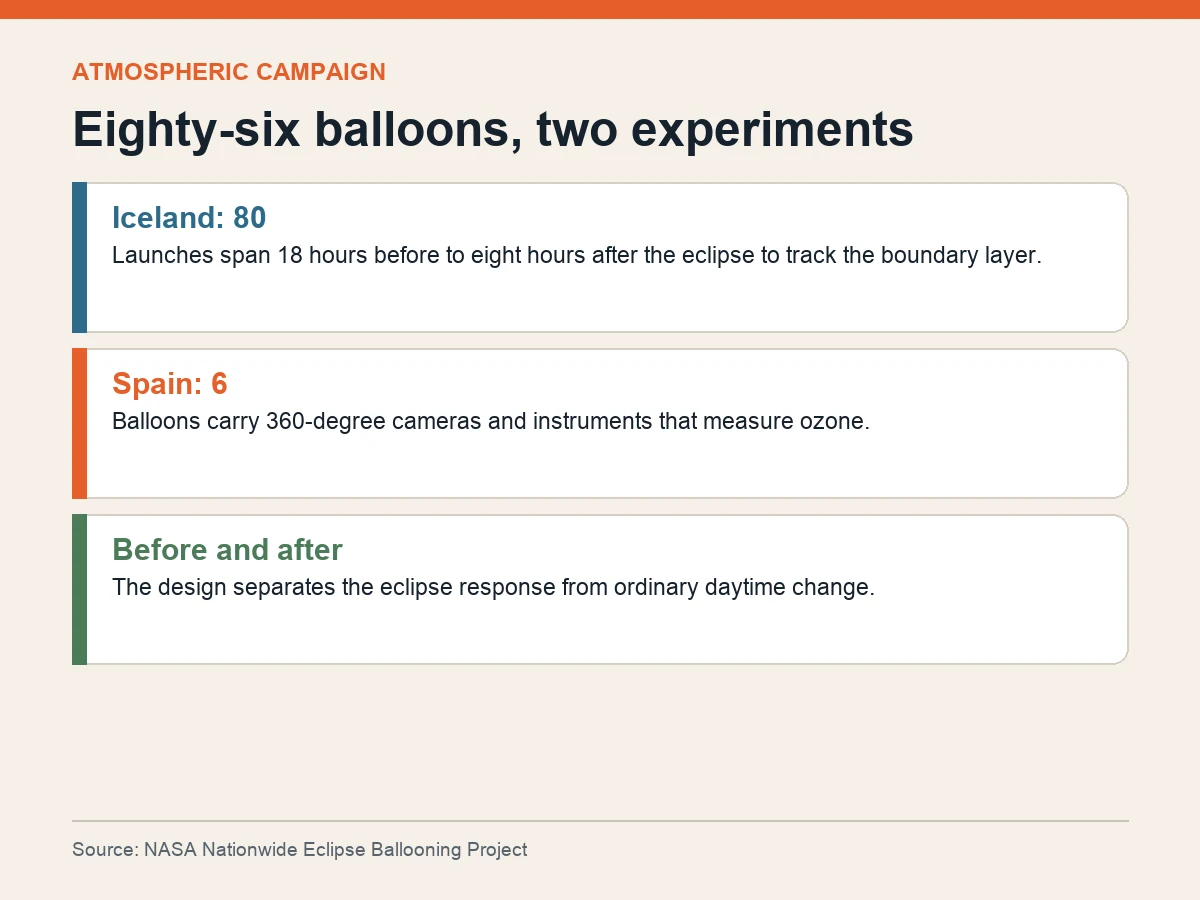
The balloon campaign targets a different layer of the event. In Iceland, two university teams plan to launch 80 balloons beginning 18 hours before totality and continuing until eight hours afterward, measuring how sudden darkness changes the atmospheric boundary layer near Earth’s surface.
Earlier eclipse campaigns found that the boundary layer thinned under clear skies but not cloudy ones. Iceland’s long August daylight creates a distinct test because its brief night may produce a weaker ordinary nighttime transition than researchers observed in 2023 and 2024.
In Spain, three teams plan six balloons with 360-degree cameras and ozone instruments. Ozone requires sunlight to form, and similar instruments measured a decline during the 2024 eclipse; the later time of day and different season give researchers another set of conditions to compare.
The flight and balloon counts are plans, not completed observations. Weather, launch conditions and aircraft operations can change them, and the scientific claims will come only after calibration and analysis. The experiment’s immediate news is its design: one brief shadow sampled across altitude, wavelength, geography and time.