
Unemployment rates moved in opposite directions across nearly equal numbers of U.S. metropolitan areas in June, while statistically significant payroll growth remained concentrated in a small group of local economies, federal data released Wednesday show.
The Bureau of Labor Statistics reported that jobless rates were higher than a year earlier in 184 of 387 metropolitan areas, lower in 178 and unchanged in 25. The national unemployment rate was 4.4 percent on a not-seasonally-adjusted basis, the same as in June 2025.
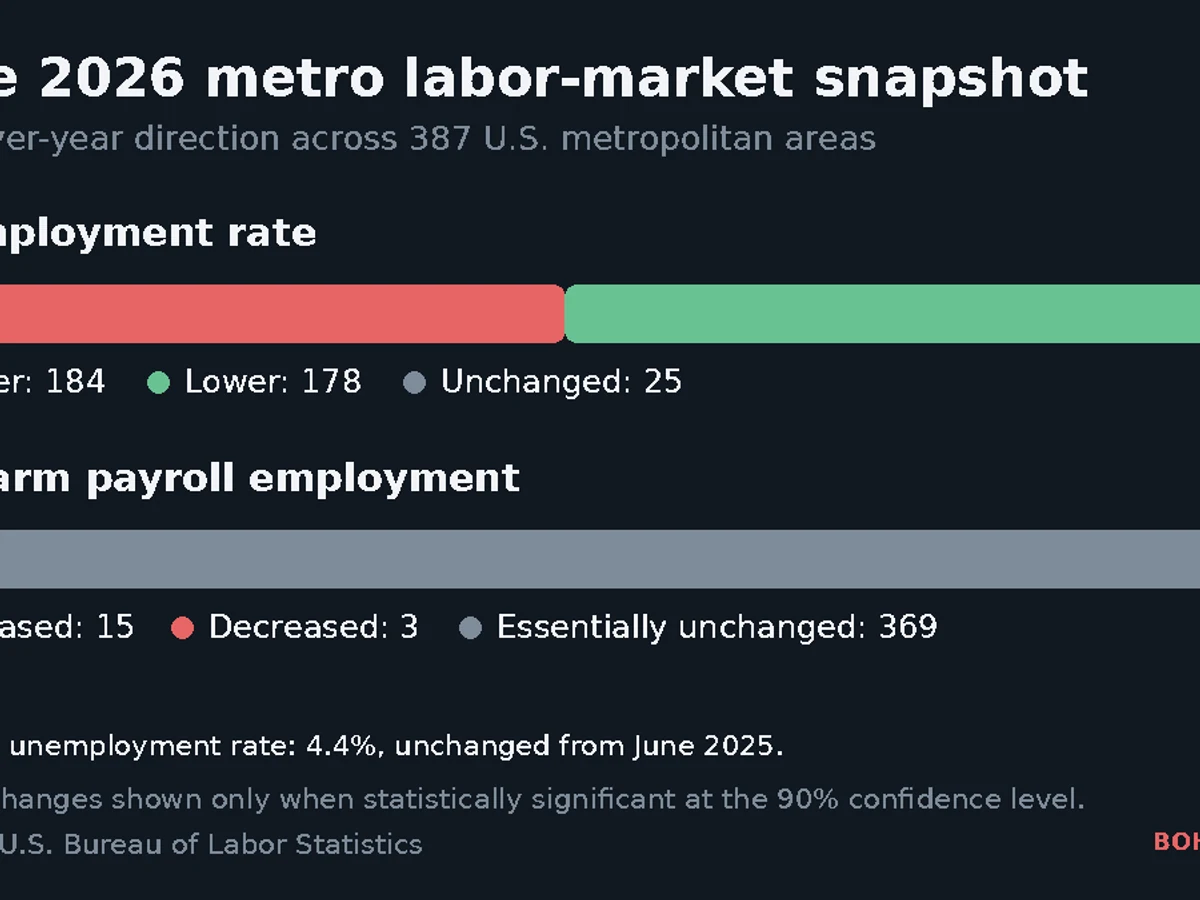
The payroll figures were considerably less balanced. Nonfarm employment increased significantly over the year in 15 metropolitan areas and decreased in three, while BLS classified the remaining 369 as essentially unchanged. BLS cites metro payroll changes in its release only when they are statistically significant at the 90 percent confidence level.
Dallas-Fort Worth-Arlington recorded the largest numerical payroll gain, adding 54,600 jobs from June 2025. Las Vegas-Henderson-North Las Vegas added 33,500, while Phoenix-Mesa-Chandler added 33,200. Athens-Clarke County, Georgia, posted the largest percentage increase at 4.1 percent.
The largest loss was in Washington-Arlington-Alexandria, where payroll employment fell by 83,500, or 2.4 percent. Portland-Vancouver-Hillsboro lost 25,700 jobs, or 2.1 percent, and Bloomington, Indiana, lost 3,300, or 4.2 percent.
Sioux Falls, South Dakota-Minnesota, had the lowest metro unemployment rate at 1.9 percent, followed by Rapid City, South Dakota, at 2.0 percent. El Centro, California, had the highest rate at 17.6 percent.
Lake Havasu City-Kingman, Arizona, recorded the largest year-over-year increase in its unemployment rate, rising 1.7 percentage points. Kokomo, Indiana, posted the largest decline, falling 1.9 percentage points.
The unemployment and payroll figures come from different BLS programs and measure different things. Unemployment estimates describe people by where they live, while payroll estimates count jobs by where establishments are located. Both sets of metro figures in the release are not seasonally adjusted.
The latest estimates remain subject to revision. BLS said it plans to publish preliminary benchmark revisions for March 2026 on Aug. 28, using employment counts derived from unemployment-insurance tax records. Final benchmark revisions for state and metropolitan series are scheduled with the January 2027 data release.