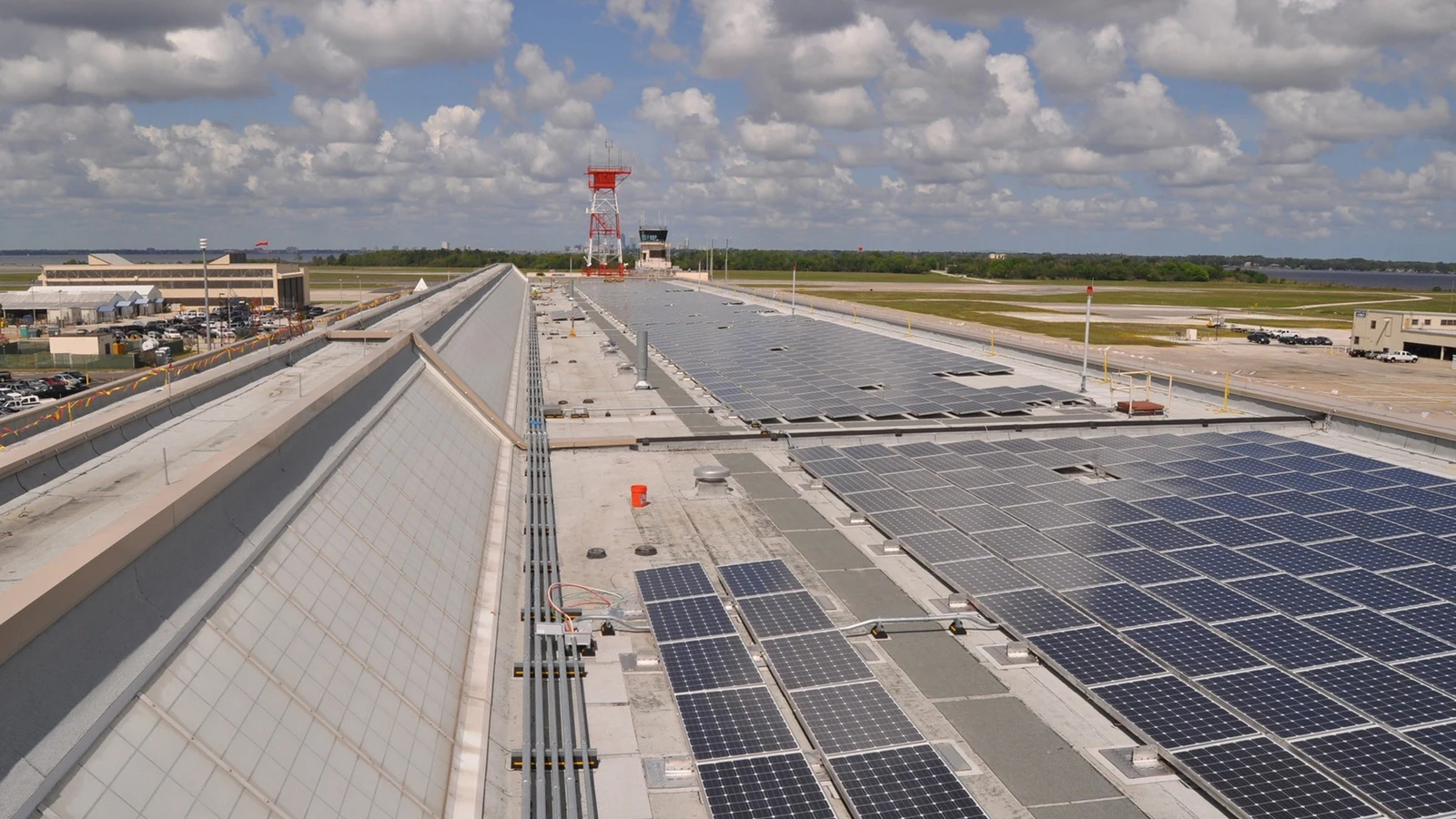
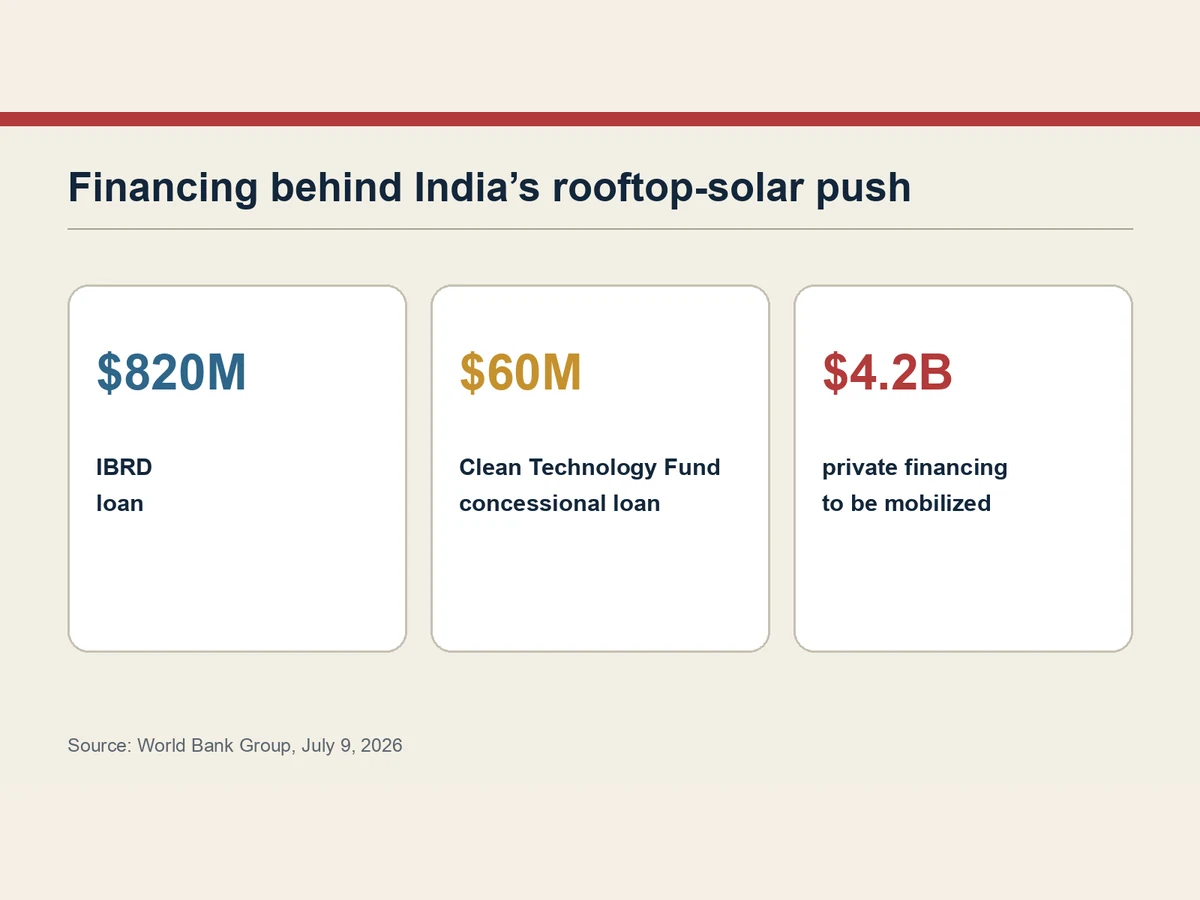
The World Bank approved an $890 million public financing package for India’s national household rooftop-solar program, with a separate goal of mobilizing $4.2 billion in commercial lending.
The package consists of an $820 million International Bank for Reconstruction and Development loan, a $60 million concessional Clean Technology Fund loan and a $10 million Livable Planet Fund grant.
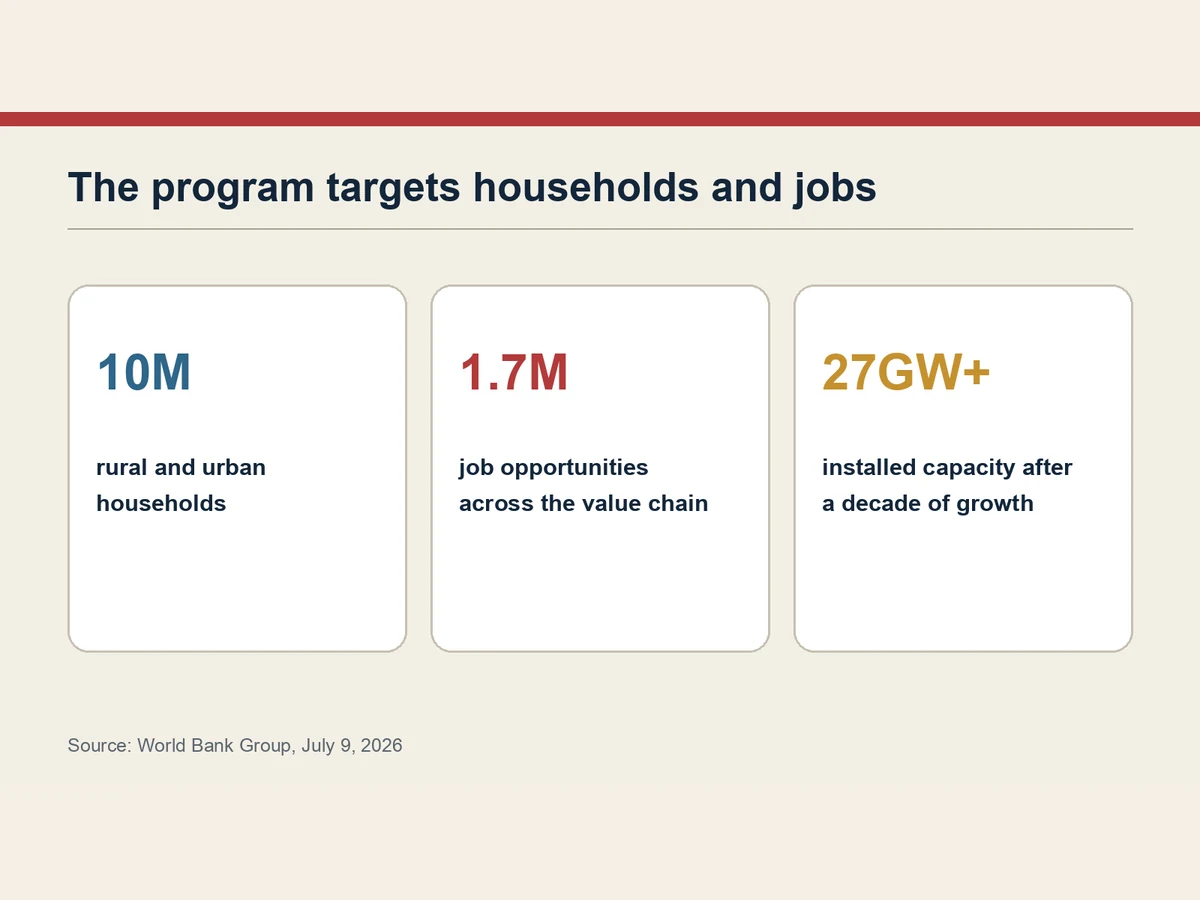
India’s PM Surya Ghar: Muft Bijli Yojana program is designed to encourage rooftop systems for 10 million rural and urban households while lowering electricity costs and supporting domestic manufacturing.
The World Bank projects 1.7 million job opportunities across solar manufacturing, installation and services. That figure describes potential activity across a value chain; it is not a count of positions already created.
The private-finance target is larger than the public package. The bank says it will mobilize $4.2 billion through commercial loans that enable households to install systems, including collateral-free financing.
The institution says its support over the past decade helped India’s rooftop-solar market grow from about 500 megawatts to more than 27 gigawatts of installed capacity.
Residential adoption has nevertheless lagged large-scale solar. Household systems involve credit access, roof suitability, local installers, grid connections and service after installation—barriers that national capacity totals can hide.
India has committed to increase non-fossil-fuel resources to 60% of its electricity mix by 2035 and reach net-zero emissions by 2070. Rooftop systems are one part of that much larger transition.
The financing announcement establishes resources and targets, not completed installations. Progress should be judged by loans actually originated, systems connected, generation delivered and bills reduced.
Distribution matters as much as volume. Future reporting will need to show whether rural and lower-income households can access the financing on workable terms rather than only whether the program reaches a national megawatt total.
The package also separates public risk-bearing from private scale. The $890 million can support program design and lending conditions, but reaching the much larger private target depends on participating banks and households accepting the terms in practice.