
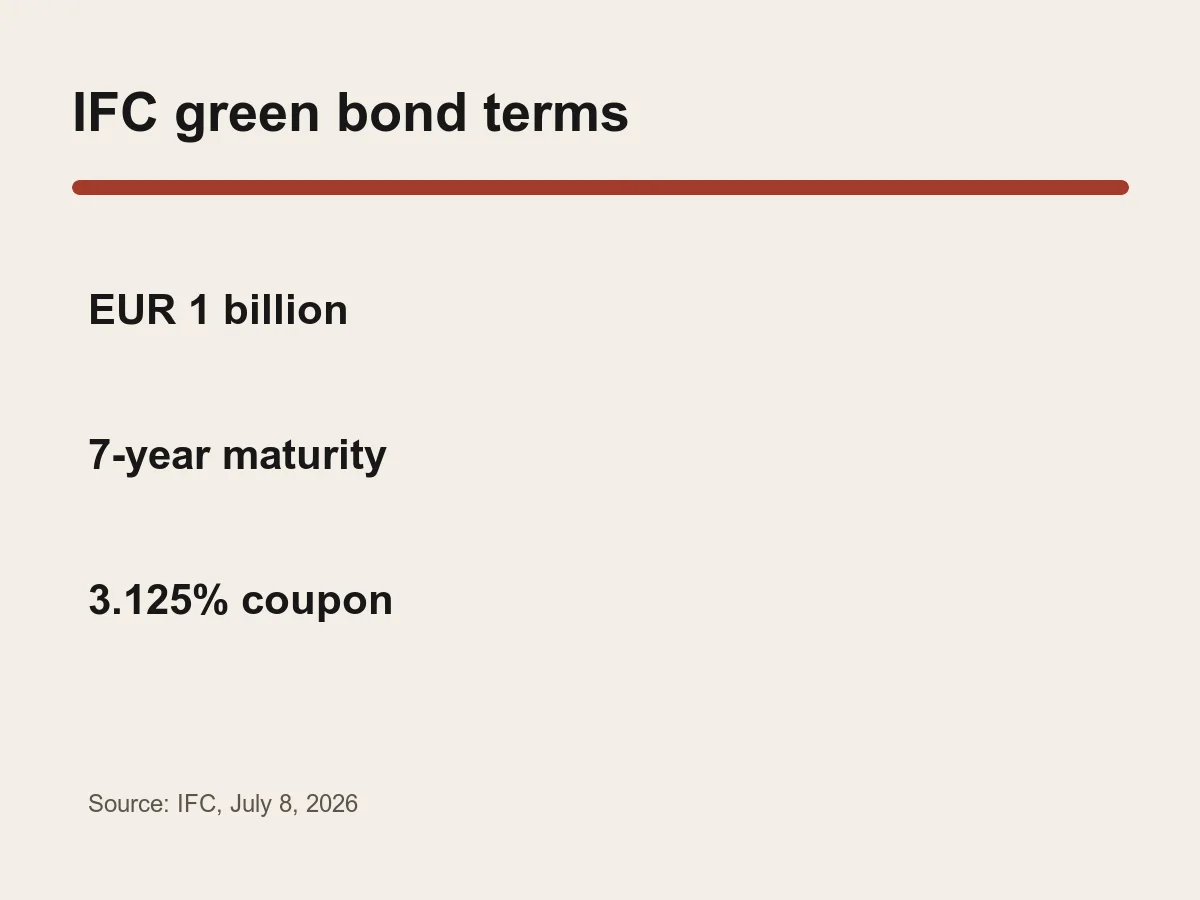
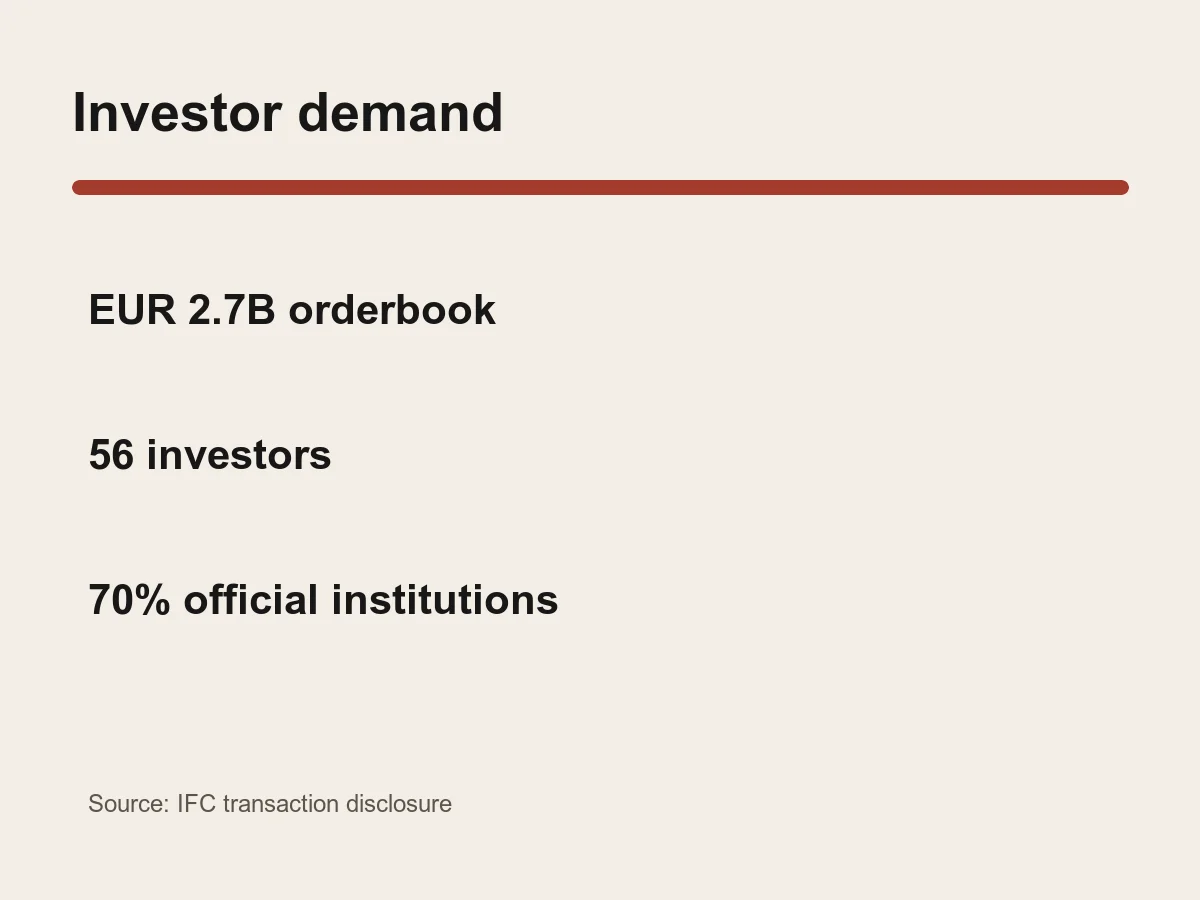
The International Finance Corporation has priced its first euro-denominated benchmark bond, a €1 billion seven-year green bond that drew orders totaling €2.7 billion from 56 investors.
IFC, the private-sector development arm of the World Bank Group, set a 3.125% semiannual coupon. The bond was priced at 99.952% for a 3.132% issue yield and is scheduled to mature Aug. 15, 2033.
A benchmark issue is designed to be large and liquid enough to serve as a reference in its market. Entering the euro benchmark market gives IFC another funding channel and a wider European investor base alongside its dollar, Australian-dollar and private-placement programs.
The orderbook was 2.7 times the issued amount. IFC reported that central banks and official institutions received 70% of the allocation, banks and corporate treasuries 17%, and asset managers, insurers and pension funds 13%.
By geography, 69% went to investors in Europe, the Middle East and Africa, 23% to Asia and 8% to the United Kingdom. Barclays, BNP Paribas, Crédit Agricole CIB and TD Securities served as joint lead managers.
The green label does not mean bondholders select individual projects. IFC raises funds under a framework that defines eligible uses and reporting, then allocates proceeds to financing associated with objectives such as climate mitigation, adaptation, biodiversity, water protection and circular-economy activity.
IFC said the issue is its second transaction under an updated green-bond framework published in July 2026. S&P Global Ratings provided a second-party opinion that the framework aligns with the International Capital Market Association's Green Bond Principles.
A second-party opinion reviews the framework, not the future performance of every financed project. Investors still face issuer, interest-rate and market risks, while the environmental outcomes depend on allocation, implementation and later reporting.
The transaction's immediate significance is financial infrastructure: IFC established a euro benchmark curve point and attracted demand well above the final issue size. The development impact must be assessed through the projects and allocation reports that follow.