Global hunger declined for a third consecutive year in 2025, reaching an estimated 645 million people, but progress was uneven and Africa now carries the largest absolute burden, according to the 2026 State of Food Security and Nutrition in the World report.
The five-agency UN assessment estimates that 7.8% of the world’s population faced hunger, down from 8.1% in 2024 and 8.6% in 2022. That represents about 14 million fewer people than a year earlier and 43 million fewer than in 2022.
Regional results moved in different directions. Asia and Latin America and the Caribbean recorded continued improvement. Africa had about 309 million hungry people in 2025, compared with 292 million in Asia, even as Africa’s prevalence rate edged down from 20.3% to 20.0%.
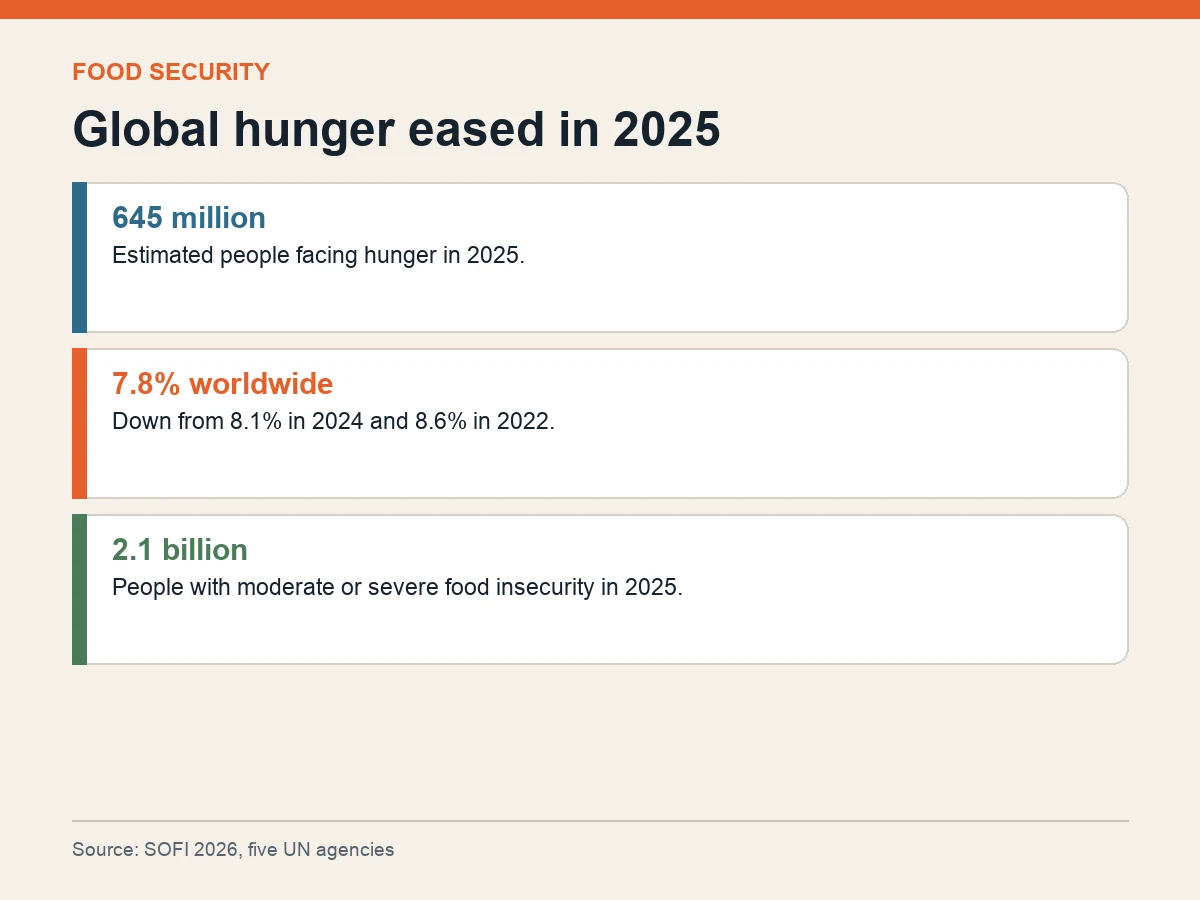
A broader measure shows how many people live near the edge of adequate access. About 2.1 billion people—25.8% of the global population—experienced moderate or severe food insecurity, meaning they sometimes compromised the quality or quantity of food they ate.
Africa’s rate on that broader measure was 56.6%, compared with 20.3% in Asia, 22.9% in Latin America and the Caribbean, and 8.7% in Northern America and Europe.
Affordability remains a separate barrier. The average global cost of a healthy diet rose to 4.28 purchasing-power-parity dollars per person per day in 2025, from 3.44 in 2021 and 2.94 in 2017. PPP dollars are designed for cross-country price comparison and are not cash prices in U.S. currency.
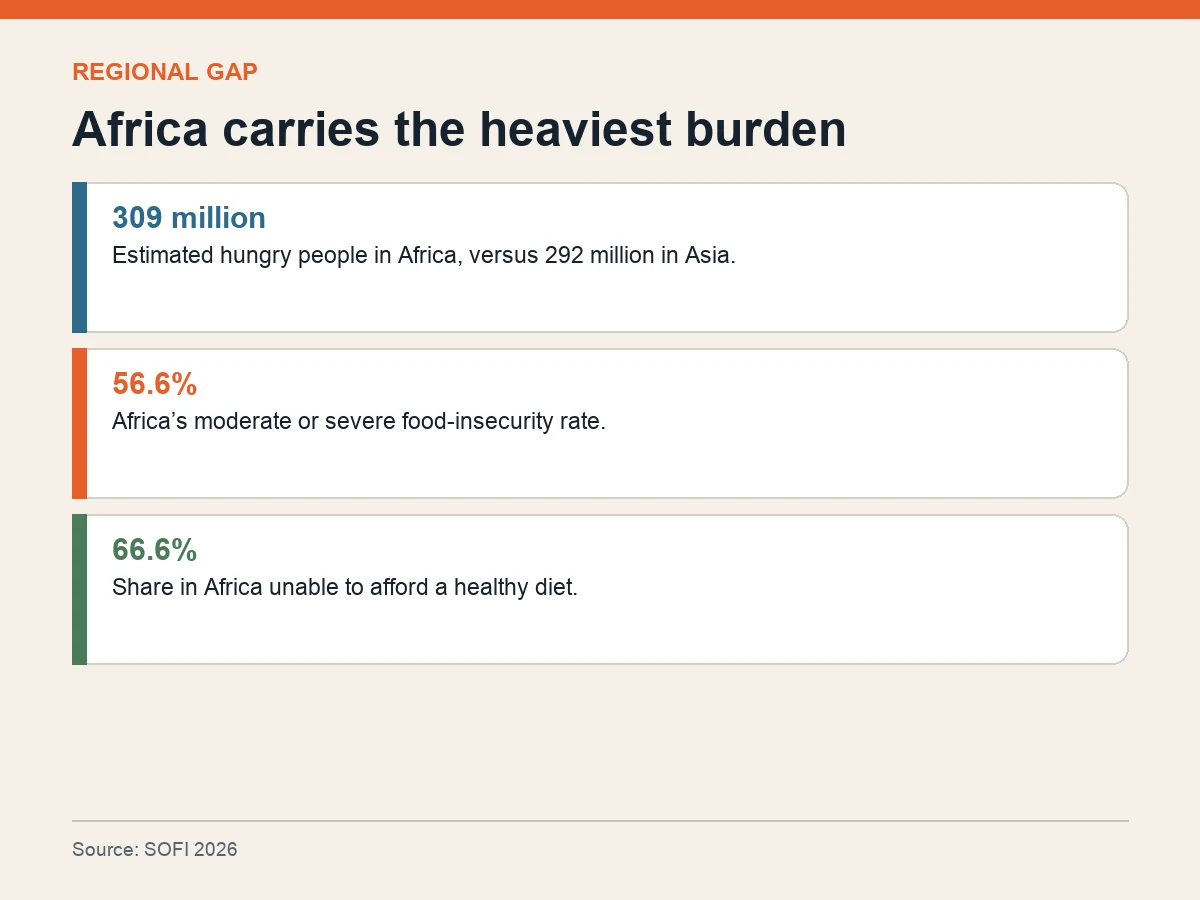
The number of people unable to afford a healthy diet nevertheless fell to 2.69 billion, or 32.7% of the global population, from 2.97 billion in 2021. In Africa, affordability worsened: 66.6% of people could not afford the benchmark diet.
Nutrition indicators remain troubling. Only 30.8% of children ages 6 to 23 months consumed a minimally diverse diet, and 150 million children under 5 were stunted. Adult obesity rose from 12.1% in 2012 to 16.2% in 2024.
These are estimates built from national data and statistical models, not a head count of every household. The report’s 2030 projections also omit some possible shocks, including weather effects from El Niño in 2026 and 2027.
The global direction improved, but the distribution did not. Progress toward lower hunger can coexist with worsening conditions in specific regions, higher diet costs and persistent child malnutrition—three reasons the headline decline does not amount to an all-clear.