
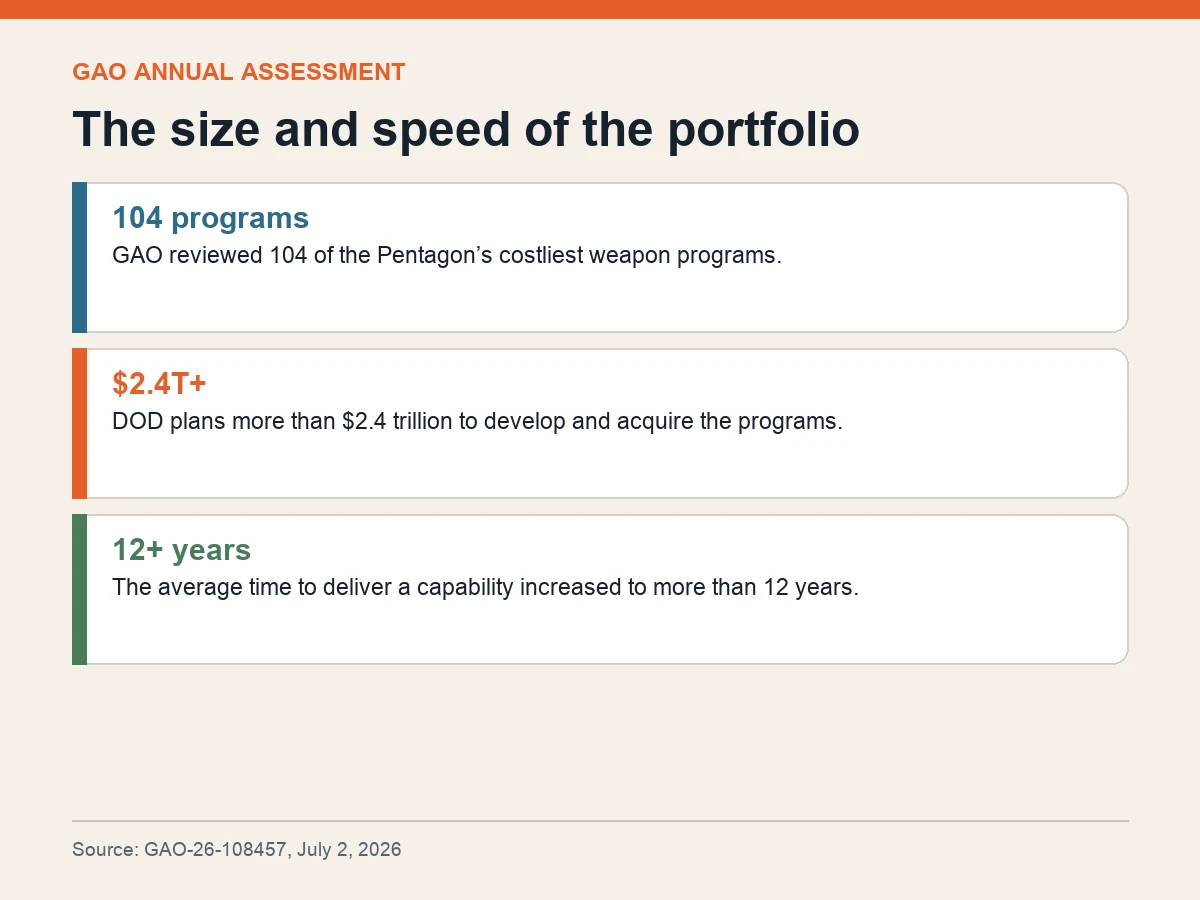
The Pentagon’s major weapon programs now take more than 12 years on average to deliver a capability, even as the department shifts more projects onto a rapid-acquisition pathway designed to finish in five years.
The Government Accountability Office reached that finding in its 24th annual weapon-systems assessment, covering 104 of the Department of Defense’s costliest programs. DOD plans to invest more than $2.4 trillion in developing and buying the systems included in the review.
The portfolio average is not a delivery date for every program. It is a warning about the direction of the system as a whole. GAO says key decisions and interim milestones continue to slip, and several programs have not established new delivery dates after delays, making the published 12-year average likely to rise.
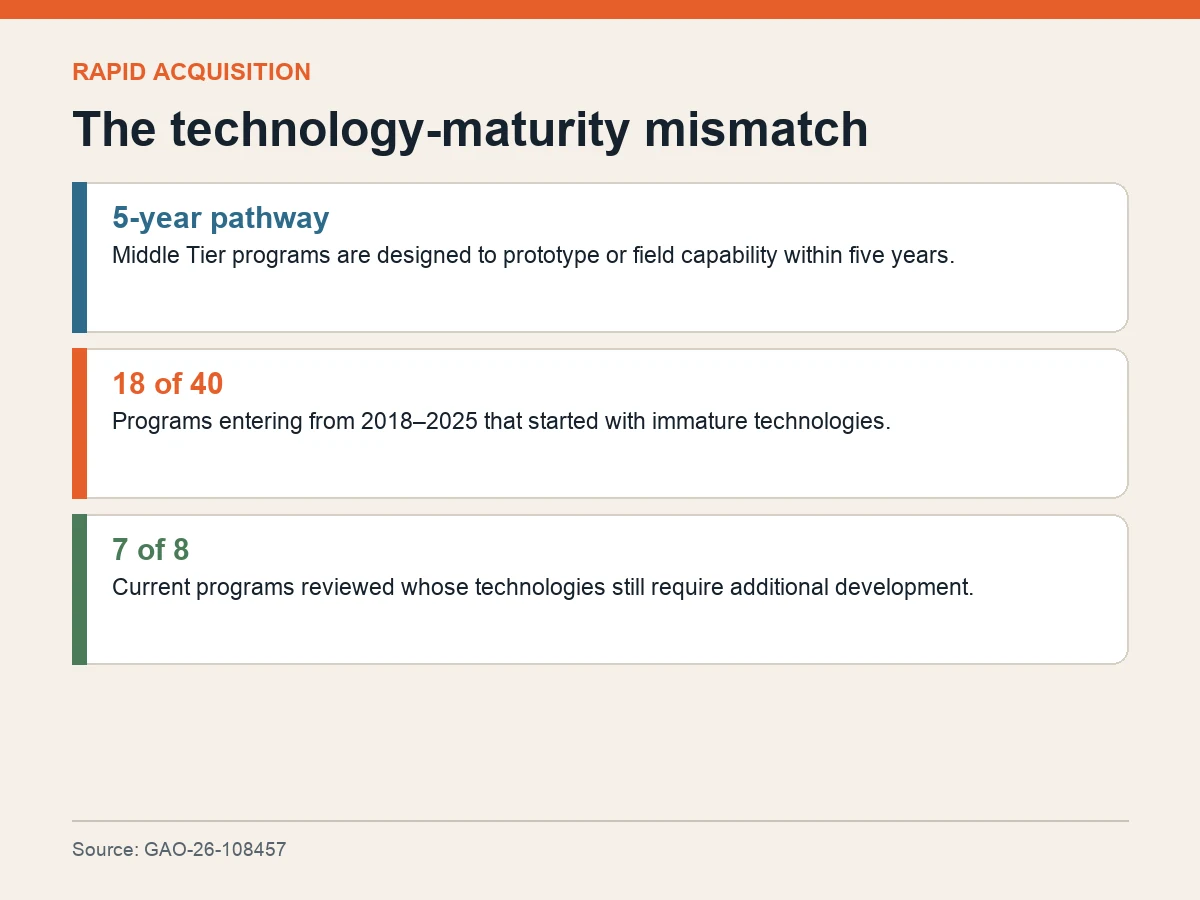
The department has increasingly used Middle Tier of Acquisition pathways for rapid prototyping and fielding. Those pathways are intended to complete within five years, but GAO found that nearly half of the programs entering them between 2018 and 2025 began with technologies that were not mature.
That mismatch is measurable. Eighteen of 40 programs entered the pathway with immature technologies. Among eight current programs examined more closely, technologies for seven remained immature and required additional development, while some rapid-pathway efforts ended without delivering a fieldable capability.
GAO separates technical ambition from acquisition design. A program can pursue difficult technology, but the watchdog argues that immature components should be developed separately until they are ready to be integrated into a delivery-focused effort. Otherwise, the five-year clock begins while fundamental technical work is still unresolved.
The financial scale is substantial. DOD plans at least $49 billion across 23 of its most expensive Middle Tier programs. That figure is not the cost of all rapid acquisition, but it shows why schedule discipline in the portfolio matters beyond any single system.
GAO recommended that acquisition policy require programs integrating multiple technologies to begin with mature technologies or to develop the immature pieces outside the rapid-delivery program. DOD concurred, leaving implementation—not agreement over the principle—as the next test.
The report does not say every delay is avoidable or that speed should replace testing. Its narrower conclusion is that a pathway built for rapid delivery cannot reliably perform that role when it is also asked to finish basic technology development after the clock has started.