
The federal government spent about $7 trillion in fiscal 2025, yet its official public spending portal still does not consistently capture some nontraditional agreements and contains unresolved problems in subaward data, according to the Government Accountability Office.
USAspending.gov is designed to let lawmakers, program managers and the public trace federal awards. Agencies are required to report spending data, and GAO credits the government with progress, but its latest testimony says completeness and accuracy still vary by award type and reporting layer.
One gap involves “other transaction agreements,” legally binding arrangements that are neither standard procurement contracts nor grants and can operate outside parts of federal acquisition law. GAO says agencies do not consistently report them to USAspending.gov.
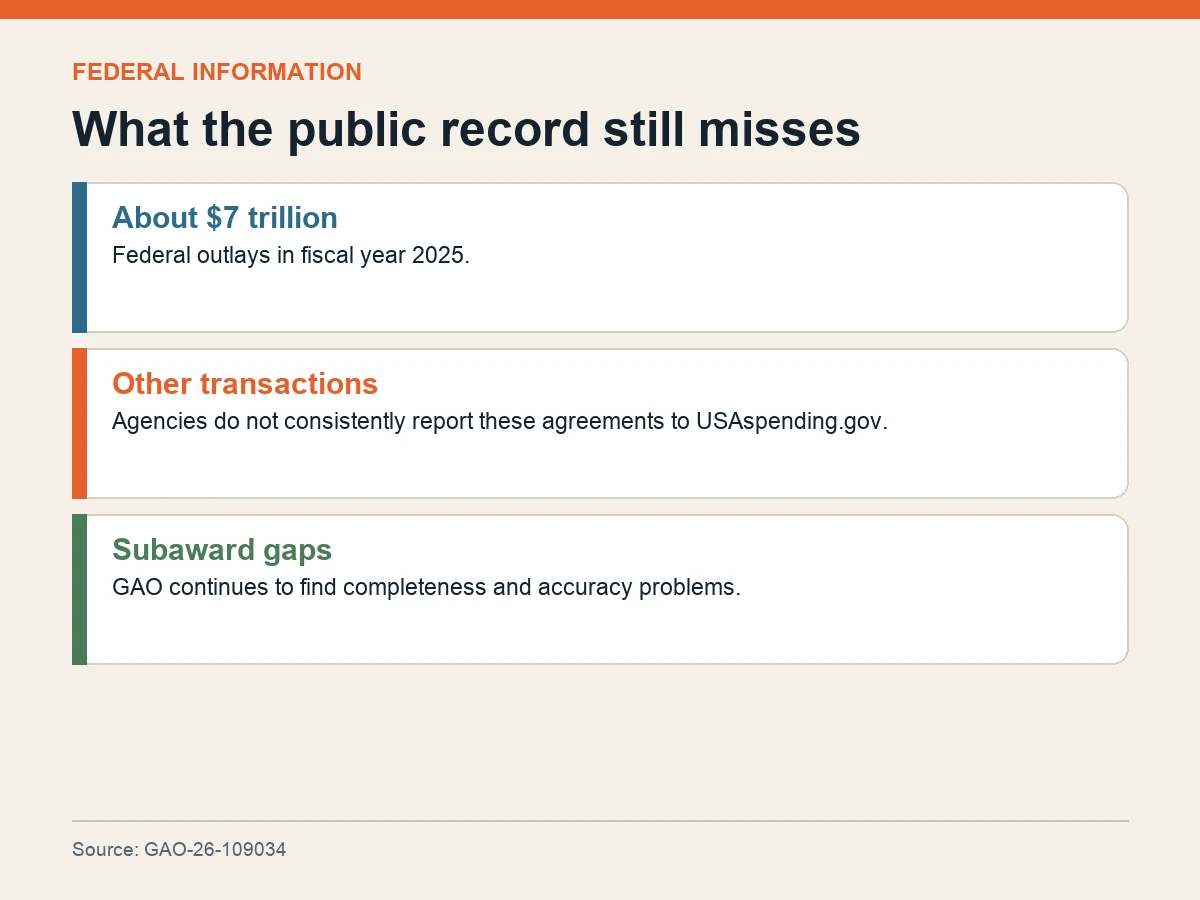
A second problem appears after a prime recipient passes money to a subrecipient. GAO has repeatedly found completeness and accuracy issues in those subaward records, which can make it harder to follow funds beyond the first award.
The testimony does not estimate a single missing-dollar total. That is an important boundary: the roughly $7 trillion figure describes all fiscal 2025 outlays, not the amount absent or incorrect on USAspending.gov.
GAO connects data quality to program integrity. Fifteen agencies reported an estimated $186 billion in improper payments across 64 programs for fiscal 2025, but “improper” is a broader accounting category than proven fraud; it can include incorrect amounts or payments lacking adequate documentation.
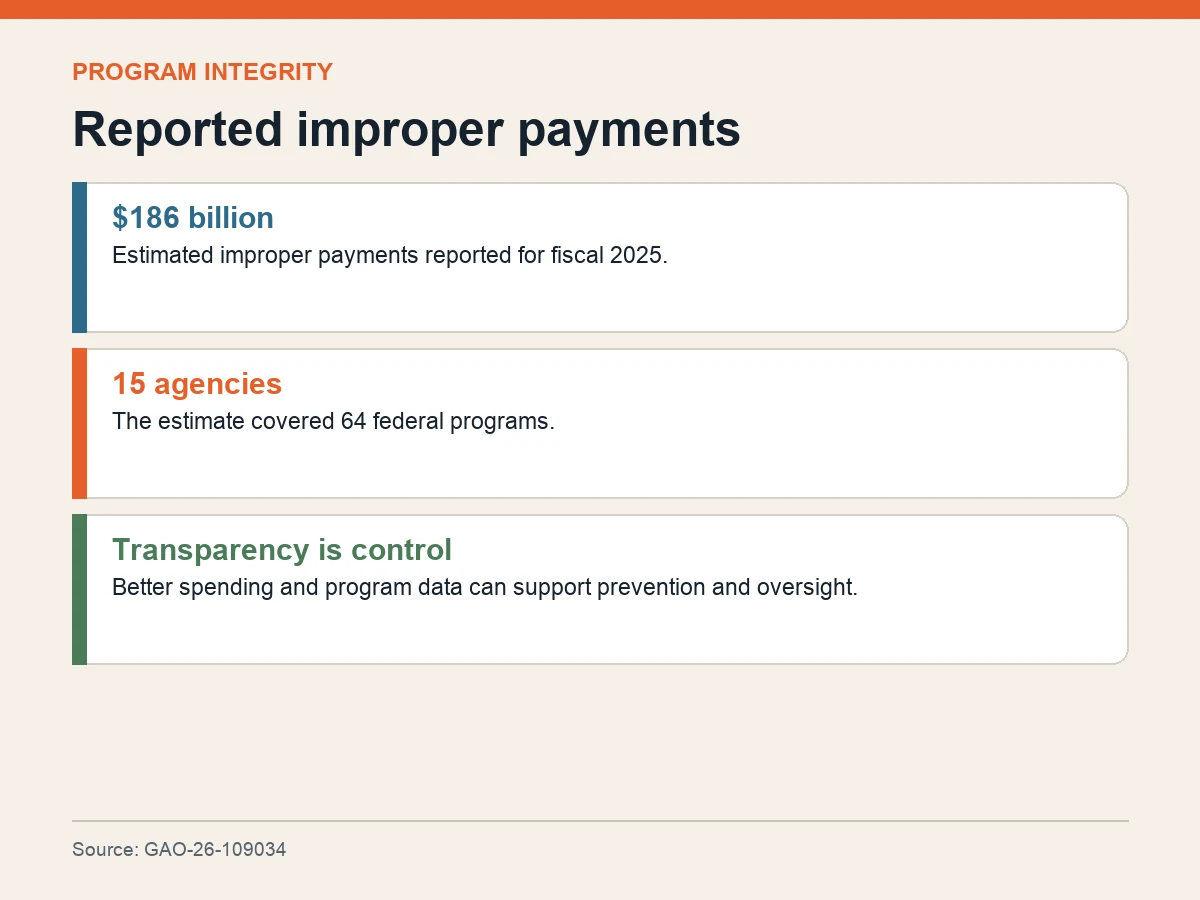
Transparency also depends on program inventories and access to records. GAO’s testimony draws on earlier work involving the Federal Program Inventory and Freedom of Information Act backlogs, arguing that public spending data is most useful when it can be matched to clear program purposes and performance.
The watchdog has recommended agency action and asked Congress to consider legislation, including requirements covering other transaction agreements. Some recommendations have been implemented, while others remain open.
The practical accountability test is whether a reader can follow a federal dollar from authorization through award and subaward, identify the program it supports and compare spending with results. GAO’s evidence says the system still breaks that chain often enough to limit oversight.