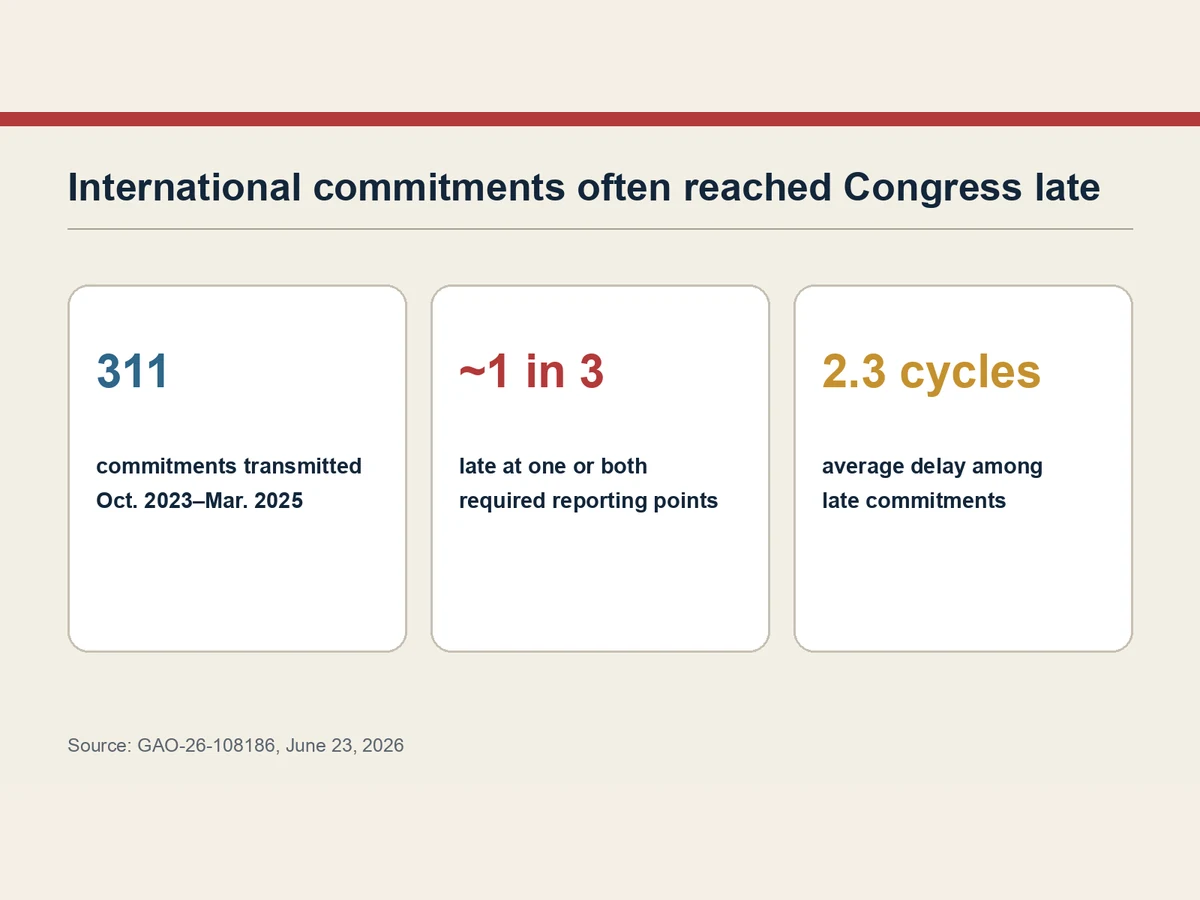
The State Department reported nearly one-third of 311 qualifying international commitments late at one or both required points, according to a Government Accountability Office review of commitments made from October 2023 through March 2025.
The amended Case-Zablocki Act expanded reporting beyond binding international agreements to include qualifying nonbinding instruments. State must transmit information to Congress and make specified material available to the public on a recurring schedule.
GAO found that late commitments reached Congress an average of 2.3 reporting cycles after they were due. One commitment was nearly five months late, showing that the problem extended beyond a short administrative slip.
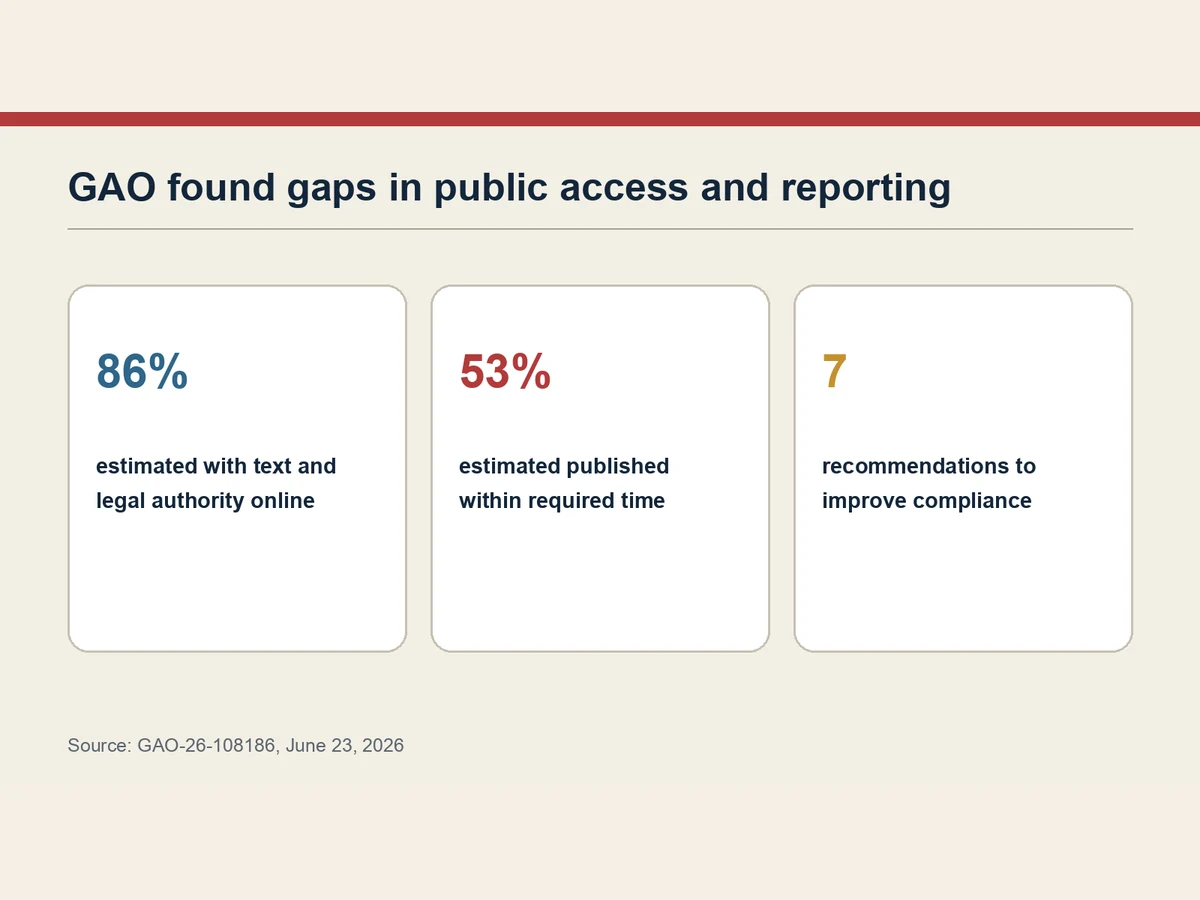
Public access was uneven as well. From a generalizable sample, GAO estimated that about 86 percent had both the text and legal authority online, but only about 53 percent were published within the required time.
The information also sat across four State web pages without one search tool spanning country, agency and subject. That fragmentation can make formal compliance difficult to translate into practical access for Congress, researchers and the public.
GAO attributed gaps to incomplete procedures, oversight and technical processes. It issued seven recommendations covering timely transmission, publication, internal controls and a more usable public website.
State concurred with five recommendations and did not concur with two. Disagreement does not close the matter: GAO will track implementation, while the department can pursue alternative steps if they address the underlying findings.
The percentages require care. They are estimates from a sample, not exact counts for every public-access attribute across all 311 commitments. The lateness finding for the transmitted commitments is the more direct corpus-wide measure.
The report gives oversight bodies a baseline after the law changed. The next test is whether later reporting cycles show fewer delays, more complete publication and a public interface that lets users find commitments without knowing which State page to search.