
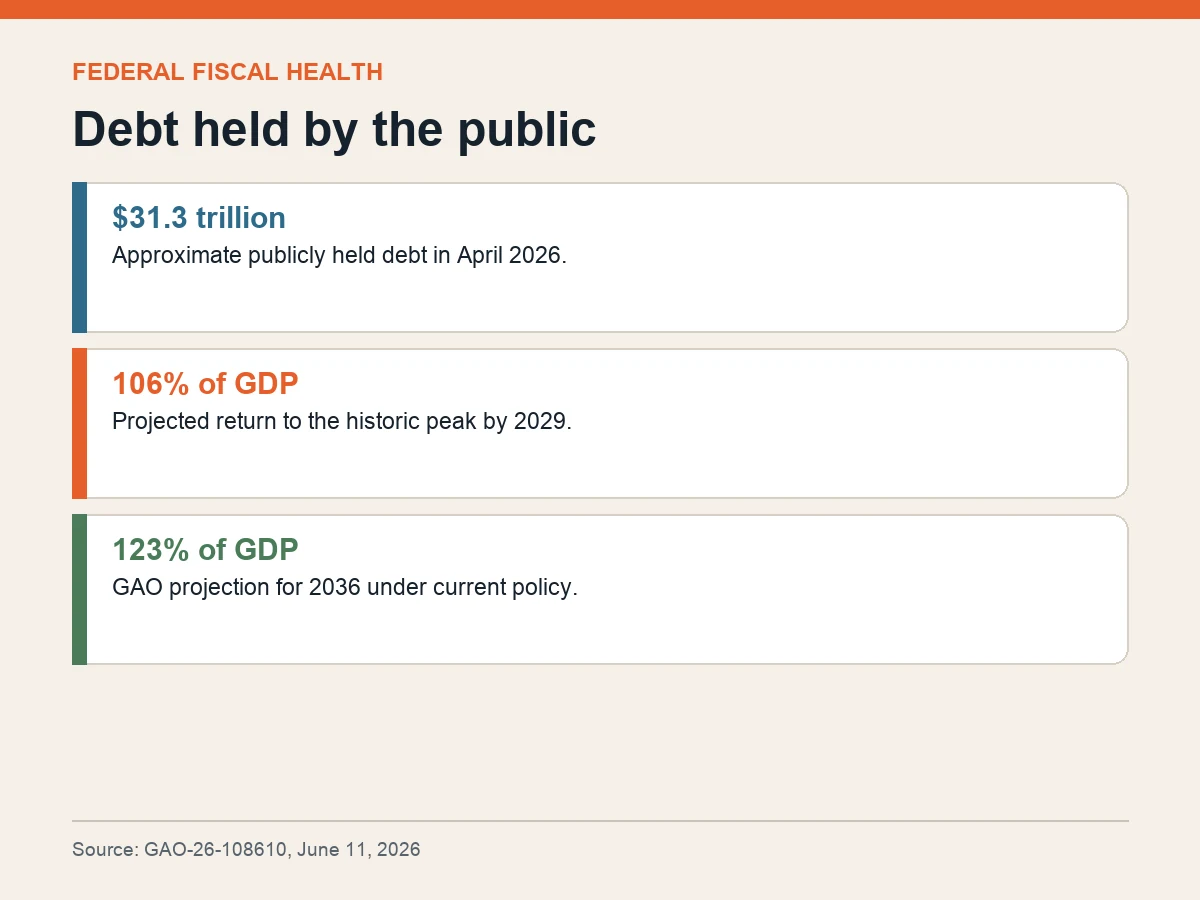
Debt held by the public reached about $31.3 trillion in April 2026—roughly the size of the U.S. economy—and is projected to climb to 123% of gross domestic product by 2036 under current policy, the Government Accountability Office says.
The ratio matters because it compares federal obligations held outside government accounts with the economy that supports revenue. GAO projects the measure will return to its previous historic peak of 106% of GDP by 2029, then keep rising.
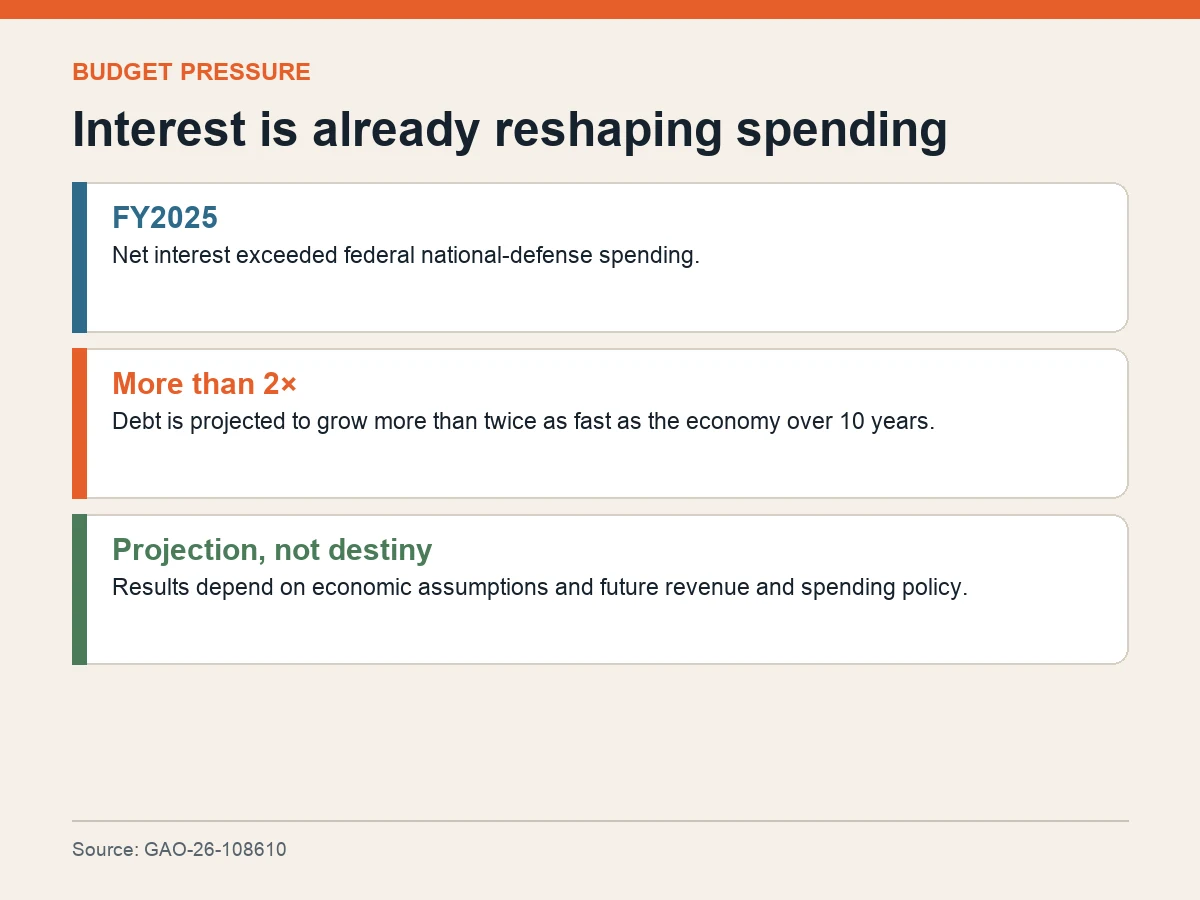
Over the coming decade, publicly held debt is projected to grow more than twice as fast as the economy. That divergence means economic growth alone would not stabilize the debt ratio under the report’s assumptions.
Interest is already reshaping the budget. Net interest spending exceeded federal national-defense spending in fiscal 2025 and is projected to continue increasing as outstanding debt and financing costs accumulate.
This is debt held by the public, not gross federal debt. The public measure excludes intragovernmental holdings such as Treasury securities held by federal trust funds, making the definition crucial when comparing figures from different sources.
The projection is also conditional, not a fixed prediction. Future legislation, tax receipts, program spending, inflation, growth and interest rates can move the path. GAO models current revenue and spending policies to show what happens if structural imbalances persist.
The watchdog identifies Social Security, federal health programs and interest as major long-term drivers, while warning that abrupt policy responses can impose larger economic and social costs than changes phased in earlier.
GAO has repeatedly recommended that Congress establish a broad fiscal plan with targets and rules. Such a framework would not itself choose between spending reductions and revenue increases, but it would require lawmakers to define a sustainable path and measure progress.
The report’s central signal is therefore the direction and speed of change. A debt ratio near 100% is not the endpoint in GAO’s model; it is the starting point for another decade in which federal obligations rise substantially faster than national output.