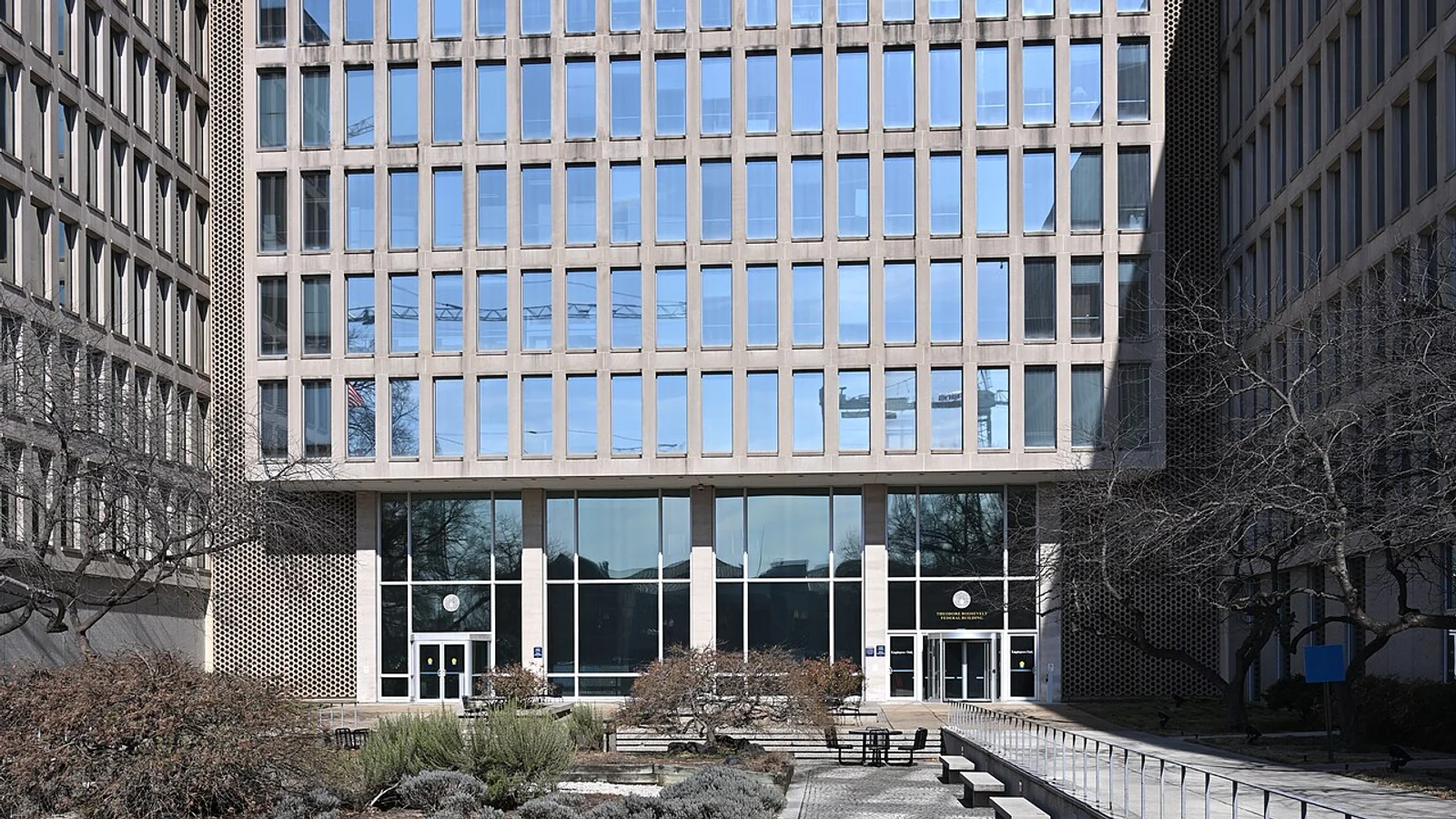
The federal government’s central human-resources agency lost 1,052 employees in 15 months, a 35% reduction that the Government Accountability Office says risks deepening skills gaps and weakening operational capacity.
The Office of Personnel Management’s headcount fell between Dec. 31, 2024, and March 31, 2026, according to a GAO analysis released July 20. OPM also reported eliminating 10 offices as it reorganized in response to presidential directives and new agency plans.
The watchdog’s two-page overview is descriptive, not a finding that every service has failed. It does say the losses reduced institutional knowledge while OPM was taking on additional responsibilities in some units.
The decline reached both ends of the age range
Employees age 60 and older experienced a 49% headcount decline. Among OPM staff under 30 who separated, 60% were still in probationary periods; across all employees who left, 23% were probationary.
GAO reported that 59% of separations occurred through a deferred-resignation program and 10% through a reduction in force. Those are shares of departures, not shares of OPM’s entire pre-reduction workforce.
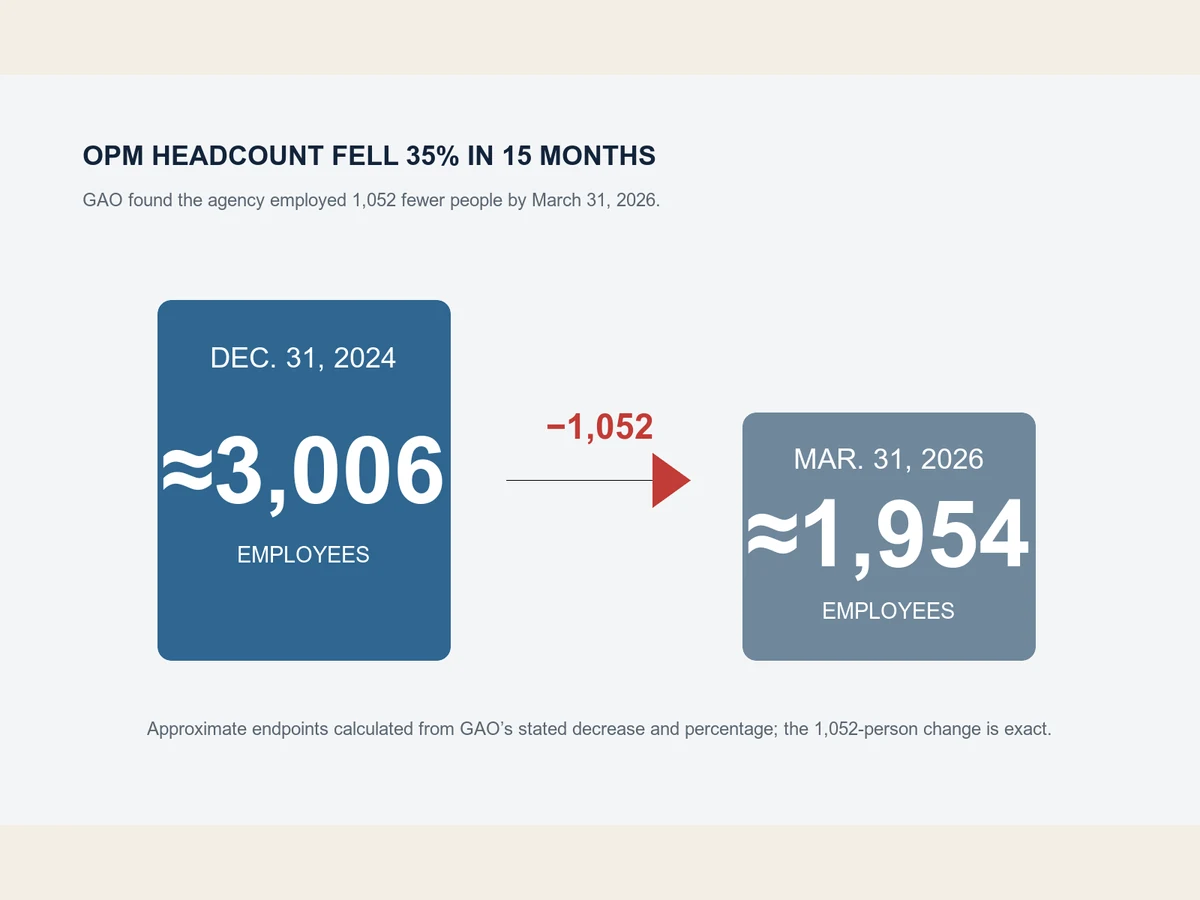
The graphic’s endpoint headcounts are approximate because GAO’s public overview gives the exact 1,052-person decrease and rounded 35% rate. The report’s central finding does not depend on reconstructing a more precise starting total.
Some mission offices lost nearly half their staffing
From fiscal 2024 to fiscal 2026, OPM reported full-time-equivalent declines of 49% in the Office of the Chief Information Officer, 45% in Workforce Policy and Innovation and 41% in Merit System Accountability and Compliance.
Human Resources Solutions fell 36% and Retirement Services fell 16%. The Office of General Counsel increased 21%, while the Office of the Director increased 79%; GAO says the two growing offices absorbed functions from other units.
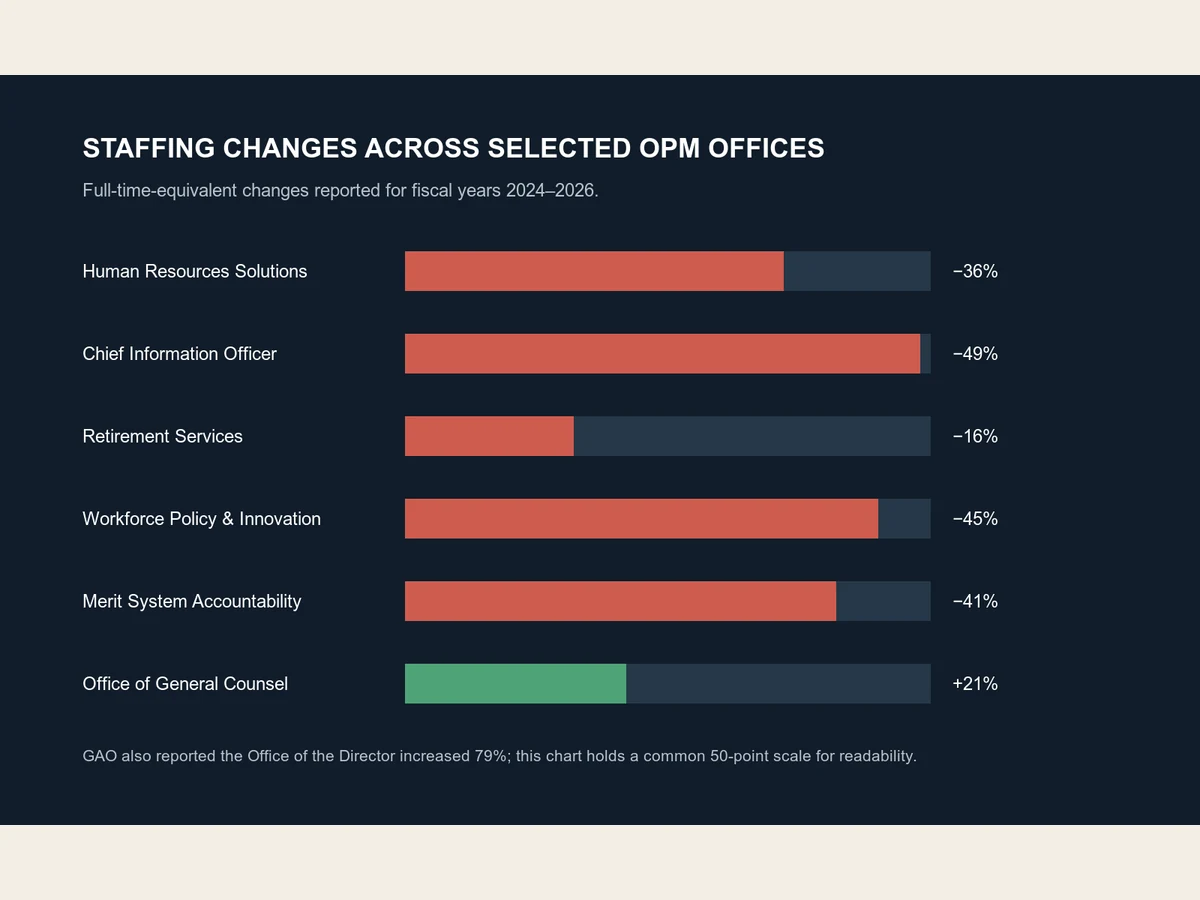
Staffing percentages alone do not measure workload, productivity or service quality. They do show where OPM says capacity shifted, and they establish the scale of change facing offices that manage federal hiring, retirement, information technology and merit-system oversight.
Experienced departures drive the institutional-risk warning
Fifty-seven percent of employees who separated had at least 11 years of service, including 226 people with 31 or more years. GAO links that experience loss to a long-standing government-wide high-risk issue: gaps in critical skills and succession planning.
OPM has not completed a 2023 GAO recommendation to make an action plan for its identified skills gaps. Agency officials told the watchdog they were prioritizing workforce changes aligned with OPM’s fiscal 2026–2030 strategic plan.
The OPM inspector general separately identified workforce reduction as a top management challenge for 2026, citing immediate operational-capacity gaps. GAO used that assessment as corroborating context, not as a substitute for its own workforce-data analysis.
GAO could not get a complete account from OPM
GAO asked OPM for documents explaining office and program changes, their rationale, expected costs and benefits, and workforce-planning processes. The watchdog says OPM commented on a preliminary draft but otherwise did not provide the requested materials, agree to meetings or answer written questions.
That limits the report. GAO says it cannot provide complete information on every change, its justification or its effect on OPM’s mission. The absence of those records in the review is not proof that every change harmed performance.
OPM’s fiscal 2027 budget proposal points toward technology modernization and possible use of artificial intelligence in offices with fewer staff. Those plans are prospective; the July review does not demonstrate that new tools have replaced the lost capacity.
The oversight question now is measurable performance: whether retirement processing, hiring support, federal workforce data, merit oversight and technology operations remain timely and reliable with fewer people and a different organizational map.