
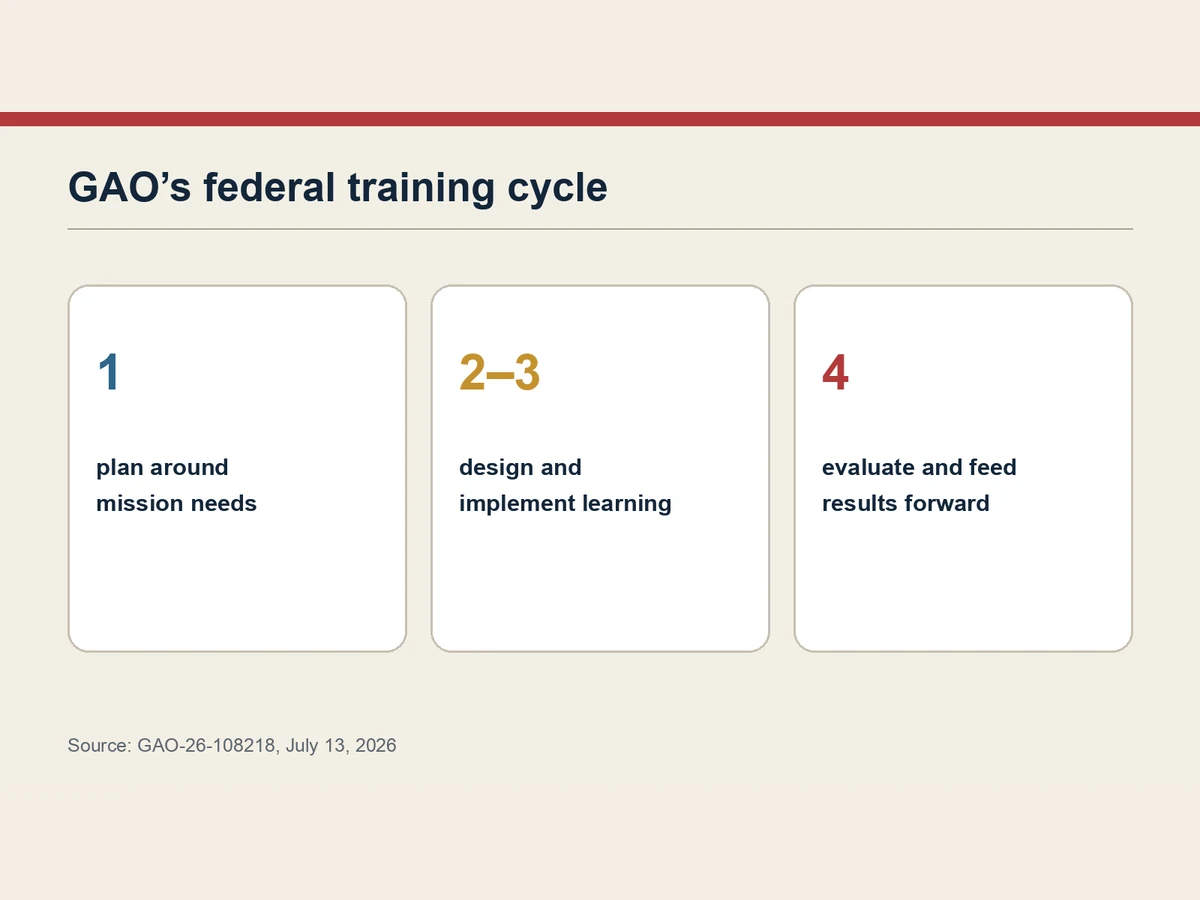
The Government Accountability Office has replaced its 2004 federal training guide with a framework built around a continuous four-part cycle: planning, design and development, implementation, and evaluation.
The update arrives after workplace learning shifted well beyond the classroom. GAO now addresses blended and online instruction, coaching, mentoring and technology-assisted training, including changes associated with artificial intelligence.
The guide’s central rule is alignment. Agencies should begin with mission priorities and workforce needs, then design learning that addresses identified skills rather than treating course delivery as the goal.
Implementation covers resources, instructors, technology, access and the operating conditions needed to make a program usable. A well-designed course can still fail if employees cannot attend or apply the learning to their work.
Evaluation is not reserved for the final survey. GAO says agencies should measure throughout the cycle and feed results back into planning and design, including whether training changes individual and organizational performance.
Across the four components, GAO identifies nine core characteristics, including stakeholder involvement, resource allocation and an emphasis on results such as improved customer service or public safety.
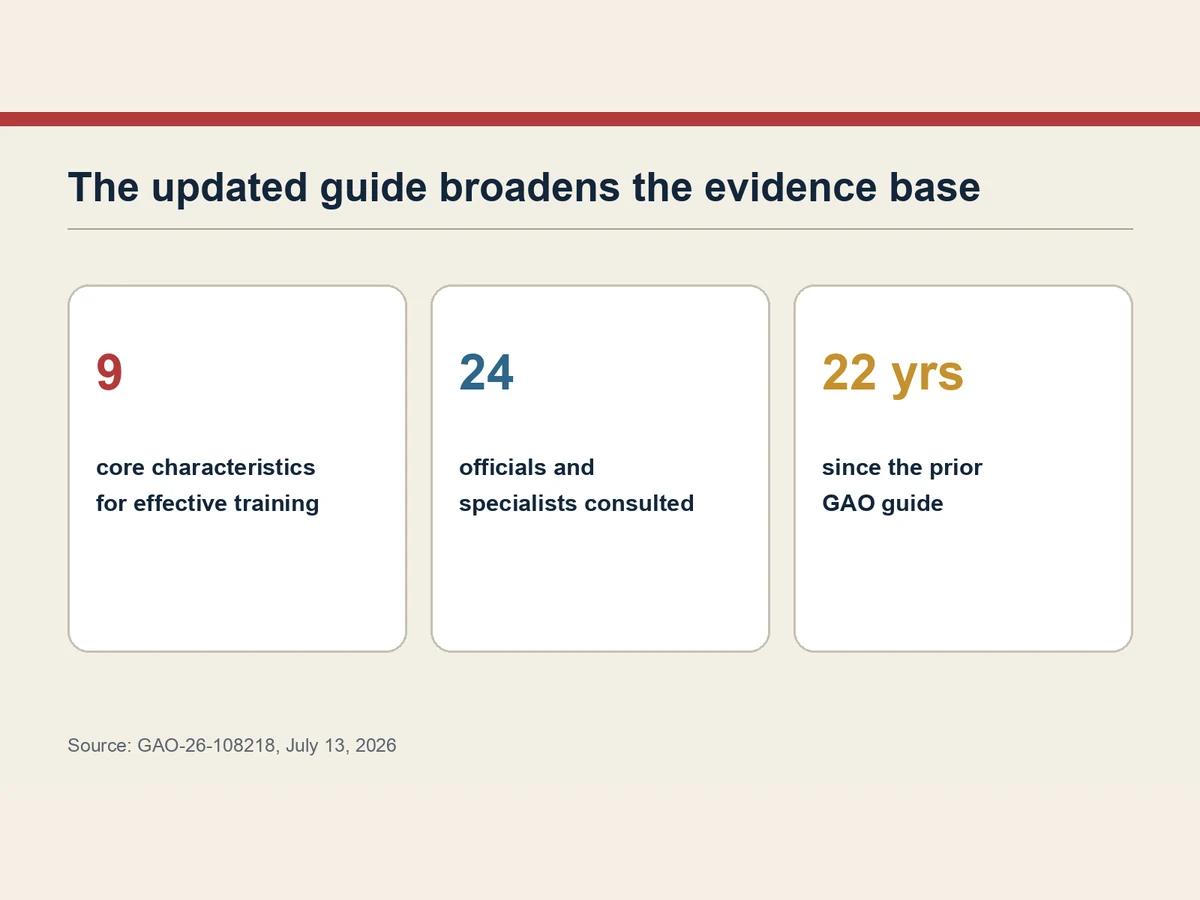
The update draws on a literature review and consultation with 24 knowledgeable officials and specialists from government, business, academia and nonprofit organizations. Those participants validated older practices and identified changes from the past two decades.
The document is a guide, not an audit conclusion that agencies already meet the standard. Managers and oversight bodies can use its questions to assess an agency-wide system or a particular program.
That distinction matters for accountability. Completion rates can show that employees attended, but they do not establish that a program improved decisions, service or safety. The framework asks agencies to connect those layers with evidence.
The practical test will come in budgets and reviews: whether agencies define the performance problem before buying training, collect measures beyond attendance and revise programs when results do not support the investment.