
Federal agencies often cannot show whether programs are solving the problems they were created to address because managers lack clear goals, relevant outcome data or strong evaluations, the Government Accountability Office says in a new synthesis of its work.
The distinction begins with what gets measured. Inputs show resources such as money and staff. Outputs count activity, such as how many people received a benefit. Outcomes describe whether intended conditions improved. GAO says programs frequently collect the first two without establishing the third.
That gap limits decisions about a program’s return on taxpayer spending. Without measurable goals and outcome evidence, Congress and agency leaders cannot reliably compare related efforts, direct resources toward stronger approaches or identify programs that need redesign.
The watchdog points to one mixed example involving 15 programs at five agencies that serve pregnant women, children through age 5 and their families. Twelve had processes that set goals, collected data and used results. GAO recommended that the remaining three—one each at Agriculture, Health and Human Services, and Veterans Affairs—complete those systems.
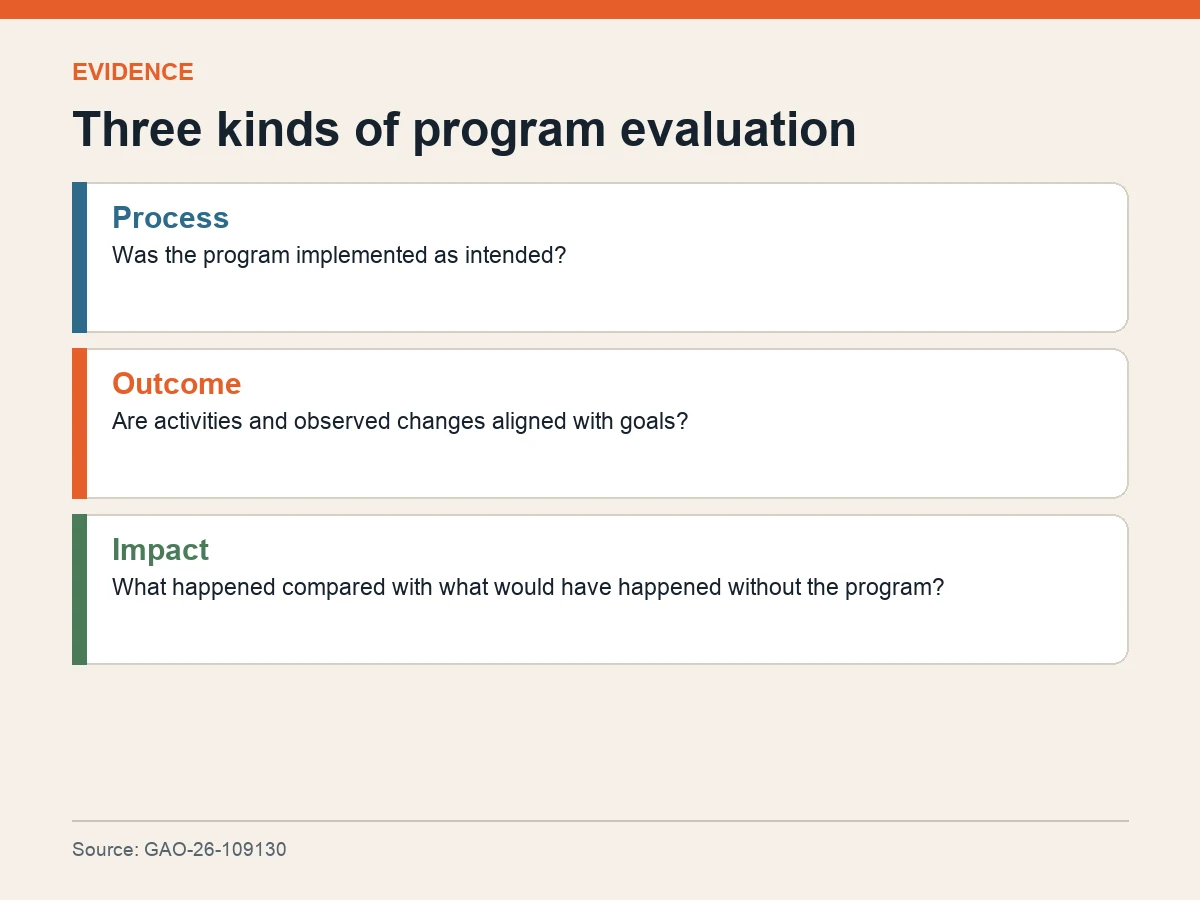
Performance management is not the same as proof of causation. GAO describes three evaluation layers: process studies test whether a program was implemented as intended; outcome studies test whether activities and observed changes align with goals; impact studies compare results with what likely would have occurred without the program.
Access to those stronger studies is limited. In a 2020 survey cited by GAO, about one-third of responding federal managers reported having robust evaluations available to help manage their programs.
The report also offers a positive example. After GAO found in 2019 that Homeland Security’s Securing the Cities program did not fully track local use of funds or assess performance, the program established goals, measures and milestones and began quarterly financial assessments by 2024.
That history shows why the finding should not be read as a declaration that federal programs do not work. GAO is identifying an evidence problem: some programs may be effective, ineffective or mixed, but managers lack enough information to tell with confidence.
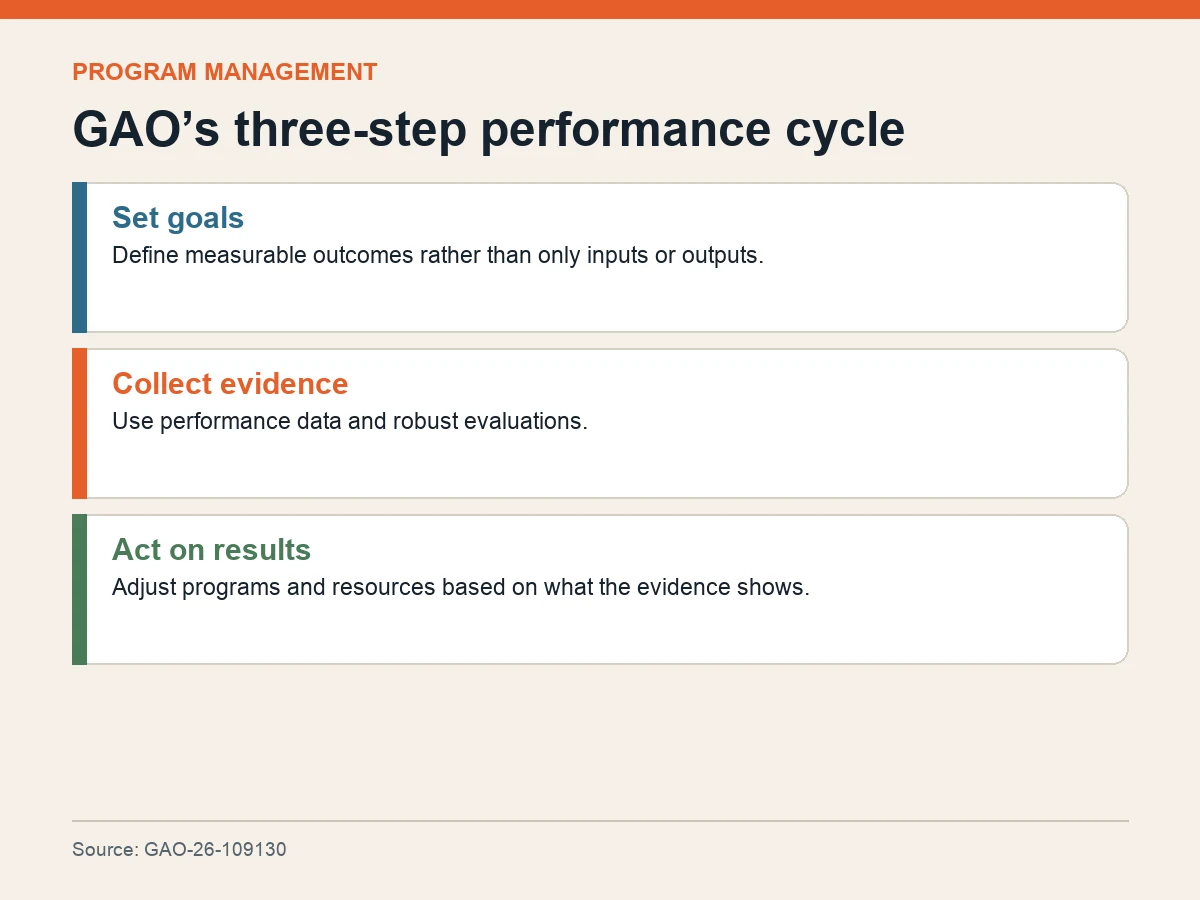
The practical standard is a continuous loop. Agencies should define measurable outcomes, collect credible evidence and use the results to improve delivery. Congress then needs comparable information across related programs to decide where coordination, consolidation or new investment would produce the best public result.