
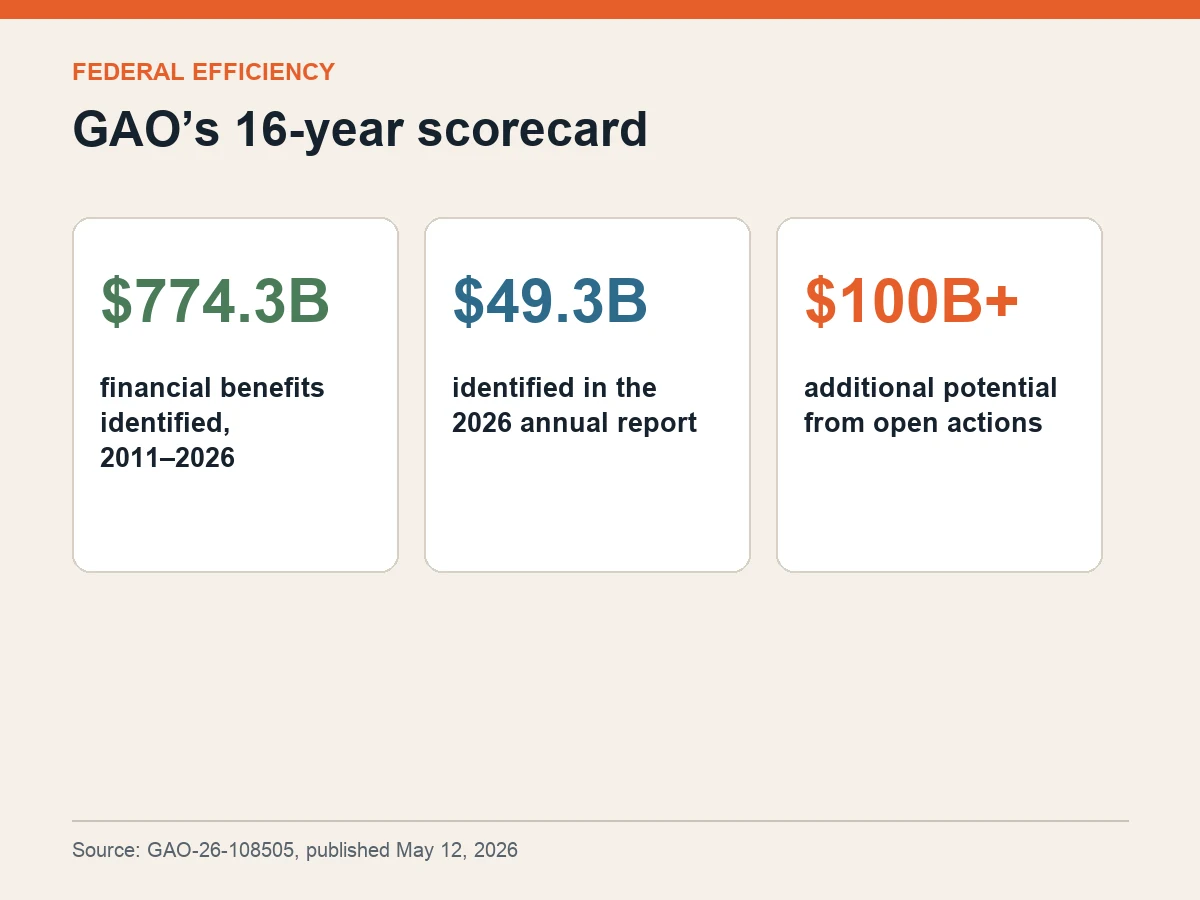
Unfinished federal efficiency actions could produce at least $100 billion in additional financial benefits, the Government Accountability Office says in its 16th annual review of duplicated, overlapping and fragmented programs.
The report is also a long-run scorecard. GAO credits congressional and agency actions responding to its work with about $774.3 billion in financial benefits from 2011 through 2026. Of that total, $49.3 billion was identified in the latest annual report.
Those figures are not a single audited savings account. GAO describes them as rough estimates assembled from different time periods, data sources, assumptions and methods, rounded to the nearest $100 million. They include cost savings and enhanced revenue collection.
The 2026 report adds 97 matters for Congress and recommendations for agencies across 38 new topic areas. Seventeen involve duplication, overlap or fragmentation; others identify ways to save money, increase revenue or improve program effectiveness.
Examples range across government. GAO highlights shared administrative services, unused federal property, veterans’ disability-exam contracts, health-care sharing between the Defense and Veterans Affairs departments, stolen nutrition benefits and fragmented employment support for older workers.
The backlog is substantial. As of March, 610 matters and recommendations remained open or only partly addressed. GAO identified measurable financial potential in 182 of them, including one opportunity above $100 billion, four above $10 billion and 19 above $1 billion.
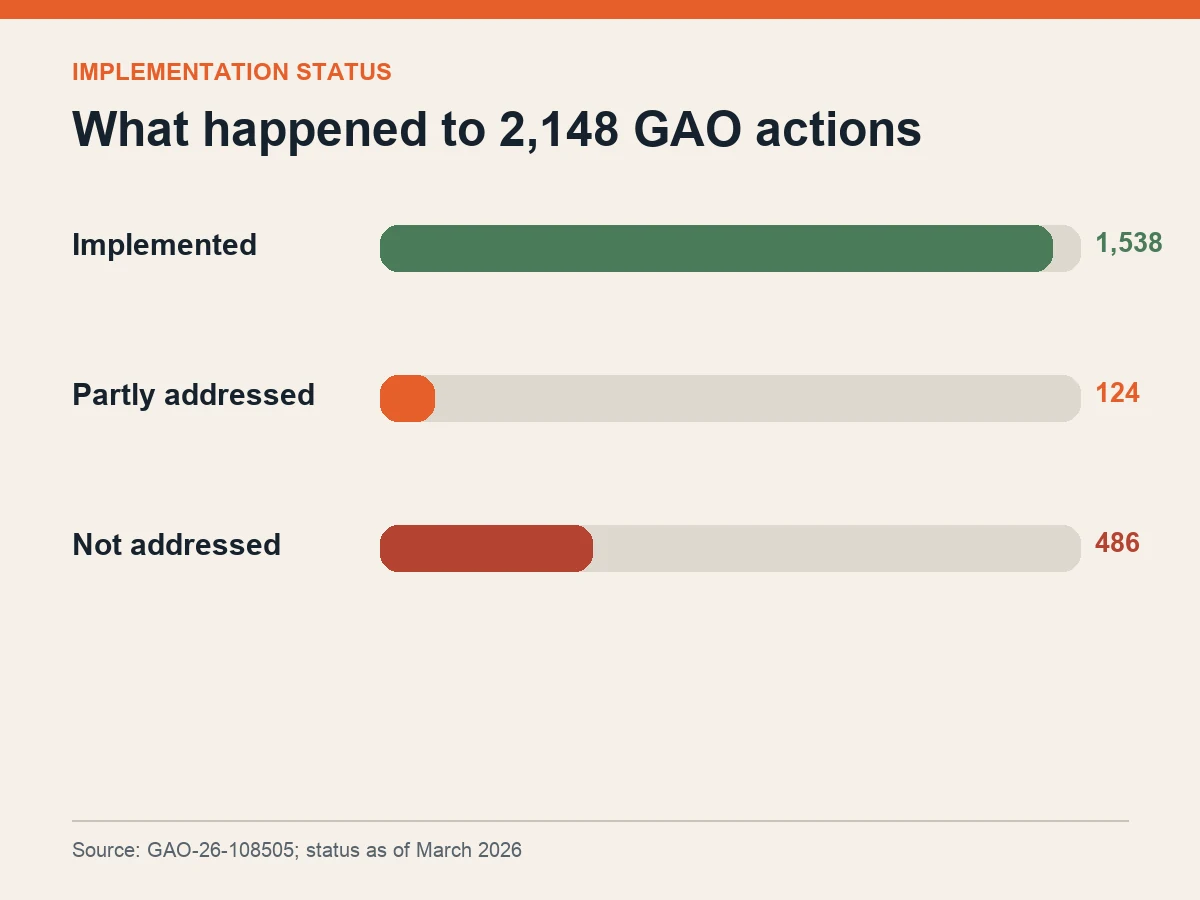
In the main status table, 1,538 of 2,148 actions were closed as implemented, 124 were partly addressed and 486 were not addressed. Another 165 items were closed as no longer valid because circumstances changed and are tracked outside that table.
The open count divides between the branches. Eighty-two matters directed to Congress remained open, while 528 recommendations to agencies were unfinished. GAO said legislation had been introduced in the 118th or 119th Congress for 30 of the open congressional matters but had not fully resolved them by February.
The report also cautions against treating every overlap as waste. Multiple agencies can legitimately share a field when a mission is complex or large. The risk arises when responsibilities, data and performance measures are not coordinated, creating confusion, duplicate effort or higher costs.
The clearest measure of future progress is implementation evidence: laws enacted, processes changed, improper payments recovered or avoided, services consolidated and benefits documented. Until those steps occur, the $100 billion remains a potential return from the open work, not money already saved.