
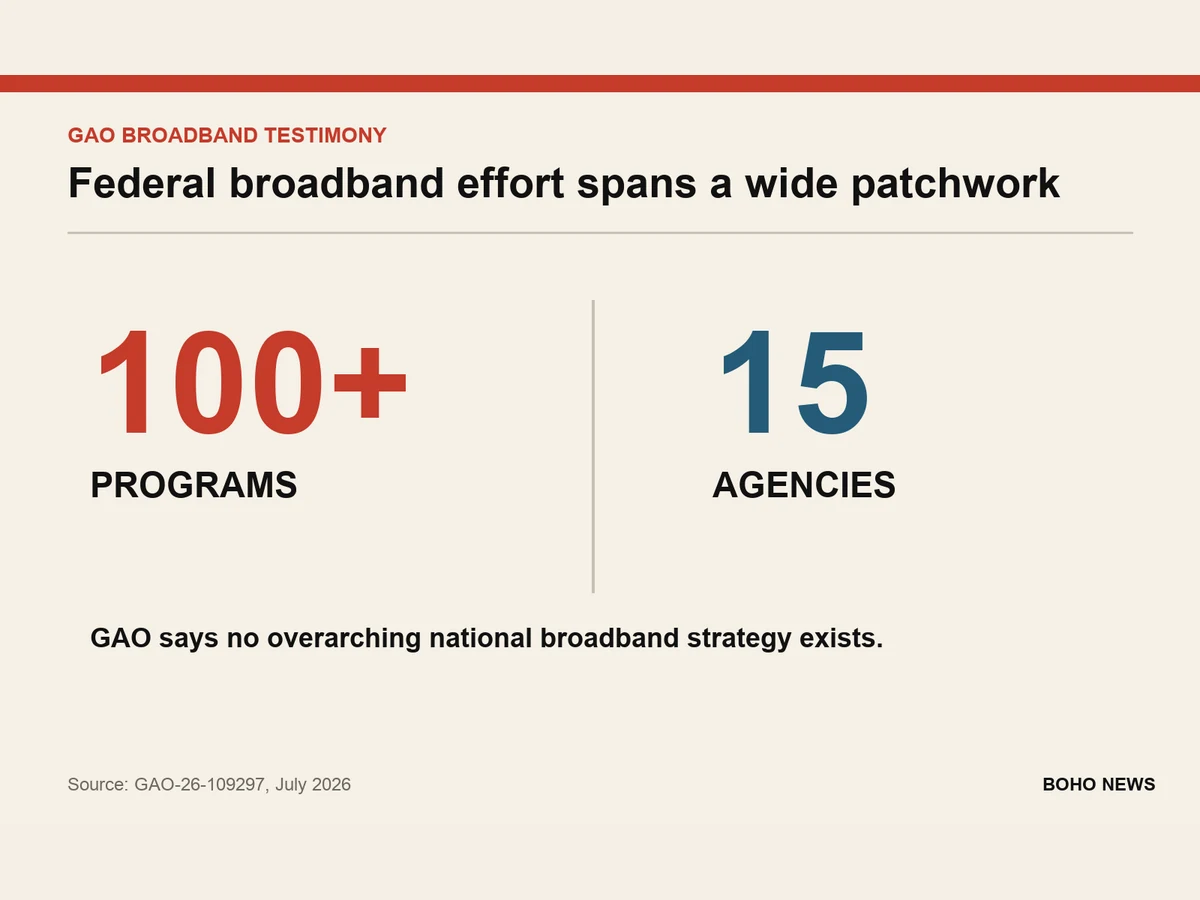
More than 100 federal broadband programs still operate without an overarching national strategy, the Government Accountability Office told Congress, leaving coordination and mapping safeguards incomplete while agencies direct tens of billions of dollars.
The scale comes from GAO’s May 2022 inventory: more than 100 programs administered by 15 agencies. Some focus principally on broadband; others can fund broadband alongside wider missions such as education, health care or economic development.
GAO’s diagnosis is not that every program is redundant. It is that fragmentation creates overlapping responsibilities and a risk of duplicative spending without clear national roles, goals, objectives and performance measures. Its 2022 recommendation for an Executive Office of the President strategy remained unaddressed as of July 2026.
Four organizations administer most deployment funding: the Federal Communications Commission, National Telecommunications and Information Administration, Agriculture Department and Treasury Department. GAO said they have coordination mechanisms, including information sharing, but April 2025 recommendations to strengthen collaboration were not fully addressed.
Agency officials reported steps toward implementing those recommendations. That distinction matters: an open recommendation records GAO’s judgment that the needed outcome has not yet been demonstrated, not proof that agencies have taken no action.
The second operational weakness is the National Broadband Map. Agencies use the FCC map to identify where service is available and to target tens of billions of dollars. GAO says uncertainty in availability data can undermine funding decisions or make duplicative awards harder to prevent.
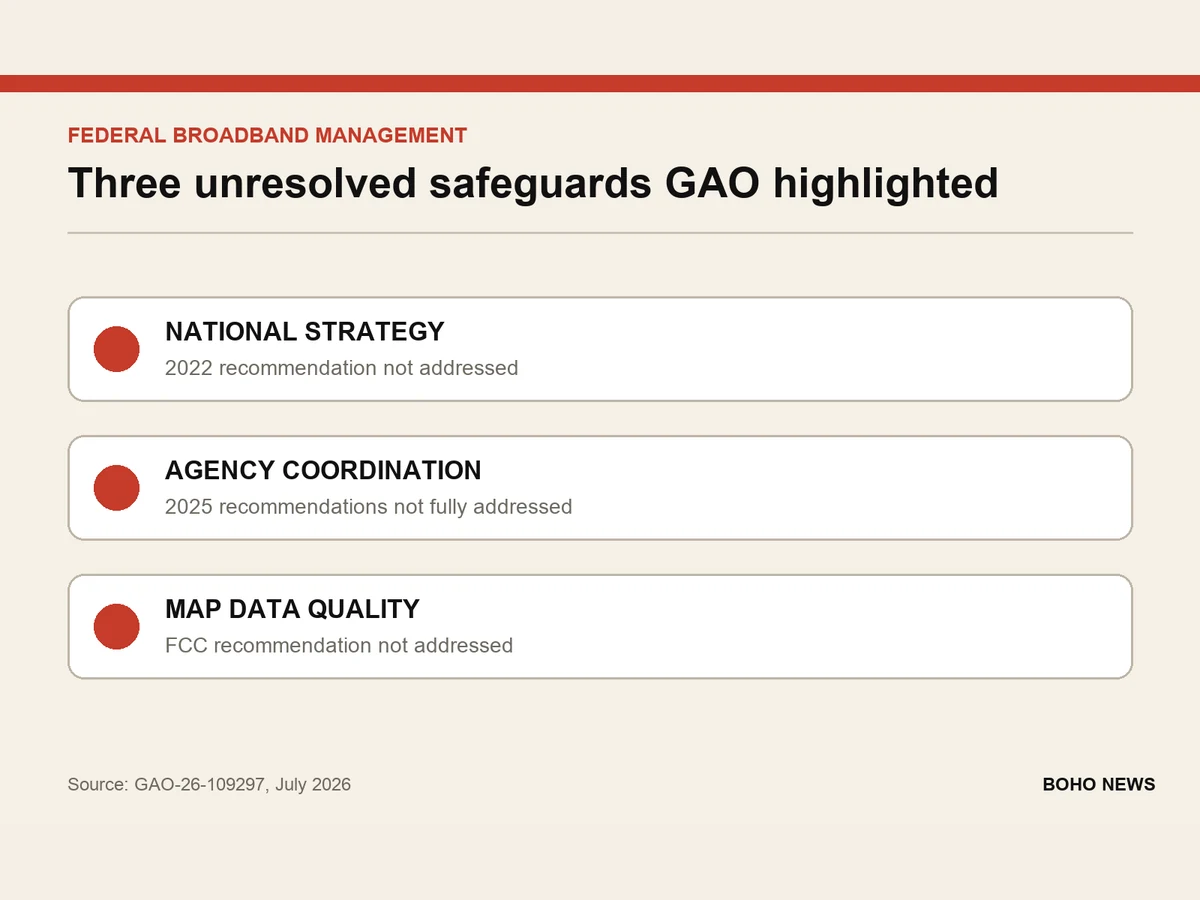
In April 2025, GAO recommended that the FCC document and evaluate how effectively its processes ensure map-data quality. The recommendation remained unaddressed as of July 2026, although FCC officials told GAO that work was underway.
The testimony also points to long-term sustainability. GAO previously warned that programs should consider whether recipients can maintain networks after construction grants are spent, citing separate recommendations involving tribal broadband projects.
For lawmakers, the open question is governance rather than whether broadband matters. Employment, education, health care and daily services increasingly require connectivity; the dispute is whether a fragmented funding system can consistently identify gaps, coordinate awards and verify that new infrastructure remains viable.
The clean measure of progress will be closure evidence: a national strategy with assigned roles and performance measures, stronger interagency practices, and documented tests showing that the map data used for funding decisions meet their intended quality standard.