
The Government Accountability Office has expanded its short list of education recommendations that it says deserve priority attention, putting federal student aid, student-data privacy and charter-school financial oversight at the center of its latest letter to the Department of Education.
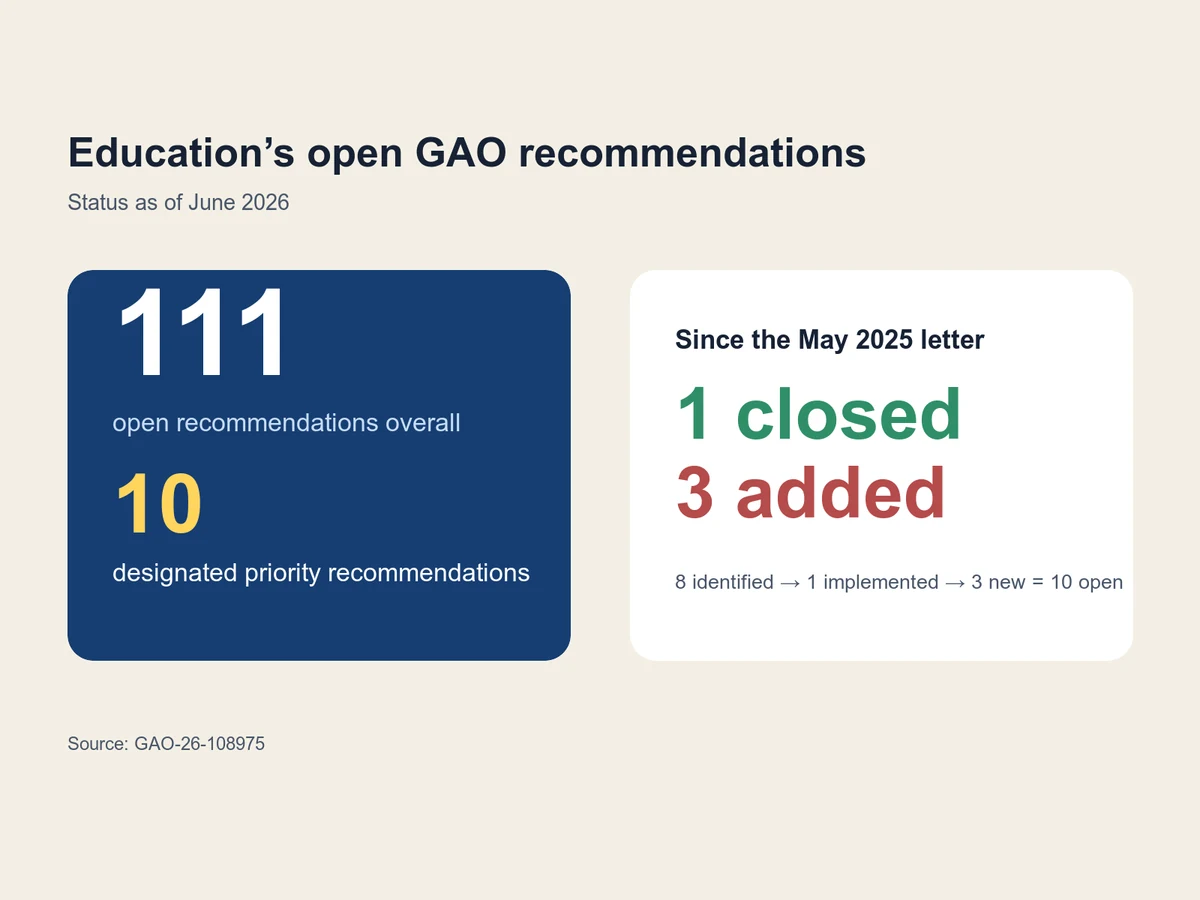
GAO identified eight priority recommendations for the department in May 2025. Education implemented one of them, and GAO added three in June 2026, bringing the open priority total to 10, according to report GAO-26-108975, published July 1 and publicly released July 8.
The arithmetic is important: one closed recommendation did not shrink the list because three new recommendations entered it. The result is a net increase of two priorities over the previous letter.
Priority is a specific oversight label
GAO uses “priority open recommendation” for a subset that warrants focused attention from an agency head. The watchdog says implementation can save substantial money, improve major decisions, reduce mismanagement or address high-risk and duplicative work, among other benefits.
That label does not mean GAO found 10 new scandals, nor does it mean every program named in the letter is failing. It means the recommendations remain open and GAO considers their potential impact large enough to elevate them above the department’s other unfinished recommendations.
Student aid is the most visible operational test
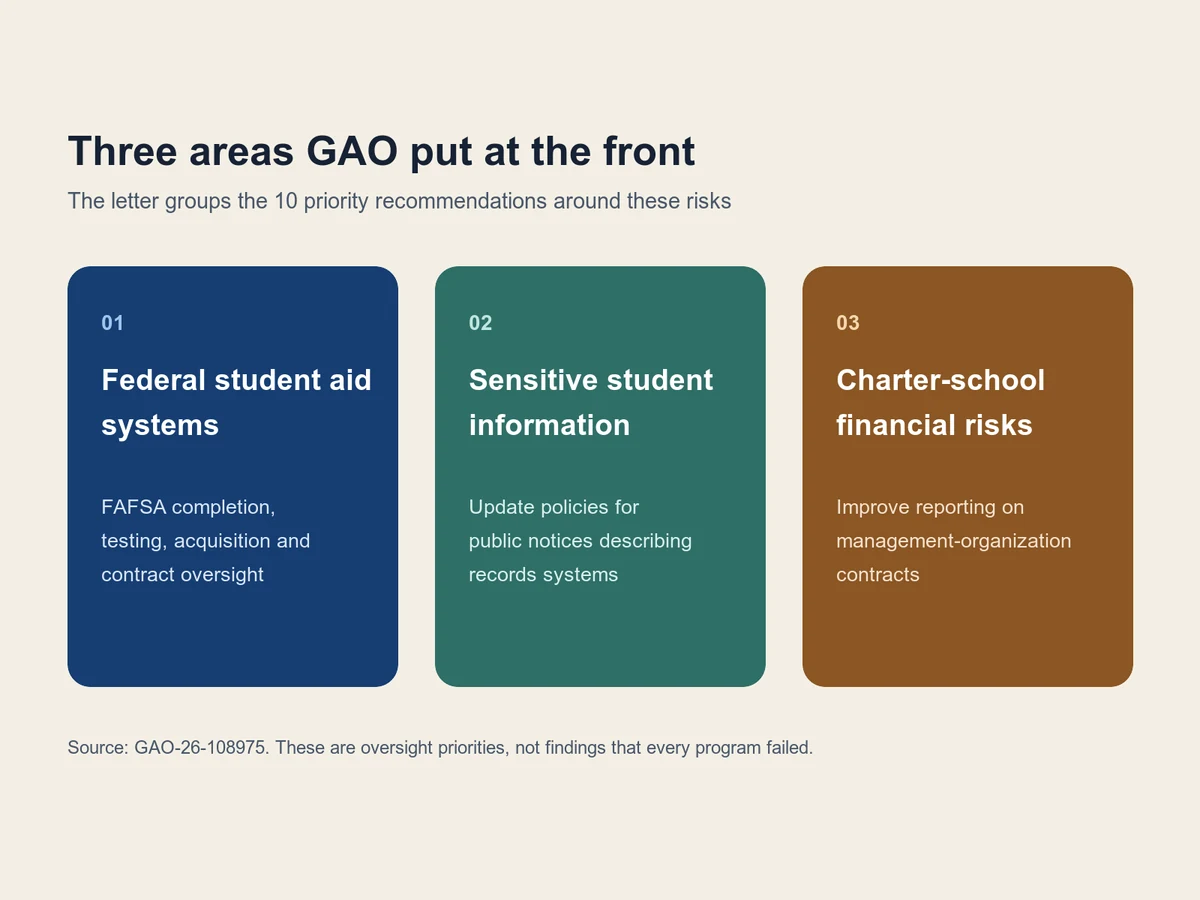
The first highlighted area is the federal student-aid system. GAO says acting on its recommendations would make it easier for students and families to apply for aid and improve the prospects for a successful modernization of the system.
That formulation matters because the recommendation is about durable administration, not a promise that a single software release will resolve every application problem. The public letter describes the desired outcome but does not set a completion date for all remaining work.
Privacy and charter oversight round out the new focus
The second highlighted area is protection of sensitive student information. GAO says stronger implementation would improve student privacy protections. The issue is institutional: how the department documents, updates and administers safeguards for information it holds.
The third is financial risk associated with charter-school management organizations. GAO says stronger oversight would help the department manage risks connected to organizations that operate or support charter schools and receive federal funds through the programs it administers.
The next useful signal is implementation
The letter establishes the current count and the areas GAO wants addressed; it does not establish that the department will complete all 10 on a particular schedule. The practical measure is whether GAO later closes individual recommendations after finding that the department’s actions satisfy them.
That makes the list a public accountability instrument rather than a final grade. One priority from the 2025 set has been implemented, showing that the count can move down. The addition of three others shows that new oversight needs can push it back up at the same time.
The sequence also prevents a misleading year-to-year comparison. Saying the department completed one priority is accurate, but incomplete without the three additions; saying the list grew is accurate, but incomplete without the closure. The net count captures both oversight actions, while the underlying recommendations explain what actually changed.
For students and families, the most immediate connection is the aid system they use. For policymakers, the letter ties that front-end experience to two quieter systems—privacy administration and financial oversight—that determine how well federal education programs protect information and money.