
Treasury and the Internal Revenue Service lack a policy for handling mass public comments written with artificial-intelligence assistance, creating a risk that tax-rulemaking staff could be overwhelmed by tens of thousands of similar but not identical submissions, federal auditors found.
The Government Accountability Office reviewed tax regulations proposed and finalized from Jan. 21, 2017, through March 31, 2026. Treasury and IRS proposed 236 regulations and finalized 231 during that period, including rules implementing major tax-law changes from 2017, 2022 and 2025.
Public comment is a required part of most proposed rulemaking. The new technical problem is duplication: AI tools can generate slightly different wording for each person making the same substantive point, which makes automated or manual grouping harder.
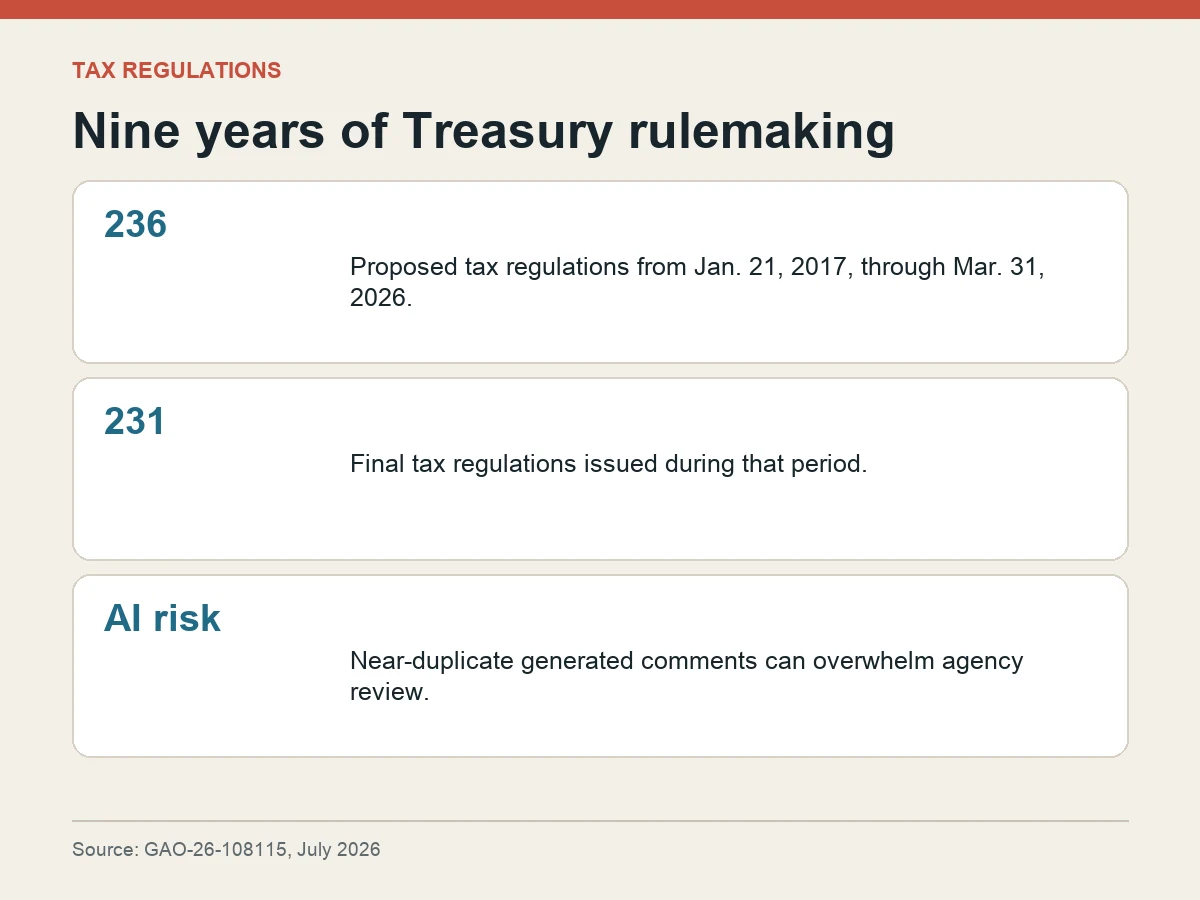
GAO said IRS had not established policies for identifying, documenting and disposing of mass comments, including AI-assisted comments, while meeting legal requirements. The report did not estimate how many comments were generated by AI.
Hearings present another access problem. Treasury and IRS hold requested public hearings in Washington, but remote participants generally use dial-in technology rather than widely available video conferencing. GAO also found that important oral comments were not always documented through other means.
Economic analysis was the third line of review. GAO identified 28 economically significant tax regulations—those with at least $100 million in economic effects—and found inconsistent use of recommended practices for estimating costs, benefits and revenue effects.
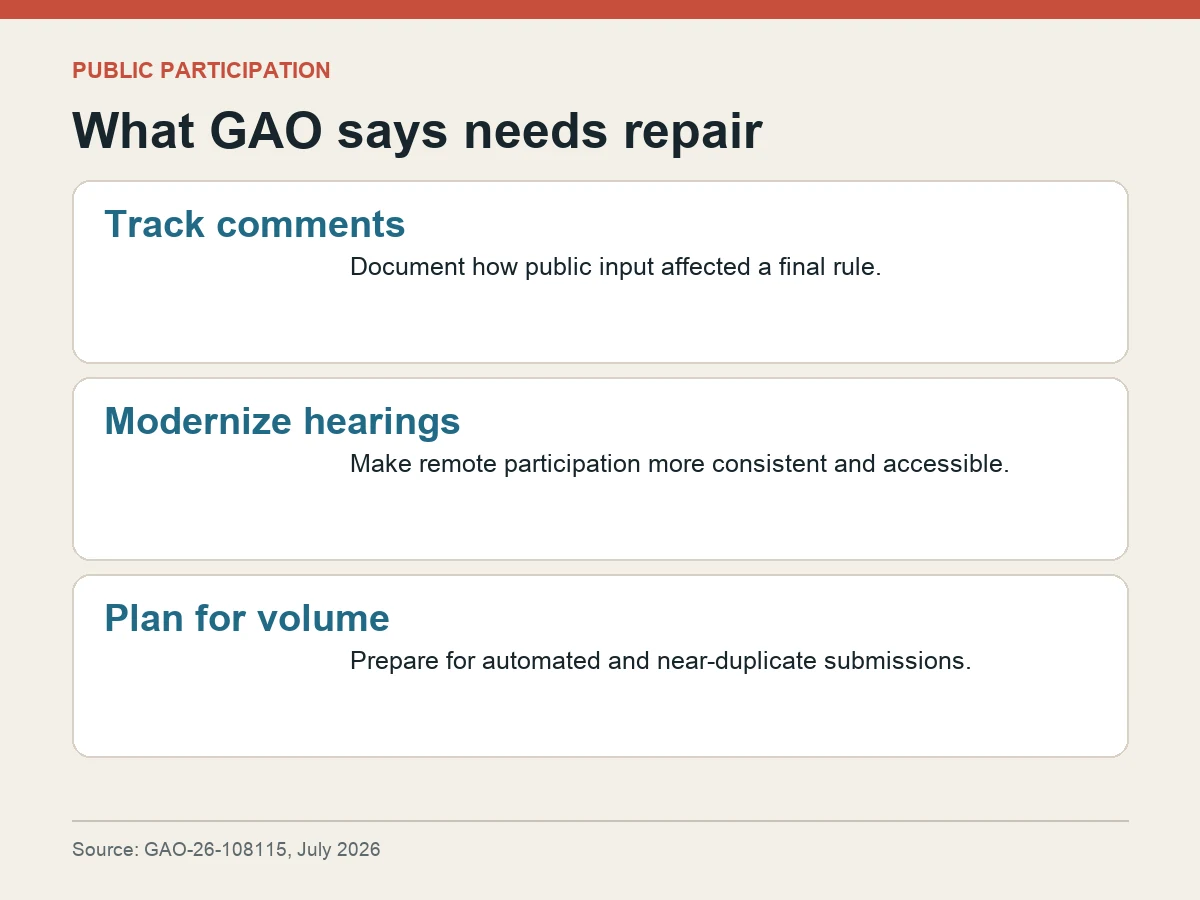
GAO made six recommendations covering economic estimates, summaries used in regulatory decisions, mass-comment policy, virtual participation and hearing documentation. Treasury agreed with two recommendations and disagreed with four.
The disagreement matters because an audit recommendation is not a rule change. Until agencies adopt new procedures, the report describes open process weaknesses rather than a completed modernization program.
The immediate issue is not whether AI-assisted advocacy is legitimate. It is whether a rulemaking system built for individually written submissions can recognize common arguments, preserve meaningful public input and keep review workable when software makes unique-looking comments cheap to produce.