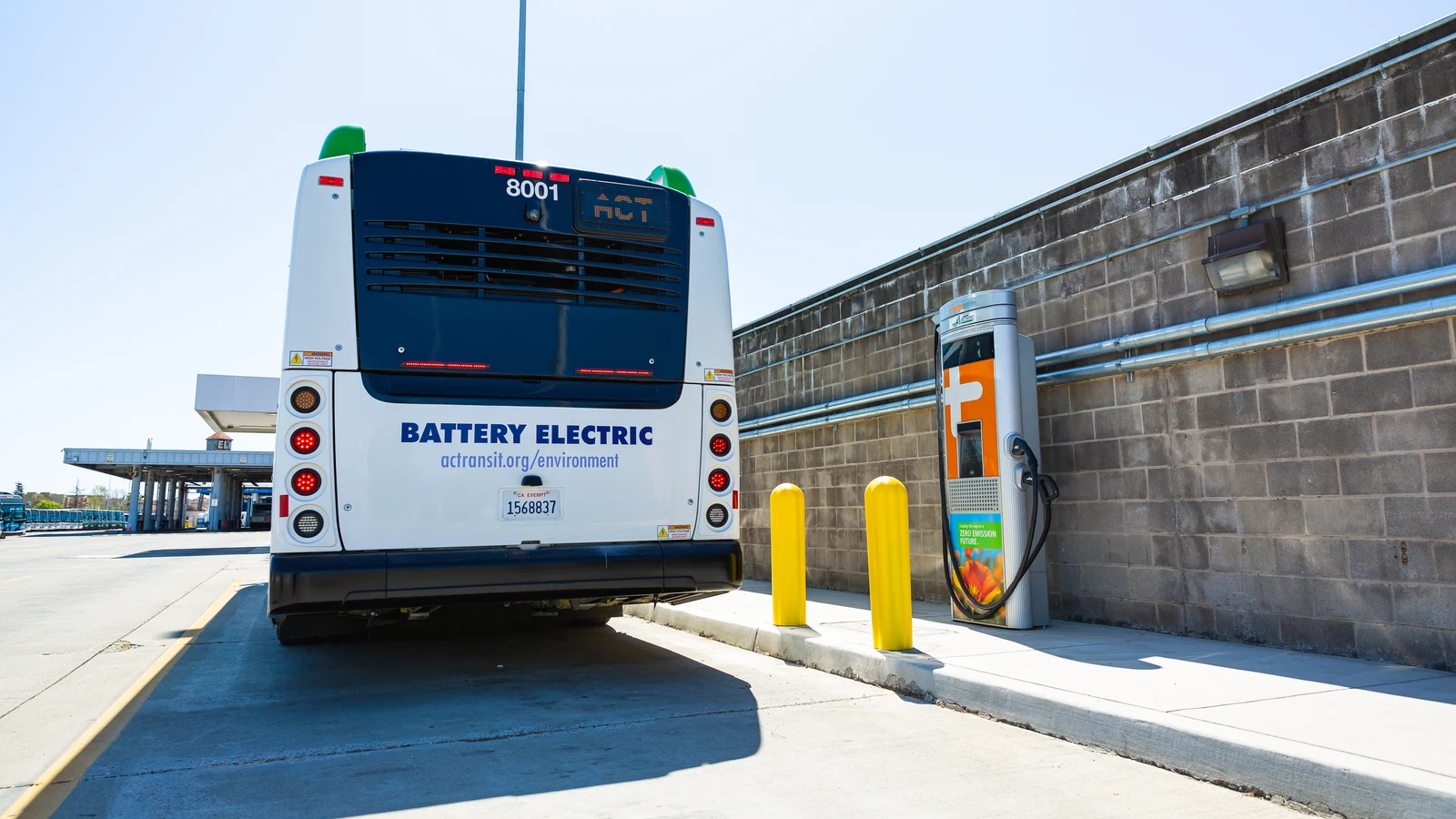
The Federal Transit Administration opened a roughly $610 million competitive grant round for buses and related facilities, with almost all of the announced money reserved for low- and no-emission projects.
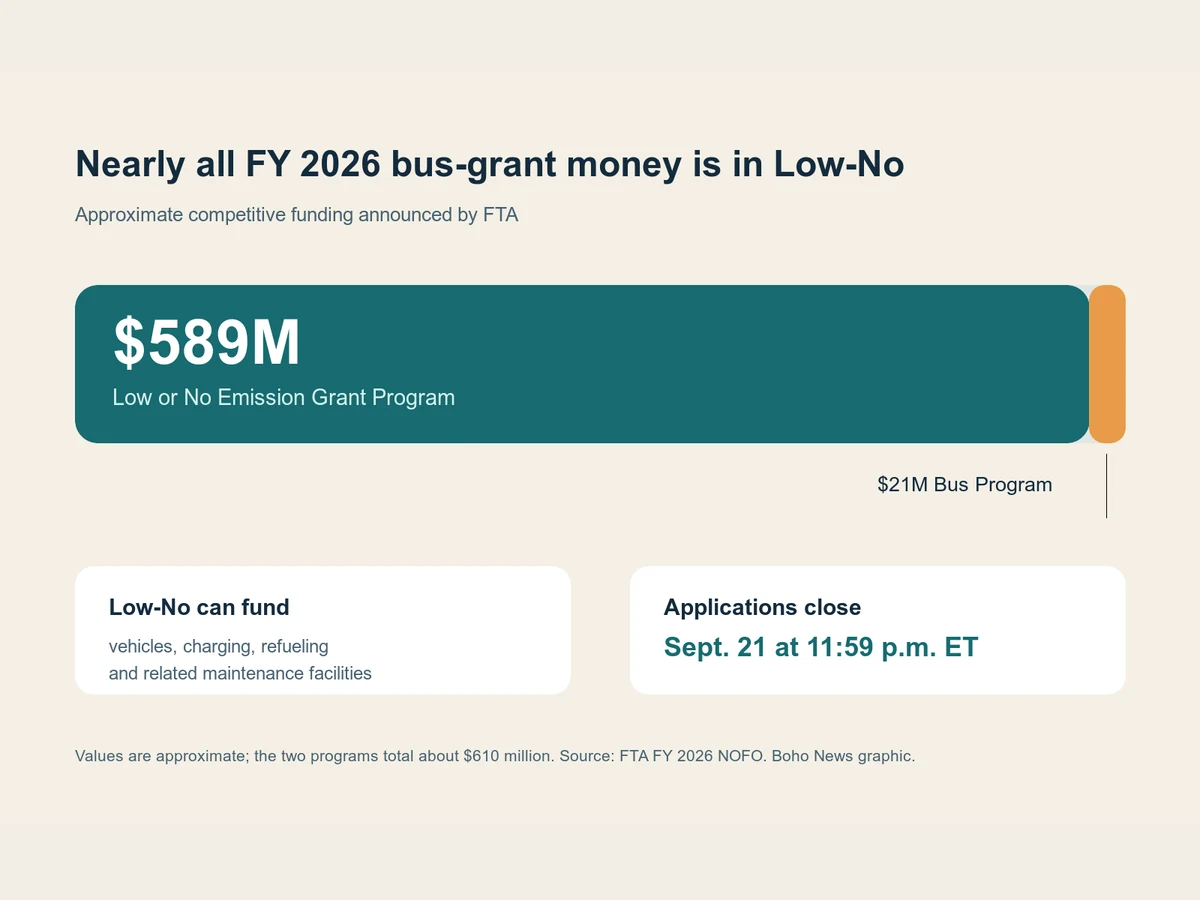
The fiscal 2026 notice makes about $589 million available through the Low or No Emission Grant Program and about $21 million through the separate Grants for Buses and Bus Facilities Program. Applications are due through Grants.gov by 11:59 p.m. Eastern on Sept. 21.
Because both amounts are approximate, the combined $610 million is a rounded figure. The Low-No share is about 96.6% of that total, while the general Bus Program accounts for about 3.4%.
The programs overlap, but they are not identical
Bus Program grants can support the purchase, lease or rehabilitation of buses and related equipment, along with the acquisition, construction, lease or rehabilitation of bus facilities.
Low-No grants are narrower on propulsion but broader across the infrastructure needed to operate it. Eligible work includes low- or zero-emission buses and supporting charging, refueling and maintenance facilities.
FTA combined the two opportunities into one notice because their eligible applicants overlap and federal law requires the programs to run on the same timeline. Applicants must still use the correct opportunity ID: FTA-2026-010-TPM-BUS for the Bus Program and FTA-2026-011-TPM-LWNO for Low-No.
Last year’s demand was substantially larger
The notice says FTA received 179 eligible Low-No applications requesting $3.1 billion in fiscal 2025. The agency funded 103 projects for a combined $1.6 billion, with awards ranging from $256,281 to $121.125 million.
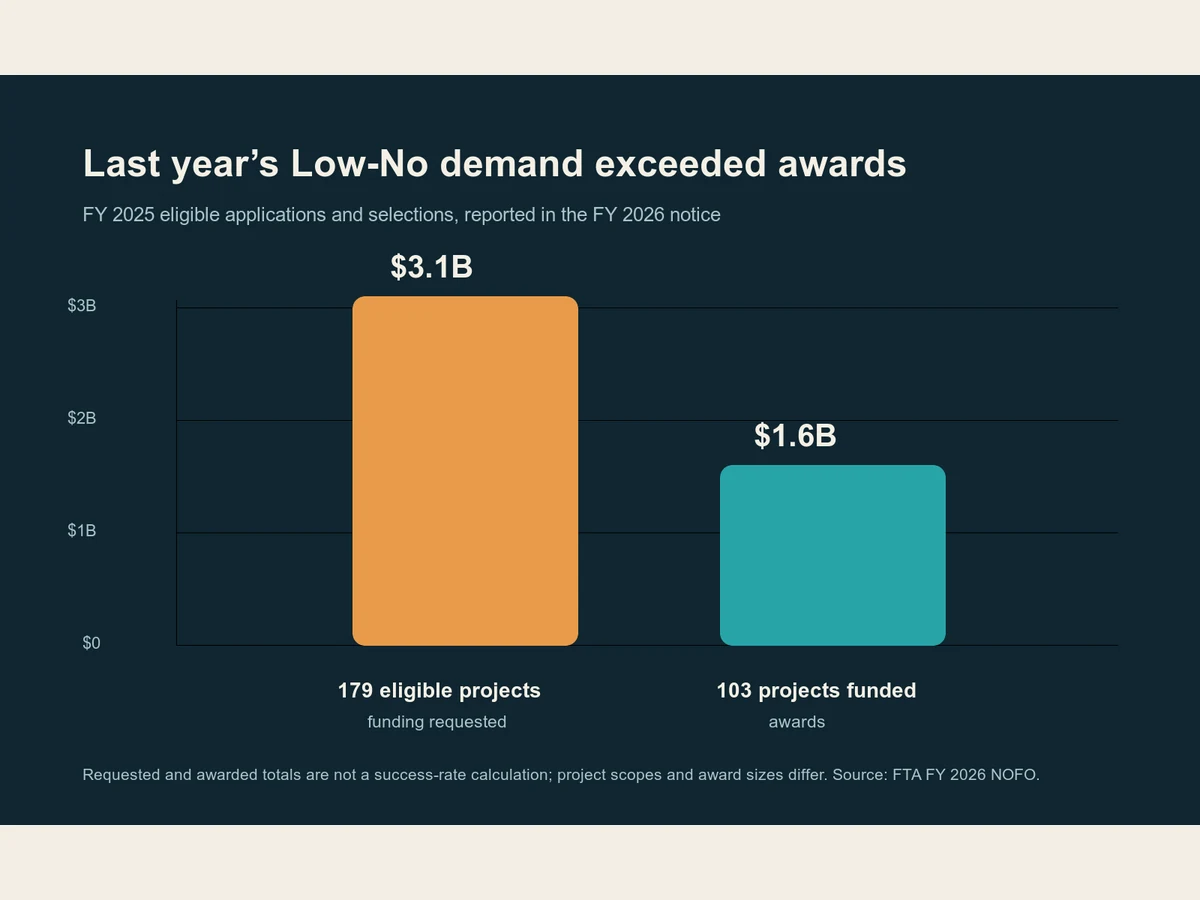
Those totals show a funding gap, but they do not produce a simple 52% project approval rate by dividing dollars. Project sizes differ, and an applicant can receive less than it requested. The notice reports both project counts and dollar totals, which answer different questions.
Zero-emission projects carry a workforce condition
For a zero-emission vehicle project, at least 5% of the federal award must support workforce development and training unless the applicant certifies that less is needed. That requirement is tied to the transition in equipment, maintenance and operating skills, not to every Low-No application automatically.
Federal cost sharing varies by activity. The notice describes an 80% federal share as the general limit, with higher federal shares available for certain vehicle and equipment costs that comply with Clean Air Act or accessibility requirements.
The notice sets no minimum award. For the Bus Program, one recipient may receive no more than 10% of the available amount; Low-No has no comparable maximum award stated in the notice.
What happens after Sept. 21
Eligible applicants include states, local governments, tribes, designated recipients and certain public bodies, depending on the program and project location. Applications sent by mail or fax are not accepted.
FTA says it expects to announce selections within 75 days after the deadline. A selection is not the same as an immediate obligation of funds: the agency warns that pre-award costs generally are not reimbursable unless FTA authorizes them in writing.
The main operational question is therefore not only which bus technology an agency wants, but whether its proposal connects vehicles, facilities, workforce and local funding into an eligible capital plan. The program name describes the equipment; the notice describes the full delivery system.