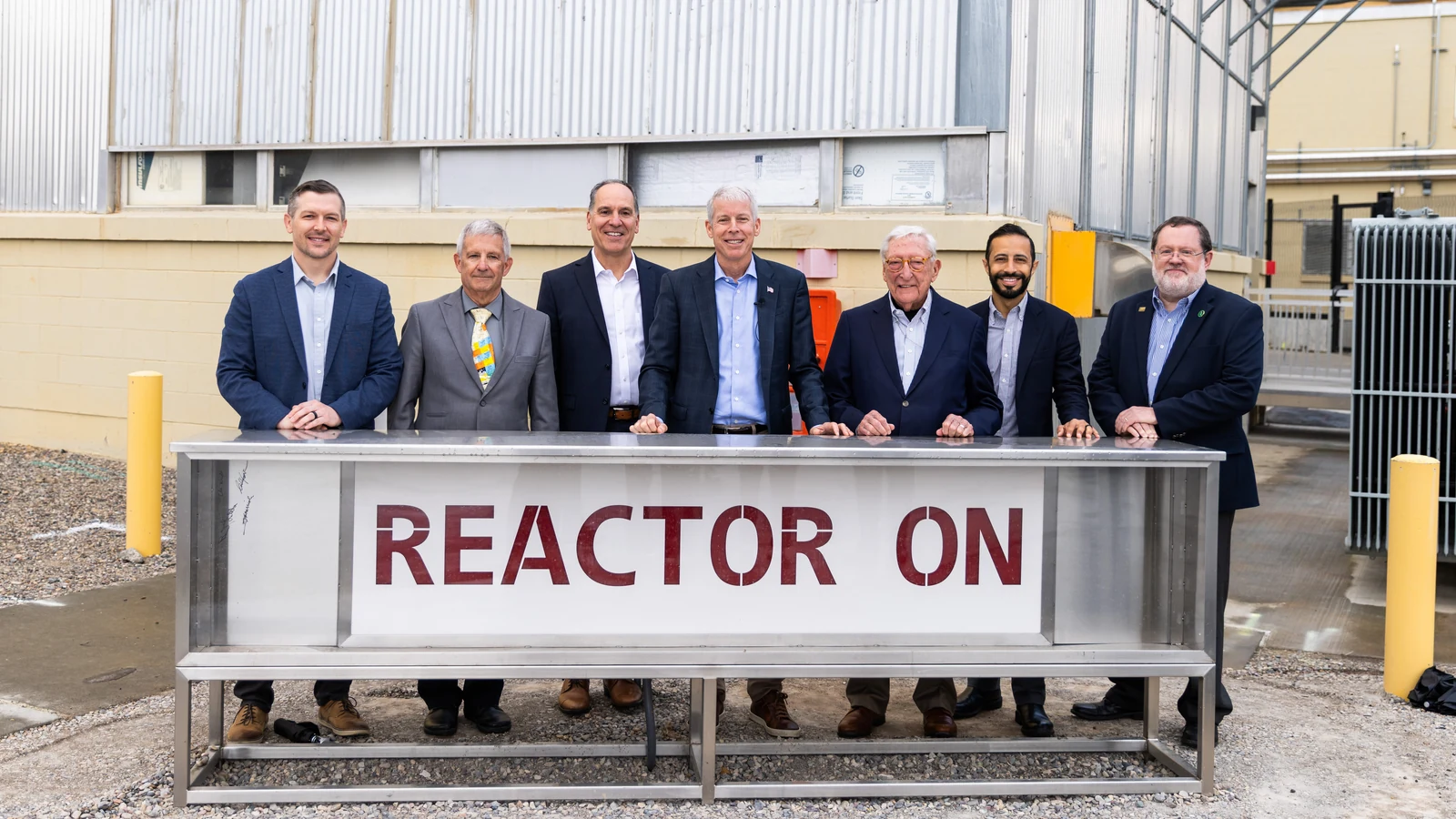
Four privately developed advanced-reactor designs completed DOE-authorized criticality tests in a 31-day burst this summer, a real technical milestone that is narrower than the phrase “reactor on” can make it sound.
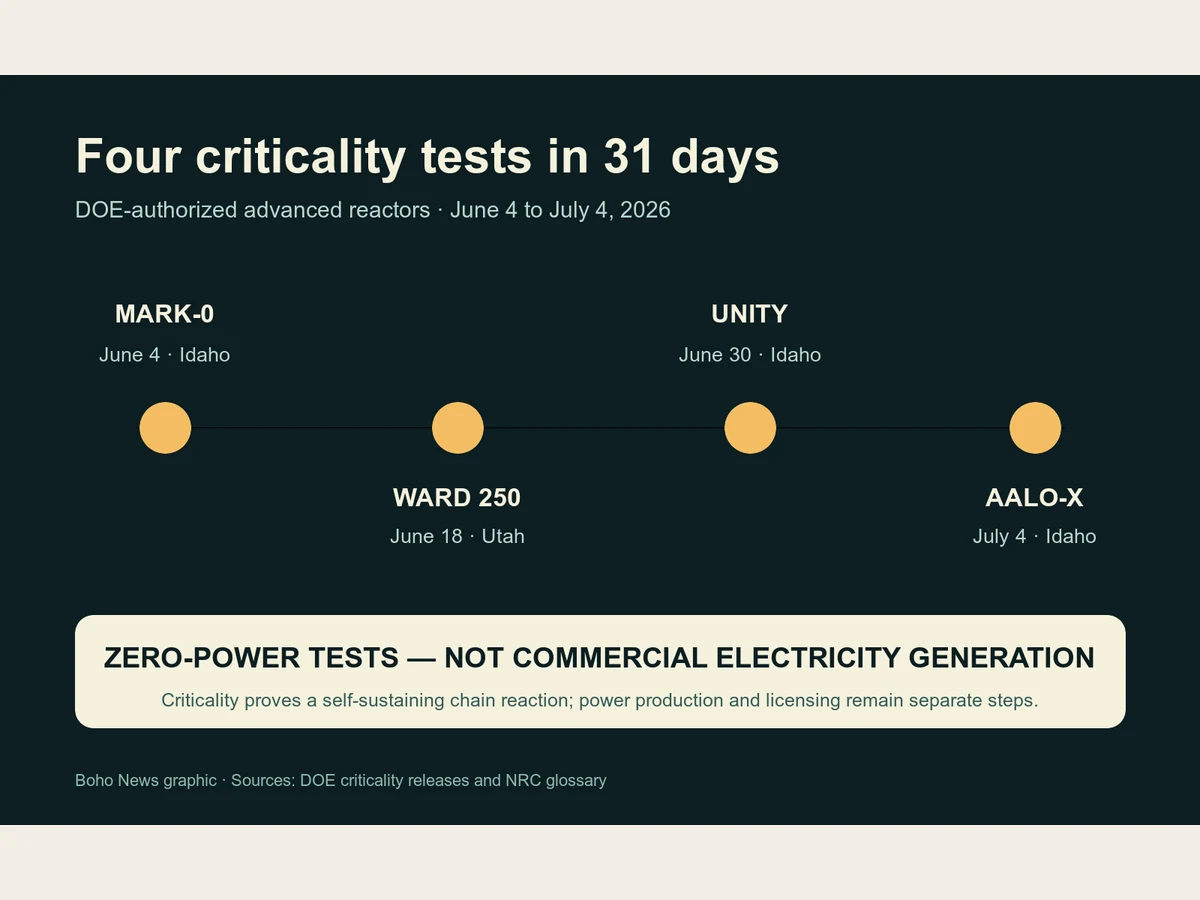
Antares Nuclear’s Mark-0 reached the milestone June 4 at Idaho National Laboratory. Valar Atomics’ Ward 250 followed June 18 at Utah’s San Rafael Energy Lab. Deployable Energy’s Unity completed its experiment June 30 at INL, and Aalo Atomics’ Aalo-X became the fourth early July 4, also at INL.
All four were described by the Energy Department as zero-power fueled criticality demonstrations. They showed that each design could sustain a fission chain reaction under controlled test conditions. They did not, by themselves, demonstrate a commercial power plant continuously generating electricity for customers.
What “critical” means here
The Nuclear Regulatory Commission defines a reactor as critical when fission events release enough neutrons to sustain an ongoing series of reactions. The term describes neutron balance, not danger and not a finished product.
A zero-power test deliberately keeps heat and electrical output very low while engineers compare measured neutronic behavior with models. DOE’s environmental record for Unity says that experiment was limited to zero-power operation and would not generate electricity, usable thermal energy or sustained reactor power.
That limitation is central to reading the announcements honestly. A successful criticality test validates important physics and operating procedures. It does not resolve fuel production, durability, heat removal, power conversion, maintenance, economics, waste handling, deployment permits or every future licensing question.
Four designs, two test pathways
Mark-0, Ward 250 and Aalo-X were part of the Energy Department’s Reactor Pilot Program. Unity reached criticality through the Nuclear Energy Launch Pad, a test framework managed by the National Reactor Innovation Center at INL.
DOE says Mark-0 was the first new privately developed non-light-water reactor to reach criticality in the United States in more than four decades. It was also the 53rd reactor built at the INL site since 1951, according to the department’s June 4 announcement.
Ward 250’s test took place outside a national laboratory, at the San Rafael Energy Lab in Emery County. DOE described it as the first department-authorized reactor built outside a national lab. That is a regulatory and siting distinction, not evidence that the system is ready for ordinary commercial deployment.
Unity used an existing below-grade room at INL’s Neutron Radiography Reactor facility. DOE’s April environmental record says the purpose was to confirm predicted neutronic performance and validate modeling assumptions before future demonstrations.
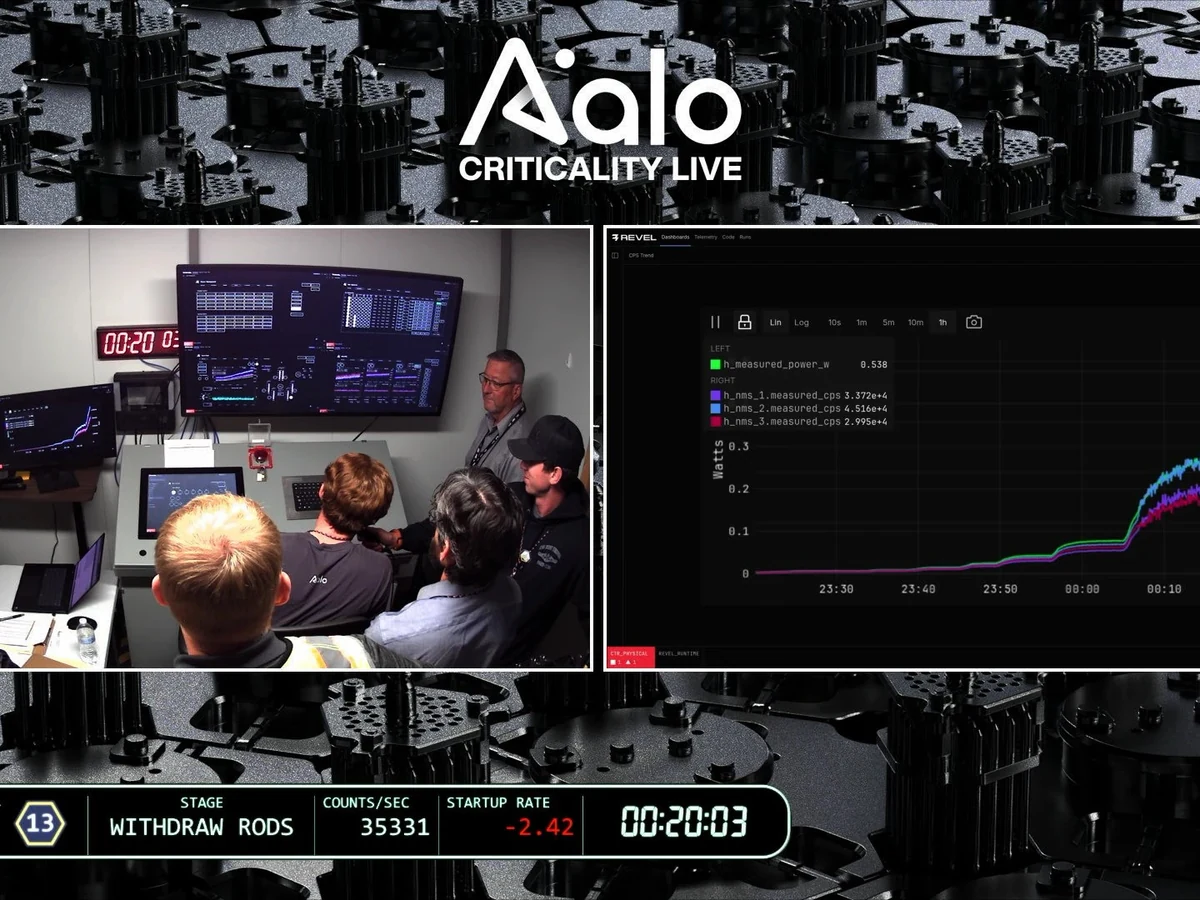
Aalo-X completed the fourth test at 12:20 a.m. Mountain time on July 4, according to the company. DOE’s July 6 announcement says the full-scale zero-power version used the agency’s authorization pathway and reached the target after construction began less than a year earlier.
DOE met a deadline; the market test comes later
The sequence exceeded the administration’s goal of at least three test reactors reaching criticality by July 4, 2026. DOE’s July 25 fact sheet packages the four results as evidence of an accelerated advanced-nuclear program.
The next claims will be harder to evaluate. Developers have discussed producing electricity in 2027 and deploying commercial systems later, but those dates are company or agency plans. Each design still has its own engineering, authorization, supply-chain and customer milestones.
For now, the strongest shared conclusion is deliberately technical: four different systems sustained controlled fission chain reactions under DOE authority between June 4 and July 4. That is more than a model or a press rendering—and less than four operating power plants.