
Spain dominated several of the 2026 FIFA World Cup’s broadest team measures, while Kylian Mbappé finished as its leading scorer, according to FIFA’s post-tournament statistical summary.
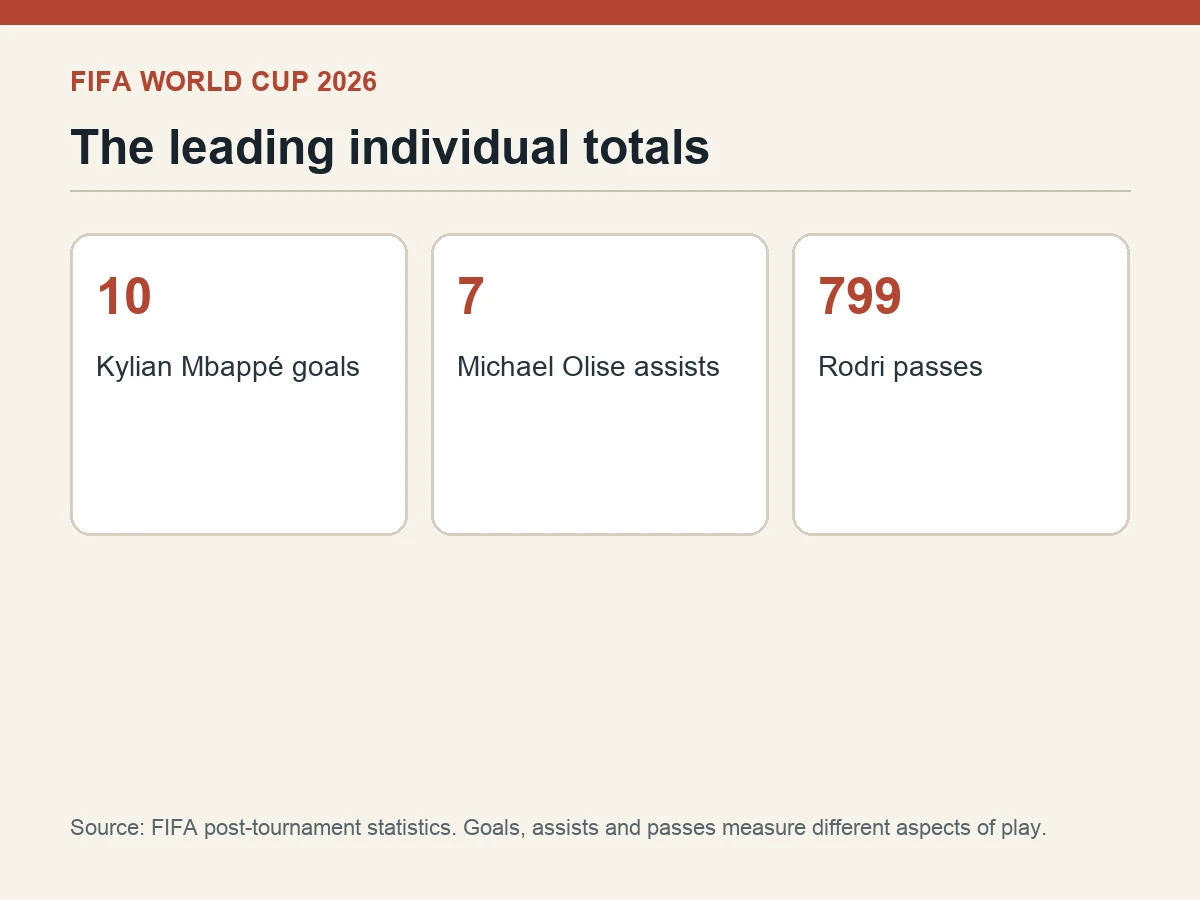
Mbappé scored 10 goals and added four assists. Michael Olise led the tournament with seven assists, separating the leading finisher from the leading creator in the final individual tables.
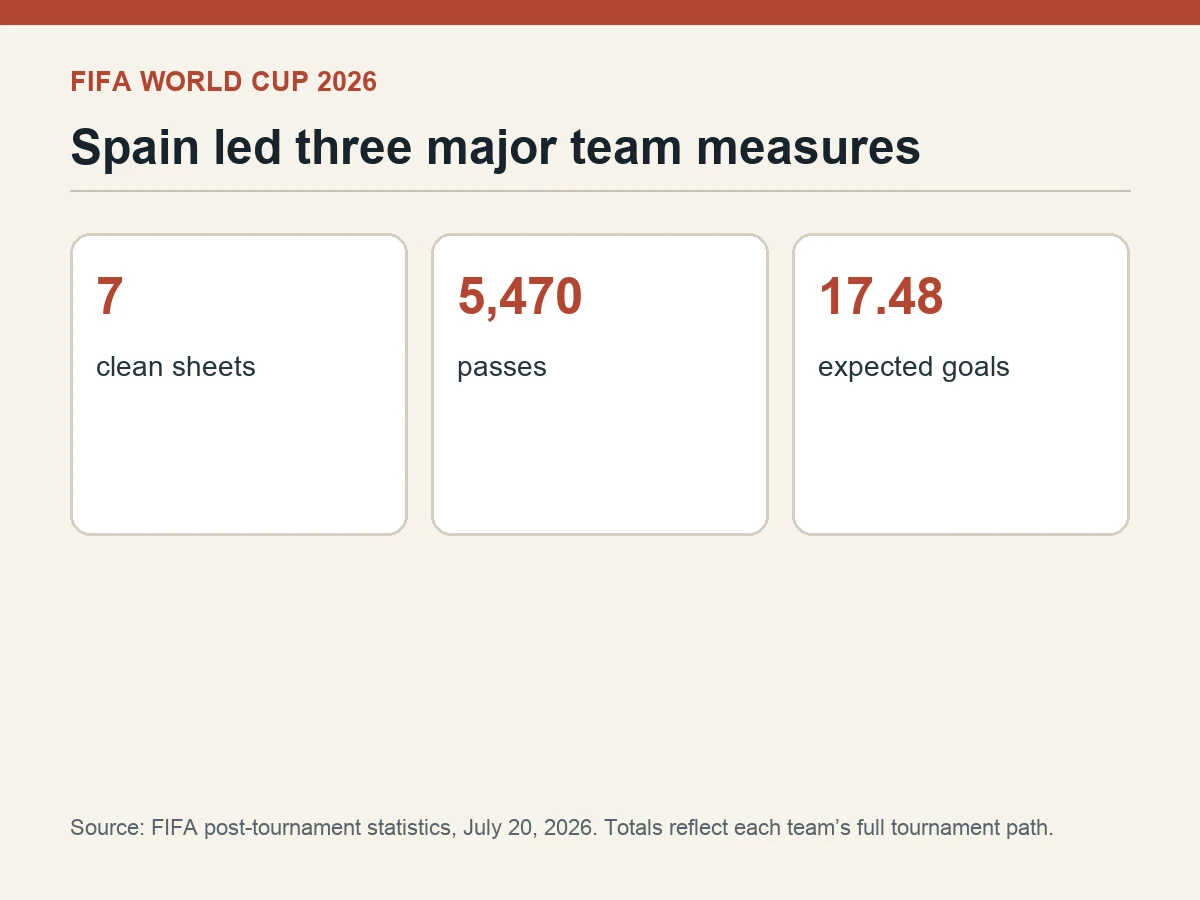
Spain recorded seven clean sheets, three more than France and Colombia, which tied for second with four apiece. A clean sheet records a match without conceding a goal; it does not distinguish whether that result came from goalkeeper saves, defensive control or an opponent’s missed chances.
The Spanish team also attempted 140 shots, narrowly ahead of France at 139. France, however, led attempts on target by 59 to 54, showing why total shooting volume and accurate shooting are related but different measures.
Passing produced a clearer gap. Spain completed the tournament with 5,470 team passes, followed by Argentina with 5,248 and France with 4,318. Rodri led the individual table at 799 passes, ahead of Spain teammates Pau Cubarsí at 690 and Aymeric Laporte at 660.
Spain also ranked first in expected goals at 17.48, ahead of France at 16.78, Argentina at 15.45 and England at 15.03. Expected goals estimates chance quality; it does not replace the actual scoreboard and depends on the model FIFA uses.
Argentina led total distance covered at 955,124.09 metres. Spain followed at 947,574.41 and England at 918,867.71. Those cumulative totals reflect tournament longevity as well as match tempo, possession patterns and defensive work.
The statistics need their denominators. Teams eliminated earlier had fewer matches in which to accumulate passes, distance, shots or expected goals, so tournament totals are not pure per-game efficiency rankings.
Even with that caution, the leaderboards describe distinct strengths. Spain combined ball circulation, chance creation and defensive results; France paired almost identical shooting volume with more shots on target; Argentina accumulated the most ground covered.
The player tables make the same point at individual scale. Goals, assists and passes measure different contributions, and no single column identifies the tournament’s complete player. Together, FIFA’s final figures provide a reproducible record of how the expanded competition was played.