
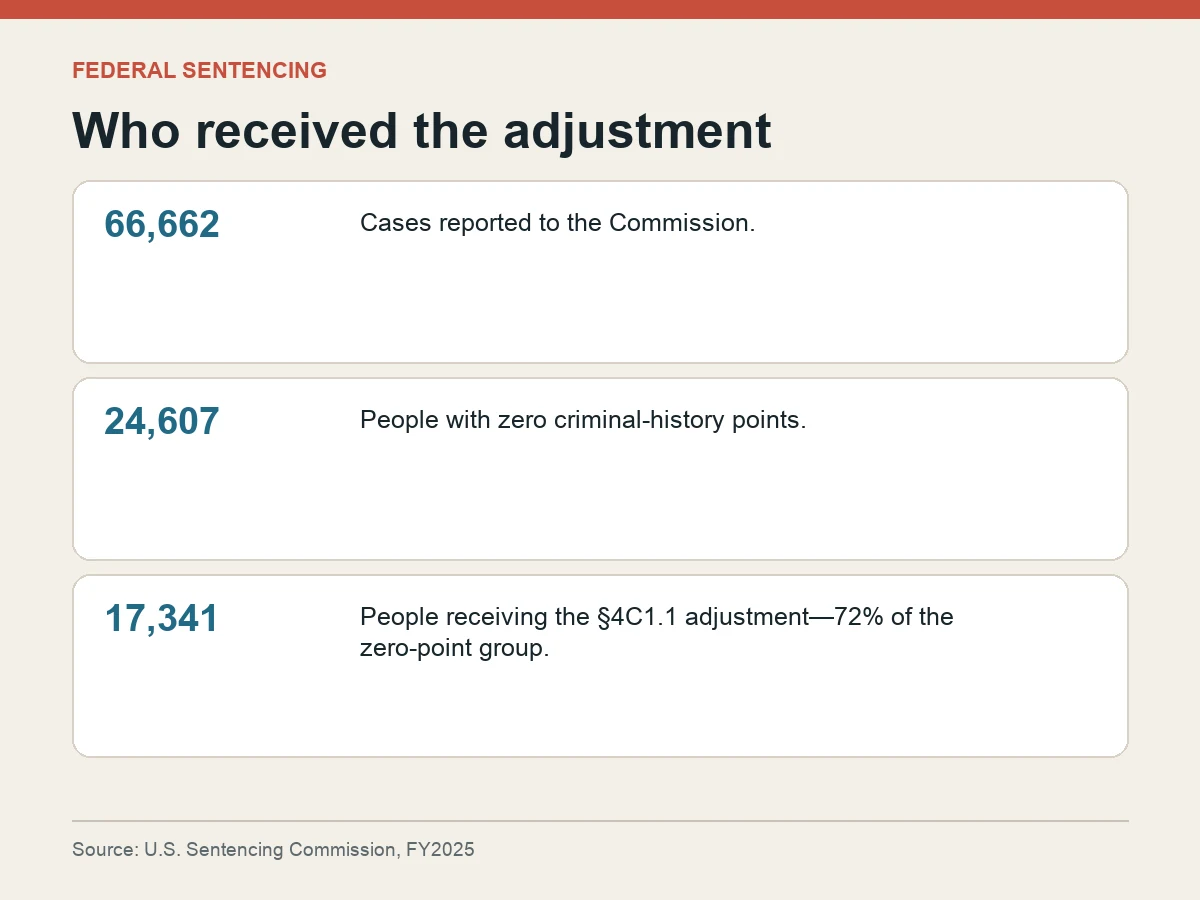
Federal judges applied a two-level sentencing-guideline reduction to 17,341 people with zero criminal-history points in fiscal 2025, according to a new United States Sentencing Commission fact sheet.
The Commission received 66,662 cases for the fiscal year. Of those, 24,607 involved people assigned zero criminal-history points at sentencing, and 72 percent of that group received the adjustment under Section 4C1.1. The provision took effect November 1, 2023.
Zero points are only the threshold. Section 4C1.1 also excludes cases with specified aggravating factors, so a person with no scored criminal history does not automatically qualify. The Commission excluded 425 zero-point individuals sentenced before the provision’s effective date and cases lacking complete sentencing information from the adjustment analysis.
The recipient group was concentrated in immigration cases, which represented 51 percent. Drug trafficking accounted for 23 percent and fraud, theft or embezzlement 14 percent. Among zero-point people who did not receive the adjustment, the offense mix was markedly different, with drug trafficking at 23 percent and firearms cases at 16 percent among the largest categories.
Geography reflected that composition. The Western District of Texas recorded 4,159 adjusted cases, followed by the Southern District of Texas with 2,327, New Mexico with 1,245, Arizona with 1,011 and the Southern District of California with 903.
Average imprisonment figures show a large gap but require careful reading. The average sentence was 15 months for recipients and 90 months for zero-point people who did not receive the adjustment. Eighty-five percent of recipients received prison terms, compared with 93 percent of nonrecipients.
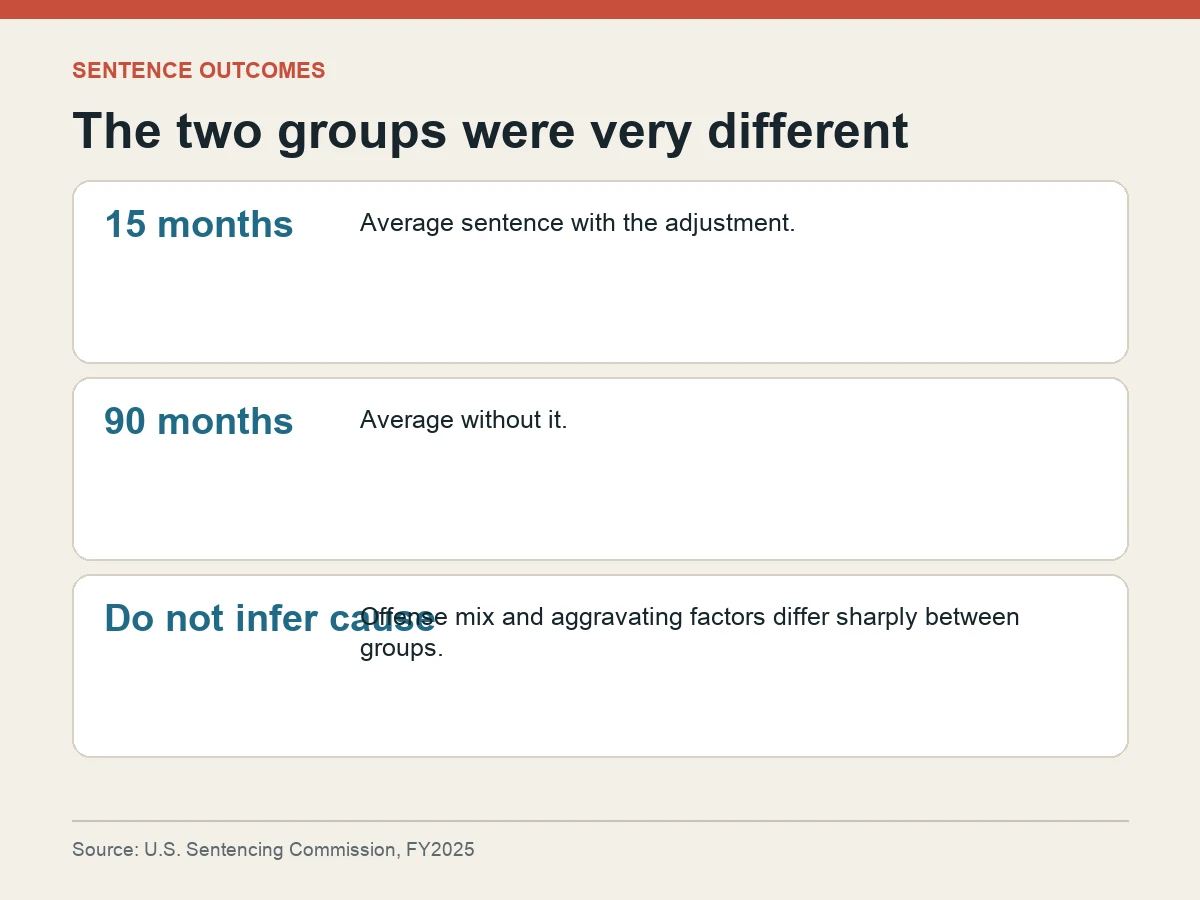
Those numbers are not a clean estimate of what two offense levels changed. The groups differ substantially in offense type, guideline exposure and the aggravating factors that can bar the adjustment. The average guideline minimum was 21 months for recipients and 117 months for nonrecipients before the final sentence comparison.
Mandatory-minimum exposure also differed: 12 percent of recipients were convicted of an offense carrying one, compared with 38 percent of nonrecipients. Among those facing a mandatory minimum, 83 percent of recipients were relieved from it, versus 15 percent of nonrecipients.
The data provide the first full fiscal-year scale picture for the new provision. They show broad use among qualifying zero-point cases and strong regional and offense concentration, while the underlying differences make simple claims about sentence reductions or equal treatment inappropriate without person-level analysis.