
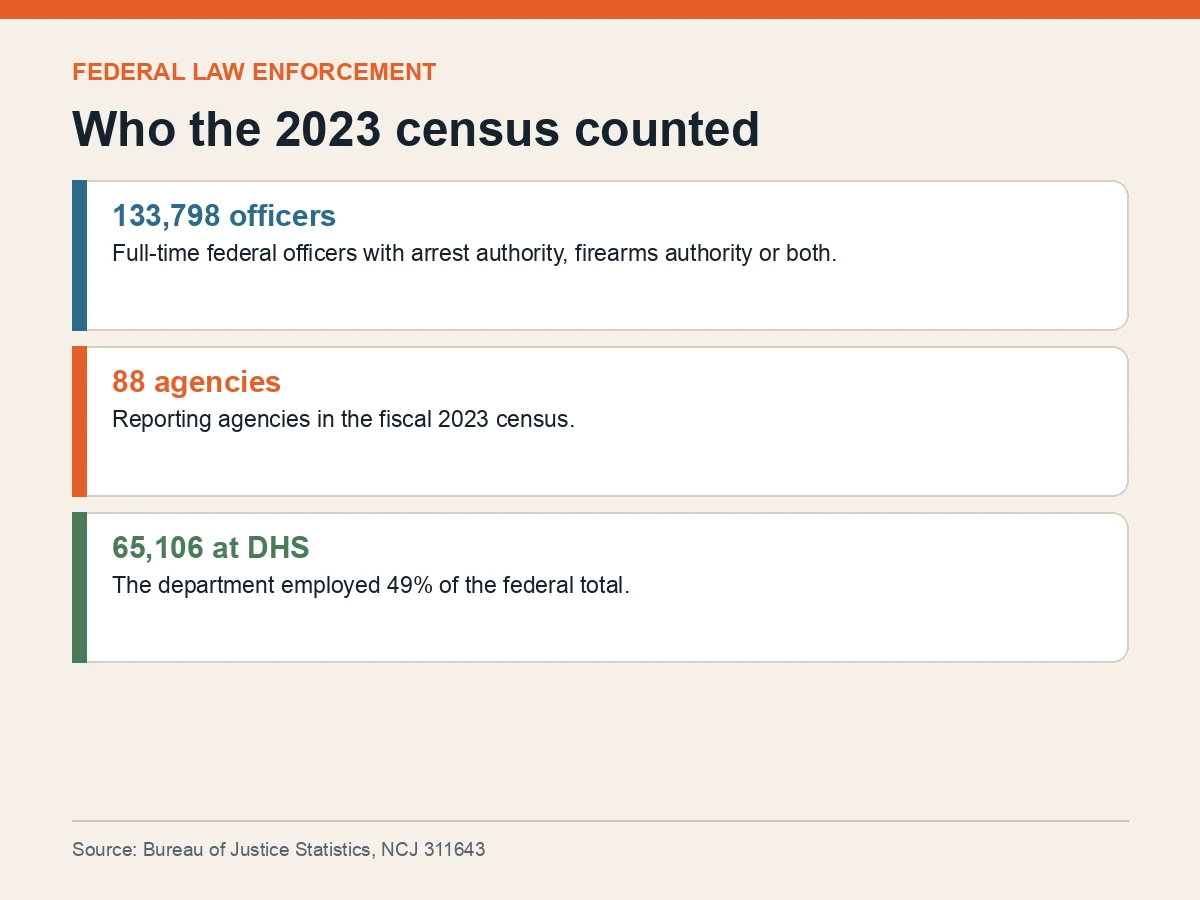
Federal agencies employed 133,798 full-time law-enforcement officers in fiscal 2023, according to a Bureau of Justice Statistics census covering 88 agencies. Nearly half worked for the Department of Homeland Security.
Homeland Security reported 65,106 officers, 49% of the federal total. The census includes officers authorized to make arrests, carry firearms or both; it is not a count of every federal employee whose job touches security or compliance.
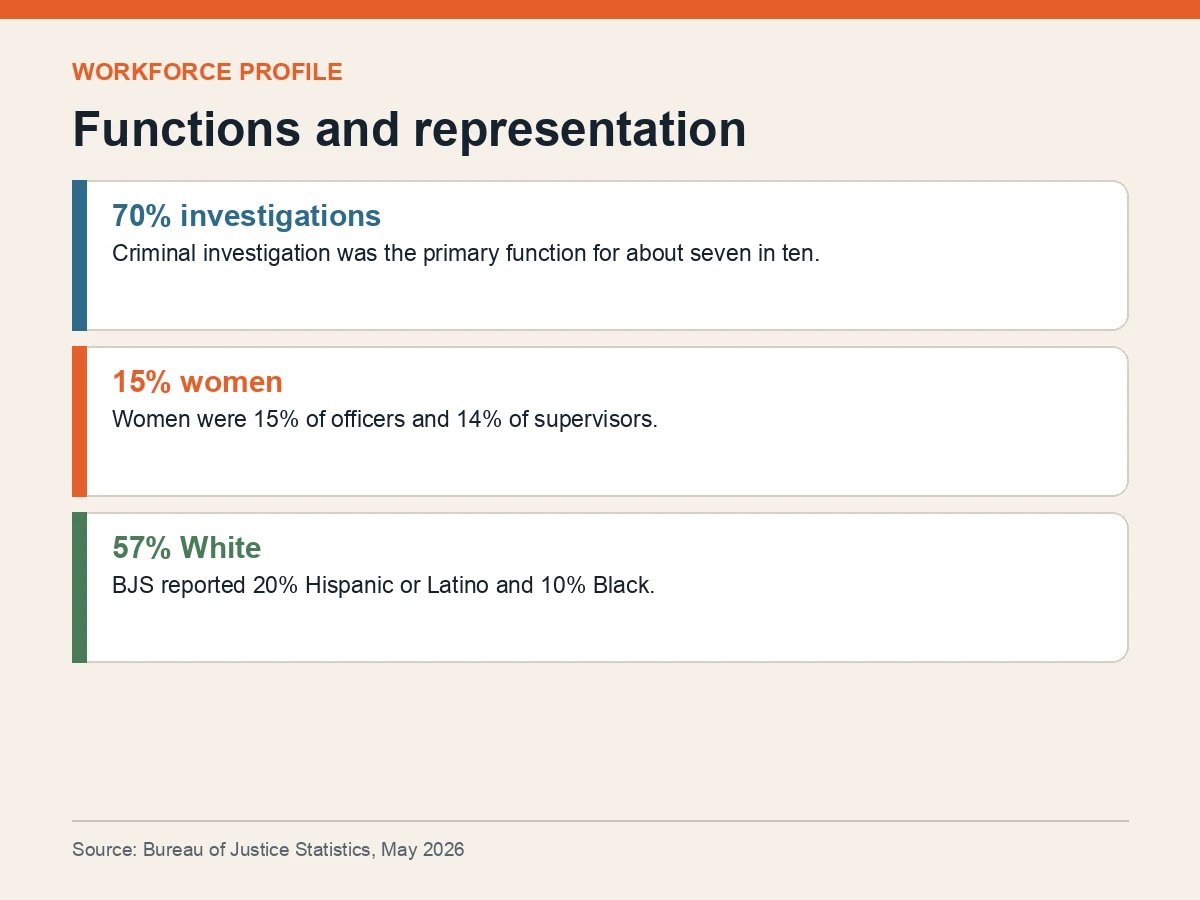
Criminal investigation was the primary function for about 70% of officers. Other functions in the statistical tables include police response and patrol, inspections and enforcement, court operations, security and protection, and corrections.
Offices of Inspectors General employed 3,519 officers, about 3% of the total. Those offices investigate fraud, waste and misconduct within federal programs, but the census aggregates many different missions under the same minimum authority definition.
Women accounted for 15% of federal officers and 14% of supervisory personnel. BJS reported that 57% of officers were White, 20% Hispanic or Latino and 10% Black. The categories describe the reported workforce, not hiring or promotion outcomes by themselves.
The survey is the tenth federal-officer census BJS has conducted since 1993. Periodic censuses provide a consistent benchmark, but the 2023 reference year means the figures should not be read as a real-time 2026 head count.
Agency size also shapes the national profile. A department holding almost half the positions can move overall demographic and functional shares even when smaller investigative or inspector-general offices have different staffing patterns.
The useful baseline is therefore both large and bounded: 133,798 full-time officers at 88 agencies under the census definition. Future comparisons will require the same definition, a new reference year and agency-level changes rather than assumptions based on current headlines.
BJS also publishes underlying tables, allowing readers to separate departments, functions and workforce characteristics rather than treating federal officers as one uniform agency.