
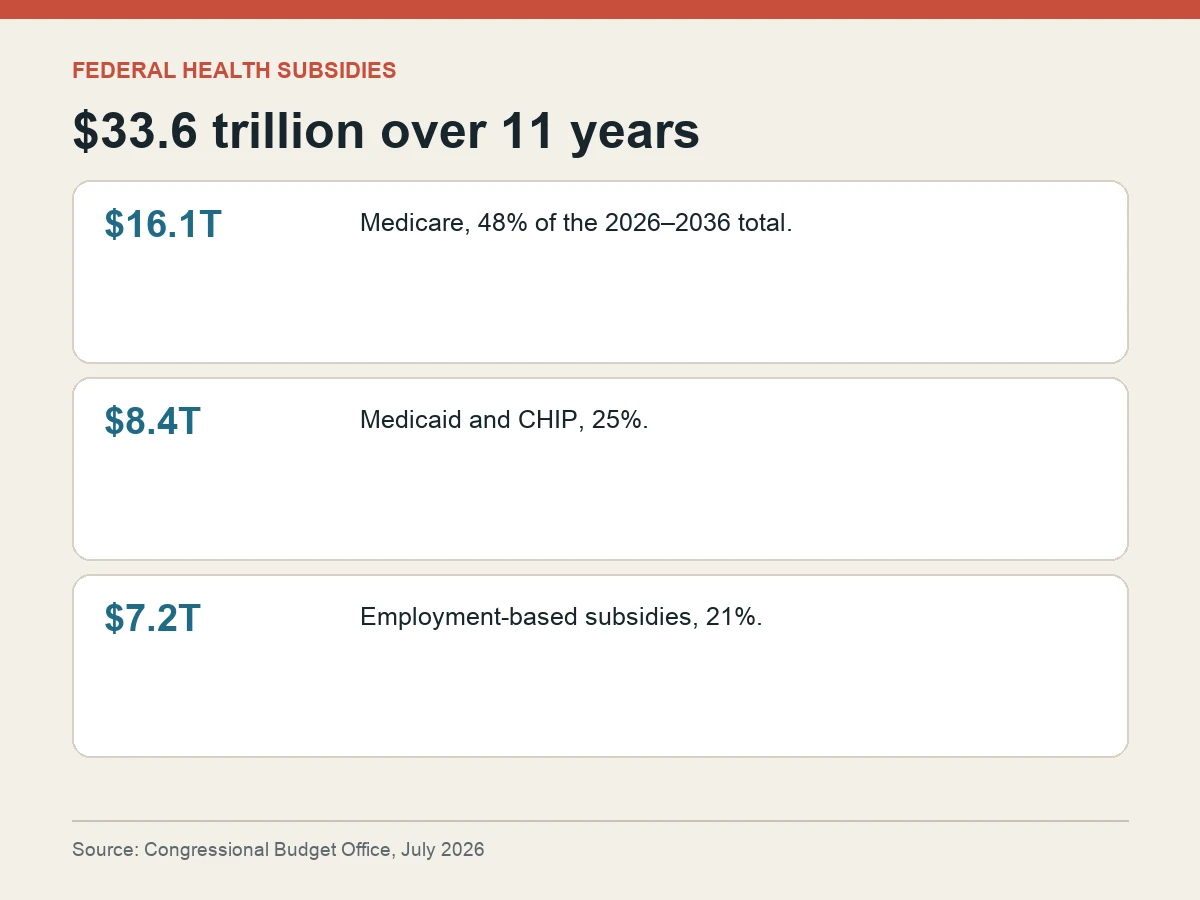
Federal subsidies for health insurance are projected to total $33.6 trillion from 2026 through 2036, rising faster than the economy while the number of uninsured people increases, according to the Congressional Budget Office.
Annual subsidies grow from $2.4 trillion in 2026 to $3.9 trillion in 2036. Measured against the economy, that is an increase from 7.4 percent to 8.4 percent of gross domestic product, making health coverage a larger federal commitment even before counting every form of health spending.
Medicare is the largest component at $16.1 trillion over the 11-year period, or 48 percent of the total. Medicaid and the Children’s Health Insurance Program account for $8.4 trillion, or 25 percent. Tax exclusions and other subsidies for employment-based coverage contribute $7.2 trillion, or 21 percent.
Premium tax credits for coverage purchased through insurance marketplaces add $1.2 trillion, about 4 percent, and smaller federal programs and subsidies make up the remaining $0.7 trillion. The categories should be read as distinct components of the $33.6 trillion total, not added again to the headline number.
Coverage remains broad. CBO projects an average of 318 million people will have health insurance in any given month from 2026 through 2036, while an average of 36 million will be uninsured. Monthly averages account for people moving into and out of coverage during a year.
The uninsured population is expected to rise from 30 million in 2026 to 37 million in 2036. CBO attributes much of the coverage change to provisions in the 2025 reconciliation law as they take effect alongside demographic and economic changes.
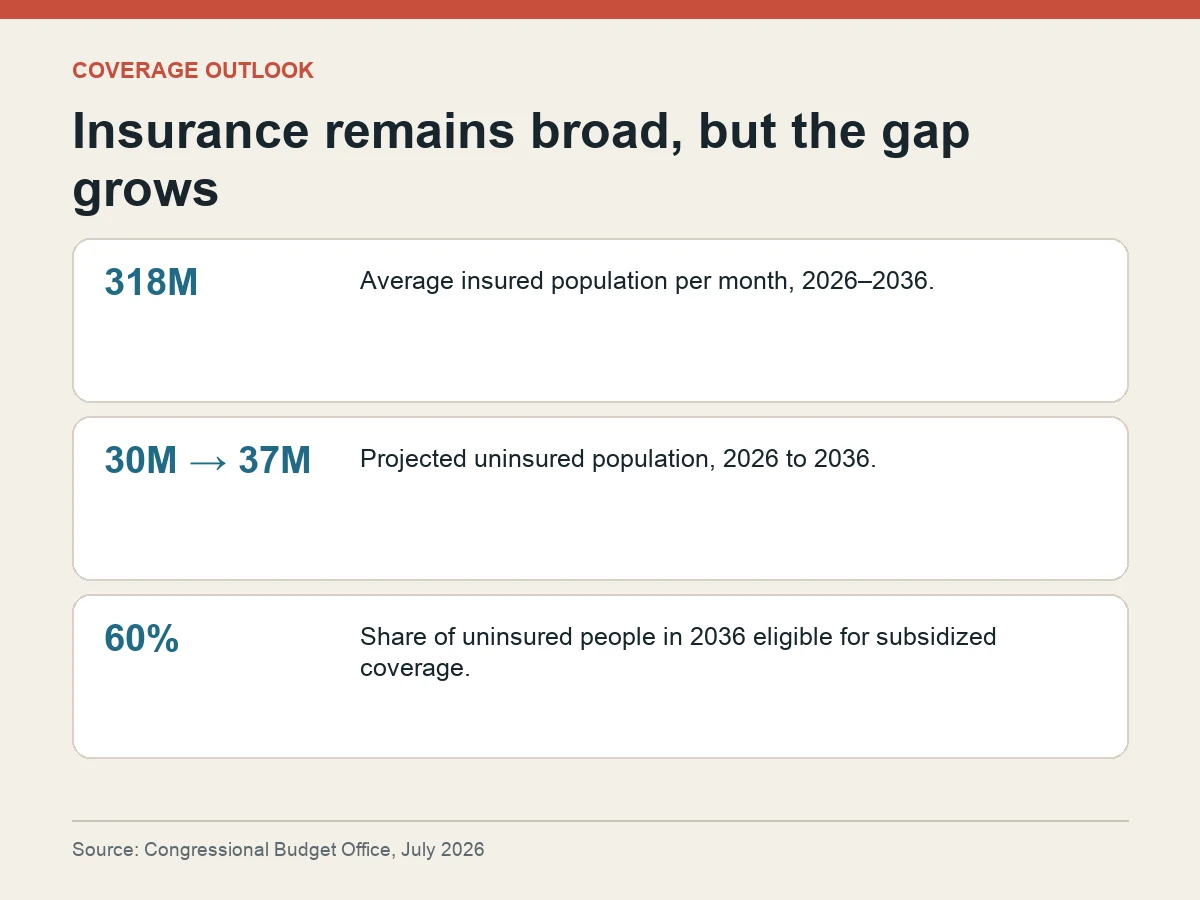
Eligibility and enrollment are not the same. About 60 percent of uninsured people in 2036 would be eligible for subsidized coverage, CBO estimates, meaning the available policy or program does not automatically translate into enrollment. Administrative barriers, affordability beyond the subsidy and individual choices can all matter.
The estimates are not a forecast of total national medical bills. They cover specified federal subsidies for insurance and exclude unsubsidized private spending, many out-of-pocket costs and other government health activity. Nor is the cumulative total a single appropriation Congress is voting on at once.
CBO’s outlook captures a central budget tension: the federal government is projected to devote a growing share of national income to supporting coverage, yet the uninsured count still rises by seven million over the period. Both sides of that equation depend on future law, prices, wages, enrollment and the economy, so the figures are a baseline for policy—not a fixed outcome.