
Transparency obligations for certain artificial-intelligence systems under Article 50 of the European Union's AI Act began applying on Aug. 2, 2026.
The rules cover distinct actors and uses rather than imposing one universal label. Providers of systems that interact directly with people generally must make clear that the interaction is with AI unless that fact is already obvious from the context.
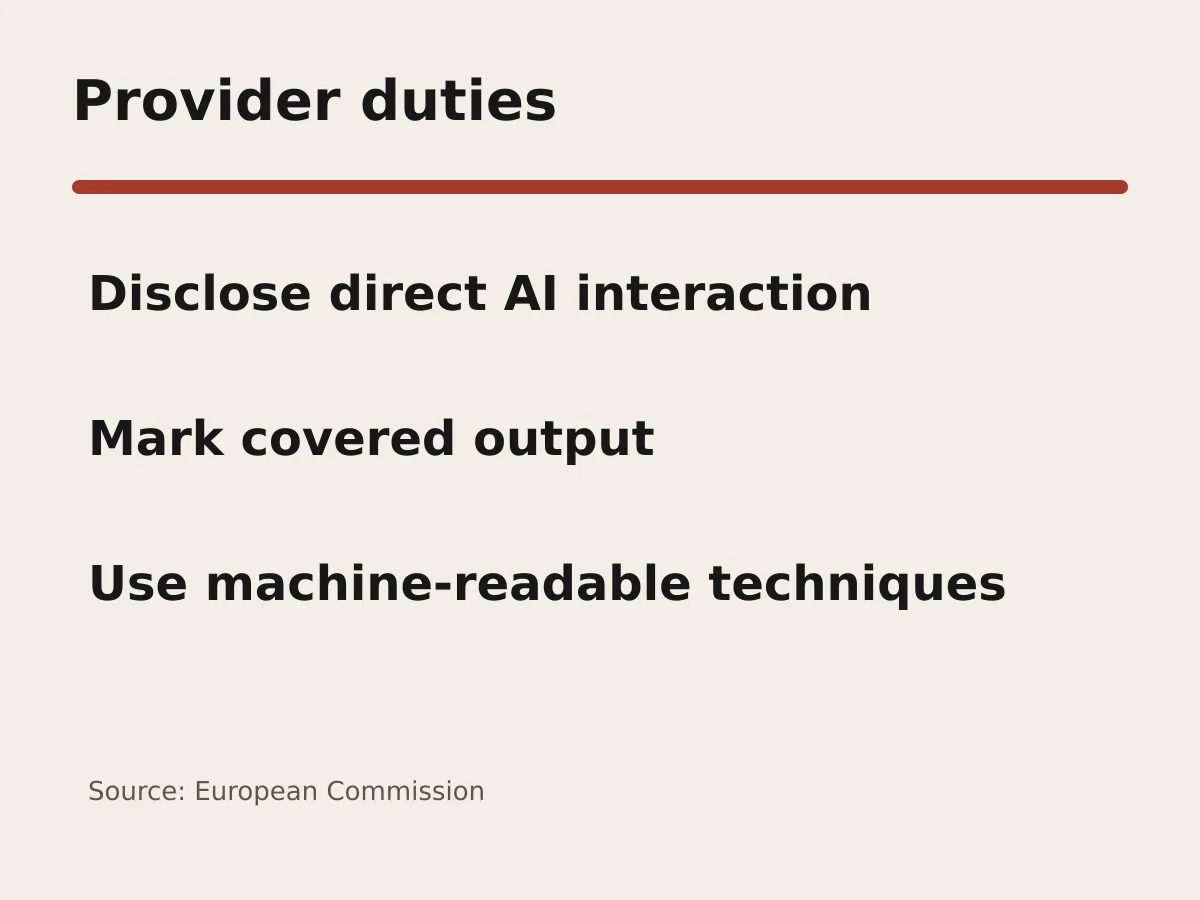
Providers of systems that generate or manipulate image, audio, video or text content must also make covered output detectable as artificial through effective, interoperable, robust and reliable machine-readable techniques.
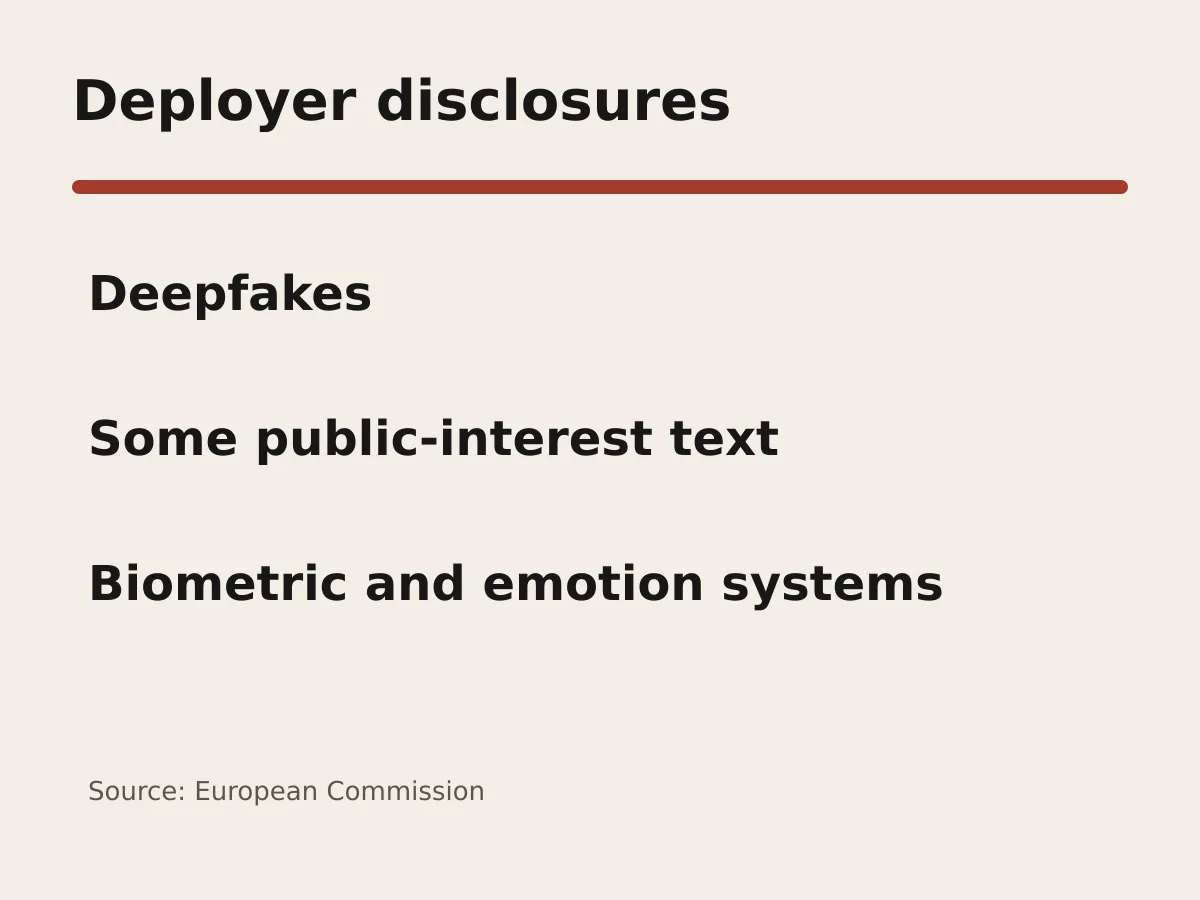
Deployers face separate disclosure duties. The Commission's guidance identifies deepfakes, text published to inform the public on matters of public interest without human review or editorial responsibility, and use of emotion-recognition or biometric-categorization systems among the covered situations.
That scope matters. The rules do not mean every AI-assisted edit requires a visible badge, and the guidance describes exceptions for standard editing, assistance that does not substantially alter input, and some legally authorized uses.
A limited transition applies to systems placed on the market before Aug. 2. For the machine-readable marking and detection duty, the Commission says those systems have until Dec. 2, 2026; content generated before Aug. 2 does not need retroactive labeling.
The Commission published final guidance on July 20 to give providers, deployers and national authorities a common interpretation. A voluntary code of practice offers one route to demonstrate compliance, but entities that do not sign must show equivalent compliance by other means.
National market-surveillance authorities will handle most enforcement. The EU AI Office has a narrower role for certain systems tied to general-purpose models or very large online platforms and search engines.
The operational question is therefore not whether all AI content gets the same warning. It is which Article 50 role, content type, exception and transition rule applies to a specific system or publication. The Commission guidance is explanatory and does not replace the regulation's legal text.