
U.S. power plants are forecast to burn a record amount of natural gas in summer 2027, as new data centers, manufacturing facilities and other large loads push electricity demand higher, according to the Energy Information Administration.
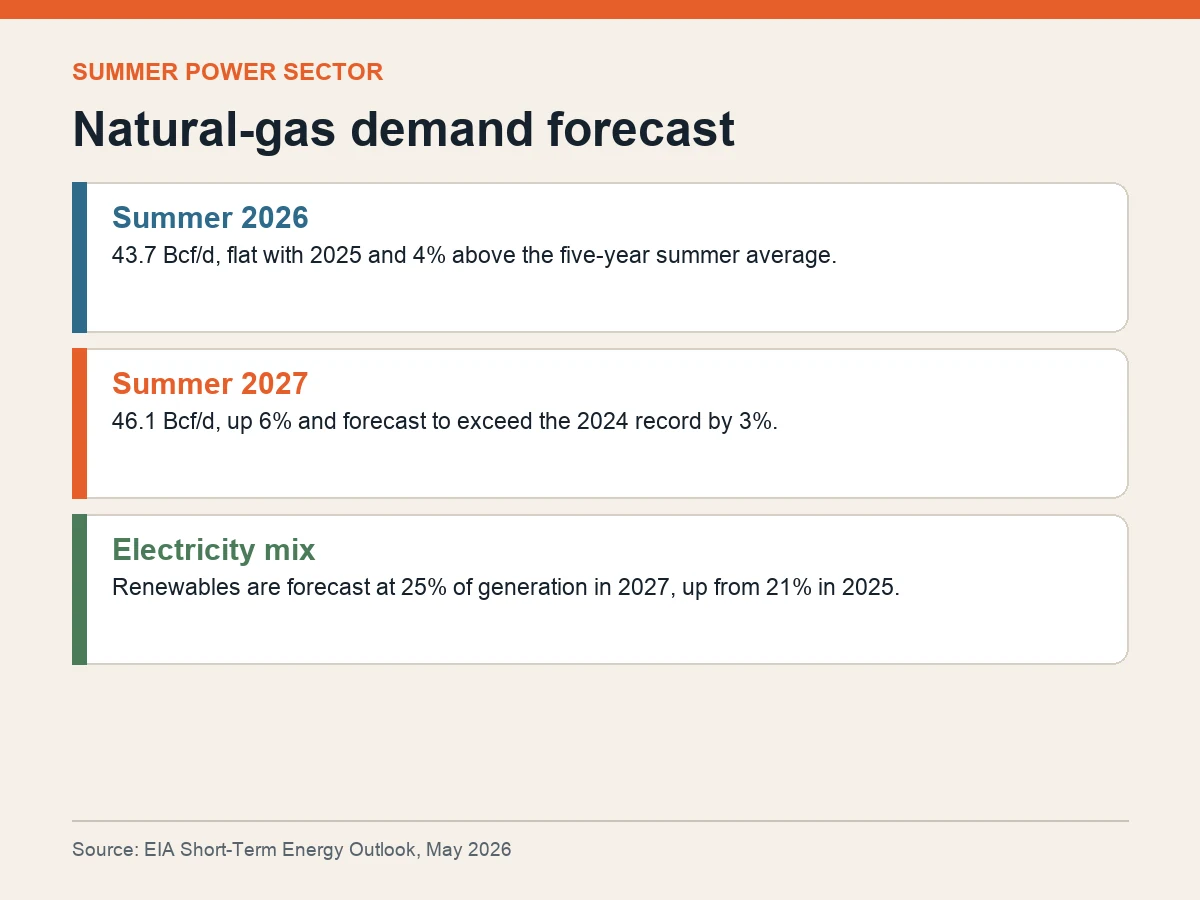
EIA expects power-sector gas consumption to average 43.7 billion cubic feet per day from June through September 2026. That is flat with summer 2025 but 4% above the five-year summer average for 2021 through 2025.
For summer 2027, the agency projects 46.1 Bcf/d, an increase of 2.4 Bcf/d or 6% from 2026. The forecast would exceed the previous 2024 record by 3%. These are modeled expectations, not consumption already observed.
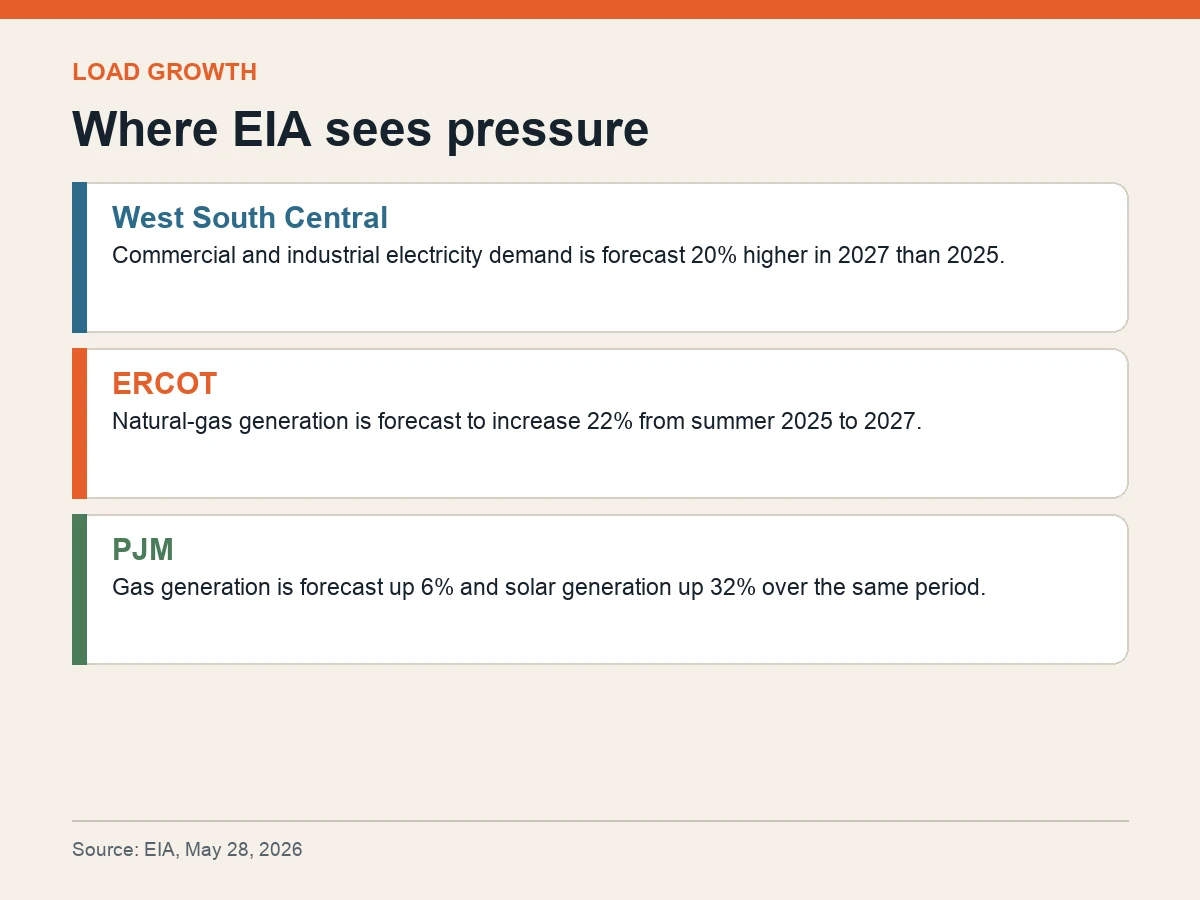
The load story is concentrated. EIA forecasts commercial and industrial electricity demand in the West South Central region will rise 20% from summer 2025 to summer 2027, driven in part by Texas data centers, manufacturing and electrification in oil and gas operations.
Within ERCOT, which runs most of the Texas grid, EIA expects natural-gas generation to increase 22% over that two-summer span. Solar generation also grows, so the forecast is not a simple substitution of gas for renewables.
In the Mid-Atlantic, the agency links rising commercial demand to computing facilities in Virginia. It forecasts PJM natural-gas generation 6% higher in 2027 than 2025, while solar generation rises 32% over the same period.
Nationally, renewables are forecast to supply 25% of summer generation in 2027, up from 21% in 2025. The mix can therefore become more renewable while absolute gas use also rises if total electricity demand expands fast enough.
Summer gas use is particularly sensitive to weather because air-conditioning drives peak electricity demand. Plant additions, outages, fuel prices, transmission limits and the timing of large new customers can all shift the actual dispatch pattern away from the forecast.
The EIA outlook describes the scale and direction of expected demand, not a reliability verdict or a guarantee that every announced data center will connect on schedule. Its central message is that load growth can lift both renewable output and gas-fired generation at the same time.