
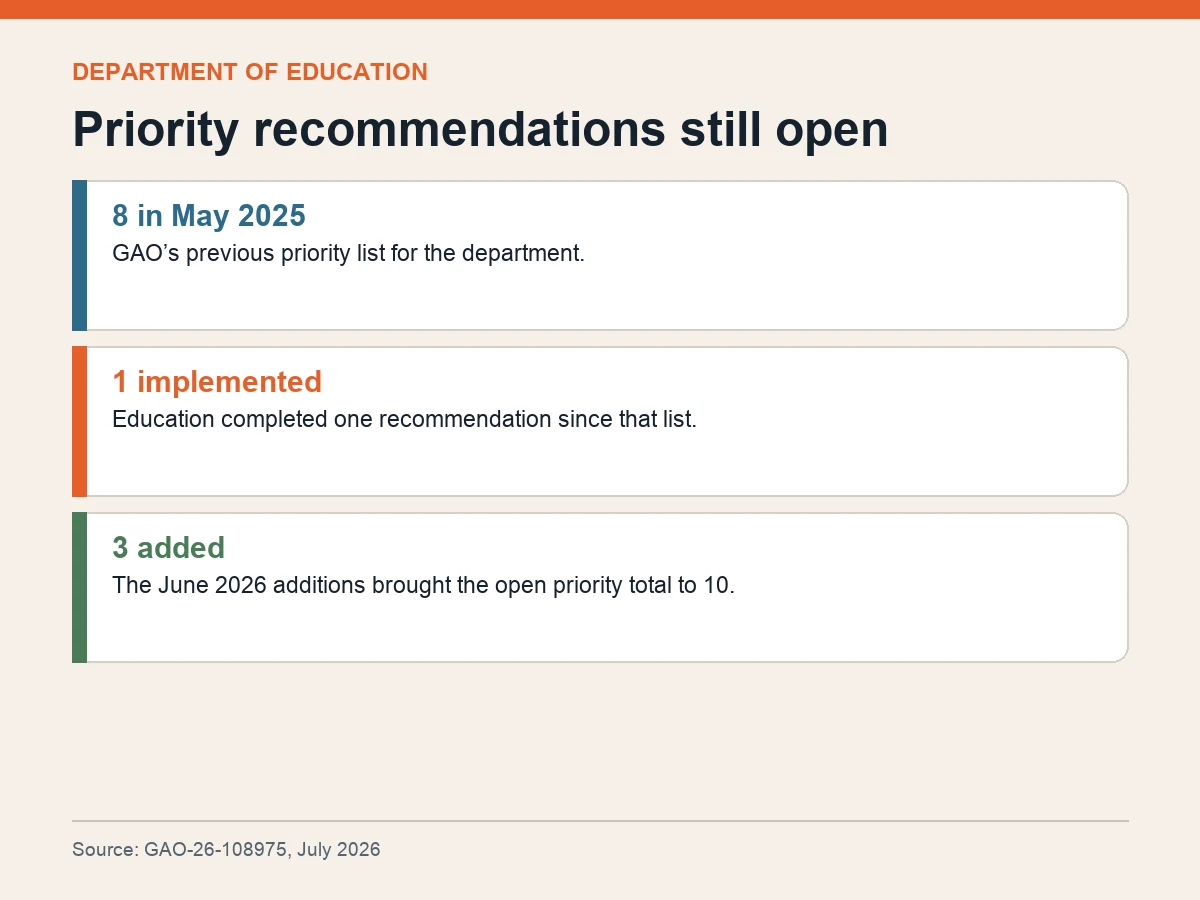
The U.S. Department of Education has 10 open recommendations that federal auditors consider priorities, after completing one item from last year’s list and receiving three new ones in June 2026.
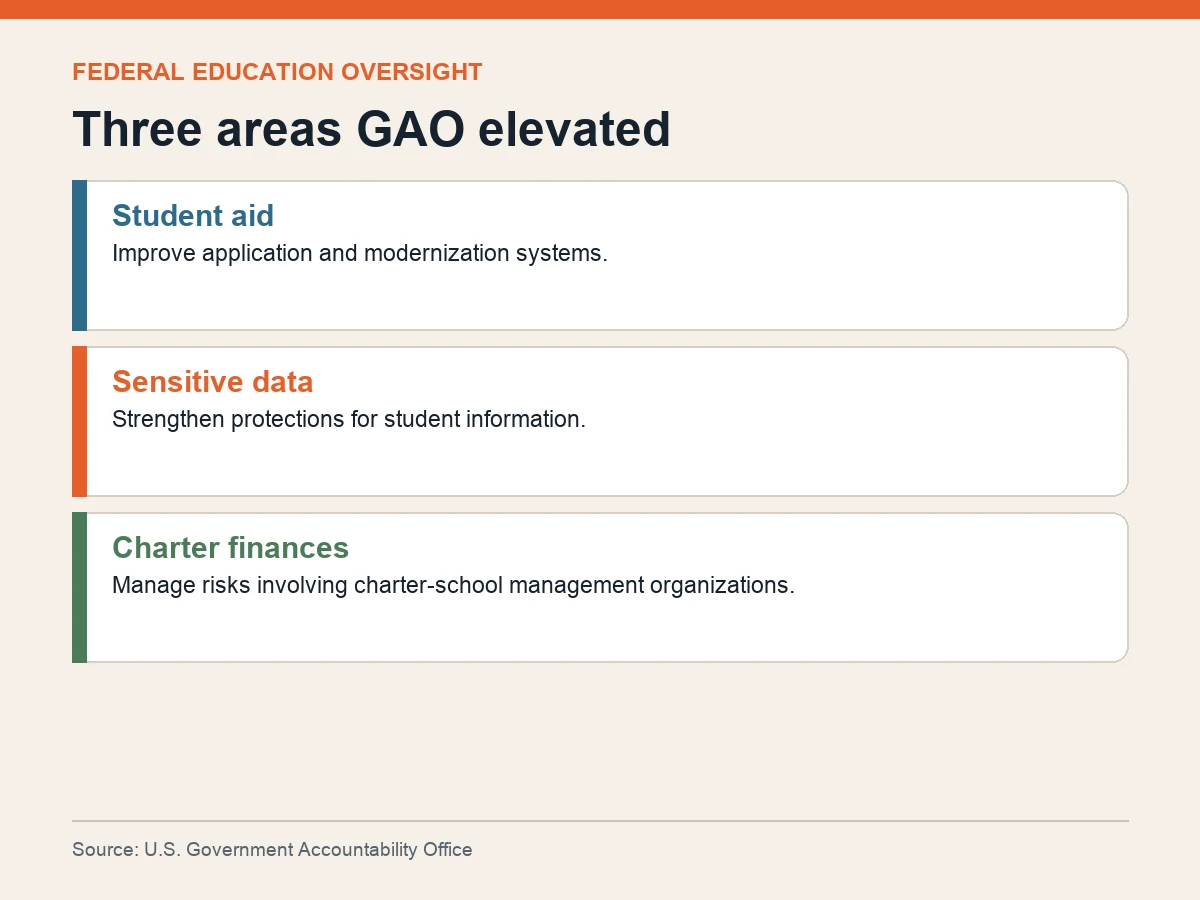
The Government Accountability Office highlighted three areas for timely attention: improving federal student aid, protecting sensitive information and managing financial risks involving charter-school management organizations. The letter does not assign all 10 items to a single program.
GAO had identified eight priority recommendations for the department in May 2025. Education implemented one, reducing that set to seven, before auditors added three more and brought the open total to 10.
On student aid, GAO says action could make it easier for students and families to apply for assistance and improve modernization of the federal aid system. That framing links user experience with the reliability of the technology and operations behind it.
Sensitive information is a separate control problem. Education handles student and borrower data, and GAO says stronger implementation of privacy protections remains a priority. The letter does not report a new breach or identify individual students.
The charter-school issue concerns financial risk associated with management organizations. GAO describes stronger oversight as a way to manage federal exposure, not as a finding that every charter operator has mishandled money.
Priority recommendations are a subset of GAO’s broader open work. Auditors use the designation for actions that could save substantial money, improve major decisions, reduce fraud or mismanagement, or address a high-risk or fragmented federal operation.
The label does not force the department to act by a specific date. It signals where GAO believes department leadership and congressional overseers should concentrate follow-through, and the audit office continues to track whether agencies implement its recommendations.
The count provides a concrete accountability baseline: one earlier priority item closed, three added and 10 now open. Future claims of improvement should show which recommendations were completed and whether the underlying student-aid, privacy and financial controls actually changed.