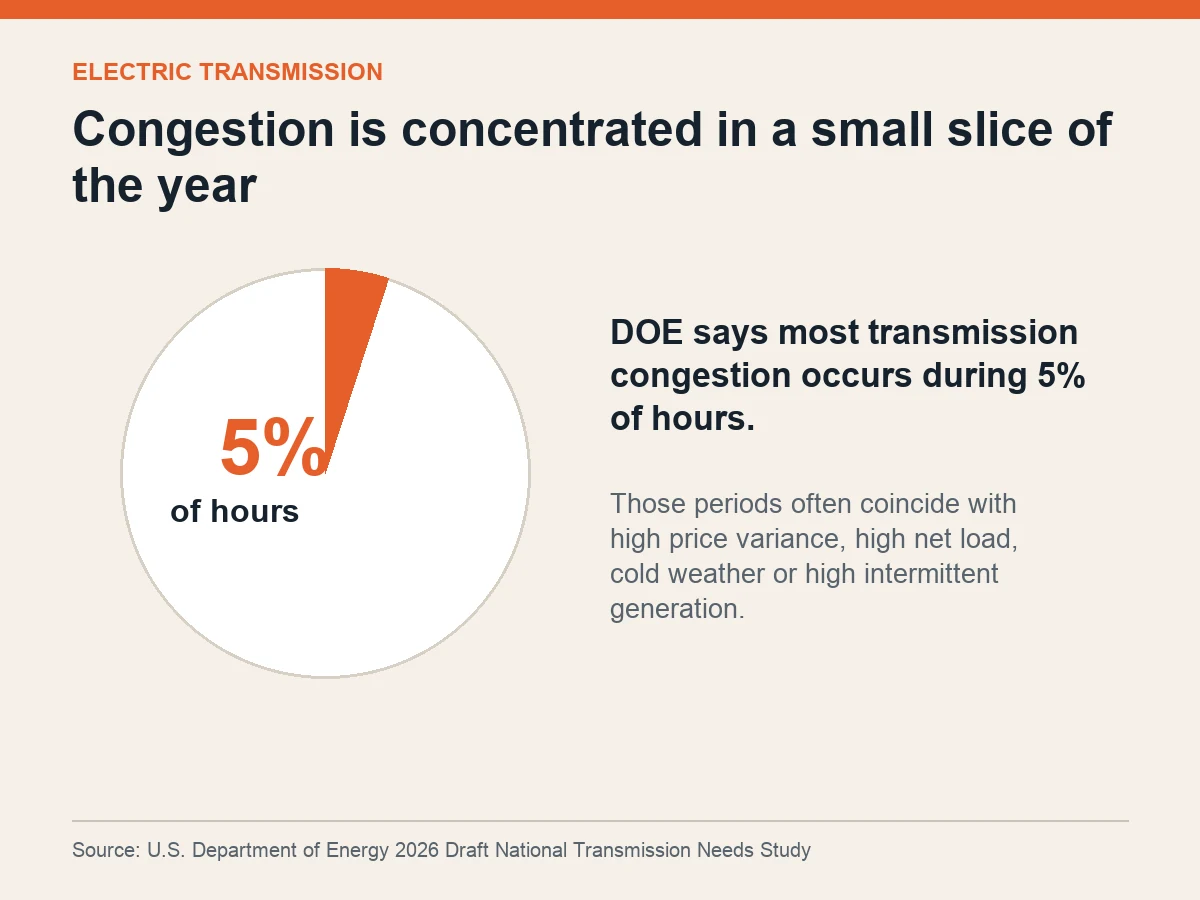
Most U.S. transmission congestion is concentrated in just 5% of hours, according to a new Department of Energy draft that argues the grid needs additional capacity as data centers, factories and other large loads push electricity demand higher.
The 2026 Draft National Transmission Needs Study is a national assessment rather than a construction plan. DOE says it combines publicly available information with more than 120 recent reports to describe present and near-term constraints, congestion and reliability needs.
The concentration matters because grid stress is not evenly distributed across the calendar. DOE says the most congested hours tend to coincide with large differences between day-ahead and real-time prices, high net load, cold weather or periods of high intermittent generation.
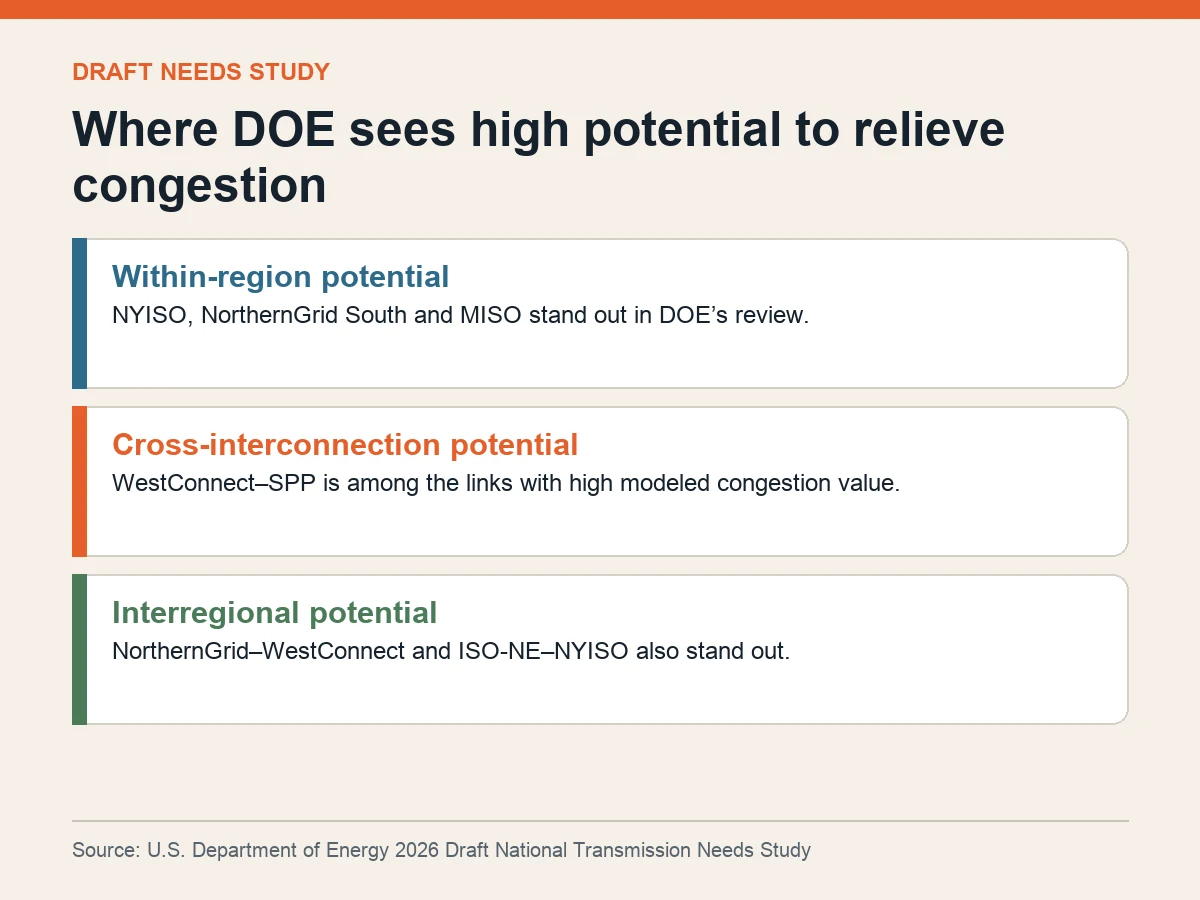
Within regions, the draft identifies the New York Independent System Operator, NorthernGrid South and the Midcontinent Independent System Operator as places with high potential for new transmission to relieve congestion costs. “Potential” describes the study’s comparative finding; it is not a permit, funding decision or approved route.
DOE also finds value across regional boundaries. Based on historical locational marginal prices, the draft points to links between WestConnect and the Southwest Power Pool, NorthernGrid and WestConnect, and ISO New England and New York as examples with high potential congestion value.
Interregional lines can provide more than an economic path around bottlenecks. DOE says they can improve reliability and resilience by giving regions access to power outside their own footprint when local generation or infrastructure is constrained.
The study arrives as several grid organizations approve unusually large portfolios. DOE notes that MISO approved the largest transmission portfolio in U.S. history in 2024 and says MISO, the Southwest Power Pool, PJM and the Electric Reliability Council of Texas have recently authorized major sets of projects.
Demand is the core driver in the Department’s framing. The draft cites hyperscale data centers, domestic manufacturing, industrial loads, building and transportation electrification, and the need to connect new generation while maintaining reliability during severe weather.
Congress requires DOE to assess national transmission constraints and congestion at least once every three years. The expanded study scope includes anticipated future needs as well as historical conditions, but DOE says it does not replace the planning processes run by regional operators, utilities and states.
The draft remains open to public comment and consultation through September 7. That process can test the data, regional comparisons and assumptions before DOE issues a final study. The result will still identify needs rather than choose the projects that answer them.